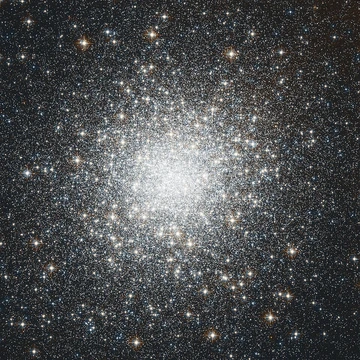
Palomar globular clusters
Fifteen faint globular clusters discovered on Palomar Sky Survey plates.

The Palomar globular clusters are a group of 15 faint globular clusters in the Milky Way galaxy, discovered in the 1950s on survey plates of the first Palomar Observatory Sky Survey (POSS). They are notable for being some of the faintest globular clusters known, with varied characteristics including some that are heavily obscured by dust, others located in the far outer halo, and at least one that originated from a different galaxy.
- Total number
- 15
- Discovery survey
- first Palomar Observatory Sky Survey (POSS)
- Discovery decade
- 1950s
- Telescope used
- 48-inch Schmidt camera at Palomar
- Notable discoverers
- George Abell, Fritz Zwicky, Edwin Hubble, Halton Arp, Walter Baade
- Previously known exceptions
- Palomar 7 (IC1276) and Palomar 9 (NGC6717)
- Easiest to observe
- Palomar 9 (NGC 6717)
- Most difficult to observe
- Palomar 15
Lore & Background
The Palomar globulars were discovered fairly late due to their faintness, heavy obscuration, remote locations, or few member stars. They were identified using the enormous 48-inch Schmidt camera at Palomar Observatory. Astronomers who identified these objects as globular clusters include George Abell, Fritz Zwicky, Edwin Hubble, Halton Arp, and Walter Baade. All Palomar globulars except two—Palomar 7 (IC1276) and Palomar 9 (NGC6717)—had never been seen before. Palomar 9 was observed by William Herschel on August 7, 1784. Palomar 7 was first discovered by American astronomer Lewis Swift in 1889, and was independently rediscovered by George Abell as part of the survey in 1952.
Some Palomar globulars, like Palomar 6, Palomar 7, Palomar 9, Palomar 10, and Palomar 11, are clusters of average size located nearby yet obscured in our line of sight by dust. Others, like Palomar 3, Palomar 4, and Palomar 14, are giants located in the far outer halo of the Milky Way. Palomar 12 originated from the Sagittarius Dwarf Spheroidal Galaxy, now known as a satellite of the Milky Way. Observation difficulty varies greatly: some are small and compact, others are very sparse and hard to distinguish from foreground stars.
Reader's Guide
The Palomar globular clusters hold significance as some of the faintest globular clusters in the Milky Way, discovered only with the advent of the Palomar Observatory Sky Survey in the 1950s. Their late discovery underscores how faintness, dust obscuration, remote location, or sparse stellar populations can hide such objects from earlier surveys. The group includes clusters of varied nature: some are average-sized and nearby but dust-obscured, others are giant clusters in the far outer halo, and at least one (Palomar 12) originated from the Sagittarius Dwarf Spheroidal Galaxy, a satellite of the Milky Way. For amateur astronomers, observing these clusters requires dark skies, excellent seeing, and high power (at least 200× magnification). Many are small and demand precise sky navigation and averted vision. Palomar 9 (NGC 6717) is the easiest to observe, while Palomar 15 is regarded as the most difficult. The legacy of the Palomar globulars lies in their demonstration of the diversity and hidden population of globular clusters in the Milky Way, and in the observational challenge they present to both professional and amateur astronomers.
Did You Know?
- All Palomar globulars except Palomar 7 (IC1276) and Palomar 9 (NGC6717) had never been seen before the Palomar Sky Survey.
- Palomar 9 (NGC 6717) was first observed by William Herschel on August 7, 1784.
- Palomar 15 is regarded as the most difficult Palomar globular to observe visually.
More in Globular Clusters, Part 2 1-24
Spotted an error? Know more?
Reader corrections go straight into our review queue. Suggest an edit · How this site is sourced