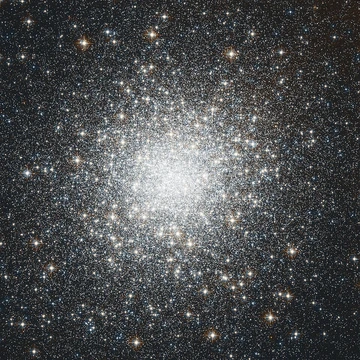
Palomar 7
A nearby Palomar globular obscured by dust, first seen in 1889.

Palomar 7 is one of the 15 Palomar globular clusters, a group of faint globular clusters discovered in the 1950s on the survey plates of the first Palomar Observatory Sky Survey (POSS). It is notable for being one of only two Palomar globulars that had been observed before the survey, having been first discovered by American astronomer Lewis Swift in 1889 and independently rediscovered by George Abell in 1952.
- Designation
- Palomar 7 (IC1276)
- Discoverer
- Lewis Swift (1889); independently rediscovered by George Abell (1952)
- Type
- Globular cluster
- Group
- Palomar globular clusters
- Characteristic
- Average size, located nearby, obscured by dust
Lore & Background
Palomar 7 is one of the Palomar globular clusters that are of average size and located nearby, yet obscured in our line of sight by dust. It was first discovered by American astronomer Lewis Swift in 1889, and was independently rediscovered by George Abell as part of the Palomar Observatory Sky Survey in 1952. Along with Palomar 9, it is one of only two Palomar globulars that had been seen before the survey.
Reader's Guide
Palomar 7 is significant as one of the few Palomar globulars known prior to the Palomar Observatory Sky Survey, having been discovered by Lewis Swift in 1889 and later independently rediscovered by George Abell. Its classification as a globular cluster of average size located nearby but obscured by dust places it among a subset of Palomar globulars that are challenging to observe due to interstellar dust along the line of sight. For amateur astronomers, Palomar 7 requires dark skies, excellent seeing conditions, and high power (at least 200× magnification) for successful observation. It is not among the easiest or most difficult Palomar globulars to observe; overall, the Palomar globulars vary greatly in difficulty, with some being small and compact and others very sparse. Visual observers may resolve individual stars in some Palomars, while others appear hazy. Palomar 7's legacy lies in its role as part of the complete set of 15 Palomar globulars, which represent some of the faintest globular clusters in the Milky Way galaxy.
More in Globular Clusters, Part 2 1-24
Spotted an error? Know more?
Reader corrections go straight into our review queue. Suggest an edit · How this site is sourced