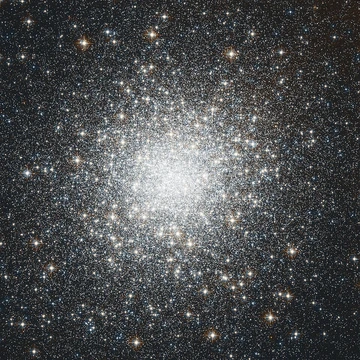
Palomar 3
A giant Palomar globular in the far outer halo.

Palomar 3 is one of the 15 Palomar globular clusters discovered in the 1950s on the survey plates of the first Palomar Observatory Sky Survey (POSS). It is notable as a giant globular cluster located in the far outer halo of the Milky Way.
- Discovery survey
- Palomar Observatory Sky Survey (POSS)
- Discovery decade
- 1950s
- Type
- giant globular cluster
- Location
- far outer halo of the Milky Way
Lore & Background
Palomar 3 is one of the Palomar globulars that are giants located in the far outer halo of the Milky Way. It was discovered in the 1950s on the survey plates of the first Palomar Observatory Sky Survey (POSS), using the enormous 48-inch Schmidt camera at Palomar. Some of the astronomers who identified these objects as globular clusters include George Abell, Fritz Zwicky, Edwin Hubble, Halton Arp and Walter Baade.
Observation of Palomar 3 varies in difficulty; like other Palomar globulars, it may be small and compact or very sparse. Dark skies and high power (at least 200 power magnification) are required for visual observation. Amateur astronomers have reported observations using 17.5 inch and larger telescopes, while others have identified the brightest Palomar globulars with more modest sizes of 10 inch telescopes or less. Palomar 3 has never been seen before its discovery in the 1950s.
Reader's Guide
Palomar 3 is significant as one of the faintest globular clusters in the Milky Way, discovered only in the 1950s due to its remote location in the far outer halo. Its status as a giant cluster distinguishes it from other Palomar globulars that are average-sized and nearby but obscured by dust. The cluster was never observed before the Palomar survey, underscoring the challenge of detecting such distant objects. For amateur astronomers, Palomar 3 represents a difficult target requiring dark skies, excellent seeing, and high magnification. Its observation contributes to understanding the outer structure of the Milky Way's globular cluster system. The cluster's discovery by the 48-inch Schmidt camera highlights the role of large survey instruments in uncovering previously unknown deep-sky objects. Palomar 3, along with Palomar 4 and Palomar 14, exemplifies the giant, remote globulars that populate the galaxy's far halo.
More in Globular Clusters, Part 2 1-24
Spotted an error? Know more?
Reader corrections go straight into our review queue. Suggest an edit · How this site is sourced