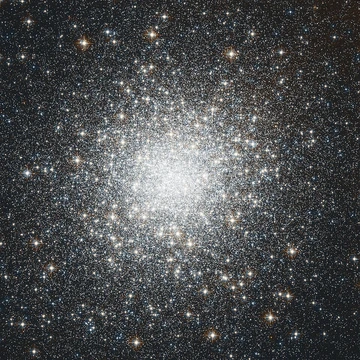
Palomar 10
An average-sized Palomar globular obscured by dust in our line of sight.

Palomar 10 is one of the 15 Palomar globular clusters discovered in the 1950s on the survey plates of the first Palomar Observatory Sky Survey (POSS). It is a cluster of average size located nearby, yet obscured in our line of sight by dust.
- Discovery survey
- Palomar Observatory Sky Survey (POSS)
- Discovery decade
- 1950s
- Type
- globular cluster
- Size classification
- average size
- Location note
- nearby, obscured by dust
Lore & Background
Palomar 10 is one of the Palomar globular clusters that are of average size and located nearby, yet are obscured in our line of sight by dust. It was discovered in the 1950s on the survey plates of the first Palomar Observatory Sky Survey (POSS), using the enormous 48-inch Schmidt camera at Palomar. Some of the astronomers who identified these objects as globular clusters include George Abell, Fritz Zwicky, Edwin Hubble, Halton Arp and Walter Baade.
Observation of Palomar 10 varies in difficulty; like other Palomar globulars, it may be small and compact or very sparse, making it hard to distinguish from foreground stars. Visual observation requires dark skies, excellent seeing conditions, and high power (at least 200 power magnification). Observers must know how to navigate the sky precisely and rely on averted vision when needed. Individual stars may be resolved in some Palomars, while others look hazy.
Reader's Guide
Palomar 10 is notable as one of the faintest globular clusters in the Milky Way, discovered only in the 1950s due to its faintness and obscuration by dust. Its status as an average-sized, nearby cluster hidden behind dust makes it a challenging target for amateur astronomers. The article notes that Palomar globulars can be observed with 17.5-inch and larger telescopes, though the brightest can be seen with 10-inch or smaller instruments under ideal conditions. Palomar 10 is not among the easiest or most difficult Palomar globulars—Palomar 9 is the easiest and Palomar 15 the most difficult—but it still requires dark skies, high power, and precise sky navigation. The cluster's obscuration by dust means it is not as readily studied as unobscured clusters, yet it contributes to the understanding of globular cluster populations in the Milky Way's inner regions. Its discovery on POSS plates highlights the role of wide-field surveys in finding faint objects missed by earlier observers.
Did You Know?
- Palomar 10 is one of 15 Palomar globular clusters discovered in the 1950s on POSS survey plates.
- It is an average-sized cluster located nearby but obscured by dust in our line of sight.
- Palomar 10 was discovered using the 48-inch Schmidt camera at Palomar Observatory.
- Observation of Palomar 10 requires dark skies, high power (at least 200x), and averted vision.
More in Globular Clusters, Part 2 1-24
Spotted an error? Know more?
Reader corrections go straight into our review queue. Suggest an edit · How this site is sourced