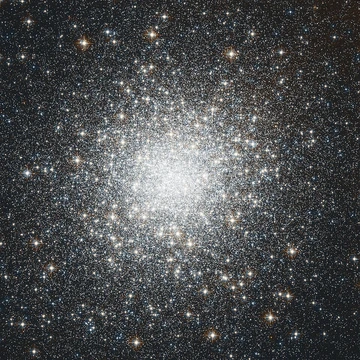
Omega Centauri
The largest and most massive globular cluster in the Milky Way.

Omega Centauri (ω Cen, NGC 5139, or Caldwell 80) is a globular cluster in the constellation of Centaurus. It is the largest and most massive known globular cluster in the Milky Way, with a diameter of roughly 150 light-years and an estimated total mass of 4 million solar masses. It is thought to have originated as the core remnant of a disrupted dwarf galaxy, and there is disputed evidence of an intermediate-mass black hole in its dense core.
Quick Facts
- Epoch
- J2000
- Class
- VIII
- Ra
- 13 · 26 · 47.28
- Dec
- −47 · 28 · 46.1
- Dist Ly
- 15.8 +/-
- Appmag V
- 3.9
- Constellation
- Centaurus
- Radius Ly
- 86 ± 6 ly
- Metal Fe
- –1.35
- Age
- 11.52 Gyr
- Names
- NGC 5139, GCl 24, ω Centauri, Caldwell 80, Mel 118
Facts from the source article.
Lore & Background
Around 150 AD, Greco-Roman writer and astronomer Ptolemy catalogued this object in his Almagest as a star on the centaur's back. German cartographer Johann Bayer used Ptolemy's data to designate it 'Omega Centauri' in his 1603 publication Uranometria. Using a telescope from the South Atlantic island of Saint Helena, English astronomer Edmond Halley observed this object in 1677, listing it as a non-stellar object, and published it in 1716 among his list of six 'luminous spots or patches'. Swiss astronomer Jean-Philippe de Cheseaux included it in his 1746 list of 21 nebulae, as did French astronomer Lacaille in 1755. It was first recognized as a globular cluster by Scottish astronomer James Dunlop in 1826, who described it as a 'beautiful globe of stars very gradually and moderately compressed to the centre'.
Omega Centauri is very different from most other galactic globular clusters, to the extent that it is thought to have originated as the core remnant of a disrupted dwarf galaxy. Its chemistry and motion in the Milky Way are consistent with this picture, and it has a range of metallicities and stellar ages suggesting it did not all form at once. The stars in its core are so crowded that they are estimated to average only 0.1 light-year away from each other. The internal dynamics have been analyzed using measurements of the radial velocities of 469 stars, with a peak velocity dispersion of 7.9 km s⁻¹.
A 2008 study presented evidence for an intermediate-mass black hole at the center, based on Hubble Space Telescope and Gemini Observatory observations, calculating the object's mass at 40,000 solar masses. However, more recent work has challenged this conclusion, disputing the proposed location of the cluster center and finding that the velocity of core stars does not vary with distance as expected. A study from July 10, 2024 examined seven fast-moving stars and found speeds consistent with an intermediate-mass black hole of at least 8,200 solar masses, but this conclusion was again questioned in a later study.
Reader's Guide
Omega Centauri is notable as the brightest, largest, and most massive globular cluster associated with the Milky Way, and one of the few globular clusters visible to the naked eye, appearing almost as large as the full Moon from a dark, rural area. Its significance extends beyond its size: it is thought to be the core remnant of a disrupted dwarf galaxy, a hypothesis supported by its chemistry, motion, and range of stellar ages. The disputed evidence for an intermediate-mass black hole in its core has made it a key object for studying black hole formation and galactic dynamics. The cluster contains several million Population II stars and is about 12 billion years old. Its legacy includes appearances in fiction, such as the novel Singularity (2012) by Ian Douglas, which presents the disrupted dwarf galaxy origin as fact, and the German science fiction series Perry Rhodan. The ongoing debate about its central black hole underscores its importance as a subject of astronomical research.
Did You Know?
- Omega Centauri was first catalogued as a star by Ptolemy around 150 AD.
- It is estimated to contain approximately 10 million stars.
More in Globular Clusters, Part 2 1-24
Spotted an error? Know more?
Reader corrections go straight into our review queue. Suggest an edit · How this site is sourced