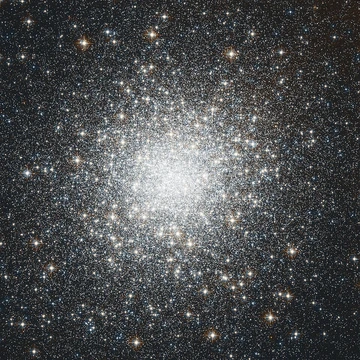
NGC 6752
Fourth-brightest globular cluster, visible to the unaided eye.

NGC 6752, also called Caldwell 93 and often referred to as the Great Peacock Globular, is a globular cluster located in the constellation Pavo. It ranks as the fourth brightest globular cluster visible from Earth, surpassed only by Omega Centauri, 47 Tucanae, and Messier 22. Observers in the Southern Hemisphere can best view it between June and October. There is also a possible alternate designation, NGC 6777, though this identification remains uncertain.
The cluster was first recorded by James Dunlop in Parramatta on 30 June 1826. He described it as an irregular bright nebula that resolved into a dense cluster of many stars, with a highly compressed center. That central region, about 1.3 light-years across, is so densely packed with stars that astronomers believe the cluster has undergone core collapse. NGC 6752 lies roughly 13,000 light-years from Earth, making it one of the closer globular clusters to our planet, and about 17,000 light-years from the galactic center. It is classified as Shapley–Sawyer Concentration Class VI, indicating intermediate density, and its age is estimated at 11.78 billion years. The cluster contains many binary star systems and blue stragglers, the latter likely formed through collisions and mergers of smaller stars.
With an apparent magnitude of 5.4, NGC 6752 can be spotted with the naked eye under dark skies free of light pollution. Through binoculars, it appears about three-quarters the size of the full moon. It sits 1.5 degrees east of the 5th-magnitude star Omega Pavonis, while the nearest bright star, Peacock, lies 3.25 degrees north and 9.25 degrees east. Six X-ray sources have been detected in the cluster’s core by the Chandra X-Ray Observatory.
Quick Facts
- Epoch
- J2000
- Class
- VI
- Constellation
- Pavo
- Ra
- 19 · 10 · 52.11
- Dec
- –59 · 59 · 04.4
- Dist Ly
- 13.0 kly
- Appmag V
- 5.4
- V Hb
- 13.7
- Metal Fe
- –1.24
- Age
- 11.78 Gyr
- Names
- Caldwell 93, NGC 6777
Facts from the source article.
Lore & Background
NGC 6752 was first identified by James Dunlop of Parramatta on 30 June 1826, who described it as an irregular bright nebula which could be resolved into a cluster of many stars, highly compressed at the centre. This corresponds with a core region densely populated with stars around 1.3 light-years in diameter, which indicates it has undergone core collapse. The cluster lies around 13,000 light-years distant and is one of the closer globular clusters to Earth, also lying 17,000 light-years away from the galactic centre. It belongs to Shapley–Sawyer Concentration Class VI, namely of intermediate density, and has been calculated to be 11.78 billion years old. There are many binary stars in the system, as well as blue stragglers, which are likely to have been formed by collisions and mergers of smaller stars.
Reader's Guide
NGC 6752 is notable as the fourth-brightest globular cluster in the sky, with an apparent magnitude of 5.4, allowing it to be seen with the unaided eye under good viewing conditions with minimal light pollution. With binoculars it appears to cover an area three quarters the size of the full moon. It lies 1.5 degrees east of 5th-magnitude Omega Pavonis, and the nearest bright star is Peacock, which lies 3.25 degrees north and 9.25 degrees east. Six X-ray sources have been identified in the cluster's core by the Chandra X-Ray Observatory. Its core collapse and high density of binary stars and blue stragglers make it a significant object for studying stellar dynamics and evolution. The cluster's identification as NGC 6777 is uncertain, preserving a historical ambiguity.
Did You Know?
- Its core is about 1.3 light-years in diameter and has undergone core collapse.
- Six X-ray sources have been identified in its core by the Chandra X-Ray Observatory.
More in Globular Clusters, Part 2 1-24
Spotted an error? Know more?
Reader corrections go straight into our review queue. Suggest an edit · How this site is sourced