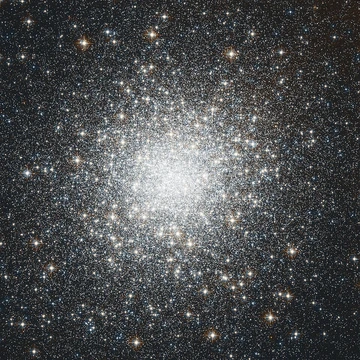
NGC 6712
Globular cluster with an accelerating black widow pulsar.

NGC 6712 is a globular cluster located in the constellation Aquila. It was likely first spotted by Le Gentil on July 9, 1749, while he was studying the Milky Way’s star cloud in that region. He described it as a "true nebula," distinguishing it from the open cluster M11. William Herschel independently found it on June 16, 1784, cataloging it as H I.47, and he initially classified it as a round nebula. It wasn’t until the 1830s that John Herschel recognized it as a globular star cluster. The cluster is estimated to be around 12 billion years old and may have once been much more massive, having lost a significant amount of material through repeated passes through the galactic disc. Compared to other globular clusters, NGC 6712 is somewhat rich in metals.
The cluster contains a black widow pulsar designated PSR J1853−0842A. In such systems, a very fast-spinning pulsar is paired with a low-mass star or brown dwarf. Intense radiation from the pulsar is gradually evaporating its companion, which has a mass between 0.018 and 0.036 times that of the Sun. While pulsars typically slow down as they age, this one is actually speeding up—a behavior that would not be possible outside the gravitational environment of a globular cluster.
Quick Facts
- Epoch
- J2000
- Class
- IX
- Constellation
- Scutum
- Ra
- 18 · 53 · 04.32
- Dec
- –08 · 42 · 21.5
- Dist Ly
- 26.4 kly
- Appmag V
- +8.69
- Metal Fe
- –0.94
- Age
- 10.4 Gyr
- Names
- GCl 103, GC 4441
Facts from the source article.
Lore & Background
NGC 6712 was probably first spotted by Le Gentil on July 9, 1749, who described it as a 'true nebula' to distinguish it from the open cluster M11. William Herschel independently discovered it on June 16, 1784, cataloging it as H I.47 and initially classifying it as a round nebula. It was John Herschel who, during his observations in the 1830s, first described it as a globular star cluster.
The cluster appears to be about 12 billion years old and may have originally been significantly more massive, having undergone substantial mass loss due to passes through the galactic disc. For a globular cluster, NGC 6712 is somewhat metal-rich.
NGC 6712 contains a black widow pulsar designated PSR J1853−0842A. This system consists of an extremely rapidly rotating pulsar accompanied by a low-mass star or brown dwarf. The pulsar's intense radiation contributes to the evaporation of its companion, which has a mass between 0.018 and 0.036 solar masses. Although pulsars typically slow down with age, PSR J1853−0842A is accelerating—a phenomenon that would not be possible without its location within a globular cluster.
Reader's Guide
NGC 6712 holds significance as a globular cluster with a well-documented history of discovery and reclassification, from Le Gentil's 'true nebula' to John Herschel's recognition of its true nature as a globular star cluster. Its age of about 12 billion years places it among the older clusters, and its relatively high metallicity for a globular cluster is noteworthy. The cluster's past mass loss from galactic disc passages suggests it was once much more massive.
The most remarkable legacy of NGC 6712 is its black widow pulsar, PSR J1853−0842A. This system demonstrates the extreme physics of pulsar evolution within dense stellar environments. The pulsar's acceleration, contrary to the typical slowdown of aging pulsars, is only possible because of gravitational interactions within the cluster. The companion's low mass and ongoing evaporation by the pulsar's radiation illustrate the dynamic processes that shape such binary systems. This makes NGC 6712 a key object for studying pulsar recycling and the evolution of compact binaries in globular clusters.
Did You Know?
- NGC 6712 was probably discovered by Le Gentil on July 9, 1749.
- John Herschel was the first to describe it as a globular star cluster, in the 1830s.
- It hosts a black widow pulsar, PSR J1853−0842A, which is accelerating.
- The cluster may have originally been significantly more massive before losing mass through galactic disc passes.
More in Globular Clusters, Part 2 1-24
Spotted an error? Know more?
Reader corrections go straight into our review queue. Suggest an edit · How this site is sourced