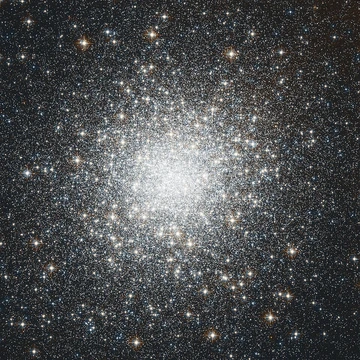
NGC 6652
Globular cluster with two millisecond pulsars and multiple X-ray sources.

NGC 6652 is a globular star cluster located in the constellation Sagittarius. It lies roughly 30,000 light-years from Earth and about 6,500 light-years from the Galactic Center. The cluster was first observed on September 3, 1826, by the Scottish astronomer James Dunlop.
Studies have measured the cluster’s metallicity at -0.81 (according to a 2011 analysis by J. Boyles and colleagues) and -0.70 (from a study by Forbes and Bridges). The same 2011 study estimated the cluster’s mass at 109,000 times that of the Sun and its distance at about 10.0 kiloparsecs (roughly 32,600 light-years).
As of November 2022, 267 pulsars had been found across 36 globular clusters in the Milky Way. Two of these are millisecond binary pulsars located in NGC 6652. The first, designated PSR J1835-3259A, was discovered using the Green Bank Telescope. It has a rotation period of 3.9 milliseconds and follows an elliptical orbit with an eccentricity of 0.95 and an orbital period of 9.25 days. Assuming a neutron star mass of 1.4 solar masses, its companion would have a mass of about 0.74 solar masses. The second pulsar, PSR J1835−3259B, spins every 1.83 milliseconds and orbits a companion with an estimated mass of roughly 0.2 solar masses—likely a white dwarf—in a nearly circular orbit. This pulsar is thought to be the source of the gamma-ray emission observed from the cluster.
A third candidate, named NGC 6652B, was identified through simultaneous observations by the Chandra X-ray Observatory and the Karl G. Jansky Very Large Array. It may be a transitional millisecond pulsar (tMSP)—one that alternates between a rotation-powered state and an accretion-powered state. Other explanations for its behavior are possible but considered less likely. Confirmation would require direct observation of a state change.
Chandra observations have revealed eleven X-ray sources in the cluster, six previously known and five new. Source A is a low-mass X-ray binary (LMXB). Source B suggests a neutron star in an LMXB system but with unusual variability. Source C’s spectrum points to a cataclysmic variable. Source D’s spectrum also indicates a neutron star in an LMXB, making it the third such source in NGC 6652. Sources E and F have spectra in the hard X-ray range, hinting at the presence of high-energy plasma.
Quick Facts
- Constellation
- Sagittarius
- Ra
- 18 · 35 · 45.63
- Dec
- -32 · 59 · 26.6
- Dist Ly
- ~30,000
- Appmag V
- 9.75
- Age
- 13.6 billion years
- Names
- NGC 6652, GCl 98, RX J1835.7-3259, 4FGL J1835.7-3258
Facts from the source article.
Lore & Background
NGC 6652 was discovered on September 3, 1826 by James Dunlop. It lies about 6,500 light years from the Galactic Center and about 30,000 light years from Earth. A 2011 study by J. Boyles and colleagues estimated its metallicity at -0.81 and its mass at 109,000 M☉, while also giving a distance of approximately 10.0 kpc (~32,600 ly). Another study by Forbes and Bridges reported a metallicity of -0.70.
As of November 2022, two millisecond binary pulsars have been confirmed in NGC 6652. The first, PSR J1835-3259A, has a period of 3.9 ms and an elliptical orbit with eccentricity 0.95 and orbital period 9.25 days; its companion mass is estimated at 0.74 M☉ assuming a pulsar mass of 1.4 M☉. The second, PSR J1835−3259B, has a period of 1.83 ms in a nearly circular orbit around a companion of about 0.2 M☉, likely a white dwarf, and is probably the source of gamma radiation from the cluster. A third candidate, NGC 6652B, was identified via Chandra and the Karl G. Jansky Very Large Array and is possibly a transitional millisecond pulsar, though other hypotheses remain.
Chandra X-ray Observatory observations detected eleven X-ray sources: six known and five new. Source A is a low-mass X-ray binary (LMXB). Source B suggests a neutron star in an LMXB with unusual variability. Source C is likely a cataclysmic variable. Source D indicates a neutron star in an LMXB, making it the third LMXB in the cluster. Sources E and F show hard X-ray spectra suggesting high-energy plasma.
Reader's Guide
NGC 6652's significance lies in its role as a laboratory for studying millisecond pulsars and X-ray binaries. The presence of two confirmed millisecond binary pulsars, including one with a highly eccentric orbit (eccentricity 0.95) and another likely powering gamma-ray emission, provides insight into binary evolution and neutron star recycling. The candidate transitional millisecond pulsar (NGC 6652B) is particularly notable because such objects switch between rotationally powered and accretion-powered states, offering a direct view of pulsar evolution. The cluster's multiple X-ray sources—including three low-mass X-ray binaries and a cataclysmic variable—further its importance for understanding compact object interactions in dense stellar environments. The metallicity discrepancy between studies ( -0.81 vs. -0.70 ) underscores ongoing uncertainties in cluster composition. Discovered in 1826 by James Dunlop, NGC 6652 remains a key target for multiwavelength observations, linking radio pulsar timing, X-ray variability, and gamma-ray studies.
Did You Know?
- NGC 6652 contains two confirmed millisecond binary pulsars, PSR J1835-3259A and PSR J1835−3259B.
- The first pulsar in NGC 6652, PSR J1835-3259A, has an orbital eccentricity of 0.95.
- A candidate transitional millisecond pulsar, NGC 6652B, was discovered using Chandra and the Karl G. Jansky Very Large Array.
- Chandra X-ray Observatory detected eleven X-ray sources in NGC 6652, including three low-mass X-ray binaries.
More in Globular Clusters, Part 2 1-24
Spotted an error? Know more?
Reader corrections go straight into our review queue. Suggest an edit · How this site is sourced