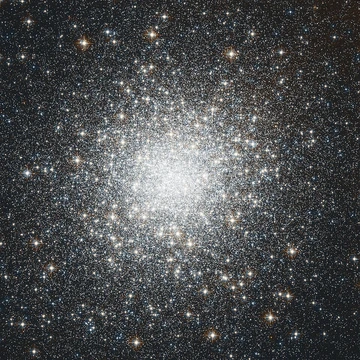
NGC 6624
Globular cluster with six pulsars and a record-spinning neutron star.

NGC 6624 is a globular cluster in the constellation Sagittarius, discovered on 24 June 1784 by the astronomer William Herschel. It is notable for containing six known pulsars, including the first discovered in this cluster, PSR J1823-3021A, as well as the low-mass X-ray binary 4U 1820-30, which hosts a neutron star spinning at 716 Hz, matching the fastest known spinning neutron star.
Quick Facts
- Epoch
- J2000
- Class
- VI
- Ra
- 18 · 23 · 41
- Dec
- −30 · 21 · 39
- Dist Ly
- 25.8 +/-
- Appmag V
- 7.6
- Constellation
- Sagittarius
- Metal Fe
- −0.56 ± 0.27
Facts from the source article.
Lore & Background
NGC 6624 was discovered on 24 June 1784 by William Herschel. It is given an apparent magnitude of 7.6 to 8.5. The cluster is visible as a hazy spot with a small telescope and appears as a star-like object with binoculars. Its core appears significantly condensed. It is located 0.8 degrees southeast of the star Delta Sagittarii, and is about 1.17 kpc (3.8 kly) from the Galactic Center.
Six pulsars are known in NGC 6624, the first of which discovered was PSR J1823-3021A. The cluster also contains 4U 1820-30, a low-mass X-ray binary with an orbital period of only 11.5 minutes, consisting of a neutron star and a white dwarf. Astronomers using the NICER instrument have found evidence that the neutron star is spinning at 716 Hz (42,960 revolutions per minute), the same velocity as the fastest known spinning neutron star PSR J1748−2446ad and the only one in such a system.
Reader's Guide
NGC 6624 holds significance as a globular cluster that hosts an exceptional number of pulsars—six in total—and a low-mass X-ray binary system with an extremely short orbital period of 11.5 minutes. The neutron star in this binary, 4U 1820-30, spins at 716 Hz, tying the record for the fastest known spinning neutron star, PSR J1748−2446ad, and is the only neutron star in such a system to achieve that rate. This makes NGC 6624 a key target for studying neutron star physics and binary evolution. Discovered by William Herschel in 1784, the cluster is observable with small telescopes as a hazy spot and with binoculars as a star-like object, located near Delta Sagittarii. Its condensed core and proximity to the Galactic Center add to its interest for astronomers.
More in Globular Clusters, Part 2 1-24
Spotted an error? Know more?
Reader corrections go straight into our review queue. Suggest an edit · How this site is sourced