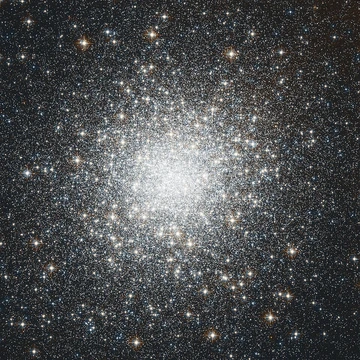
NGC 6522
Possibly the oldest globular cluster in the Milky Way.

NGC 6522, a globular cluster found in the southern constellation Sagittarius, sits within the Milky Way’s central bulge. It is centered on a patch of sky called Baade’s Window. This cluster may be the oldest known in our galaxy, having formed more than 12 billion years ago. Its age means it appeared roughly four billion years before the Milky Way’s galactic bar developed, and it might have once been confined within that bar; now it follows the bar in its orbit around the galactic core. The cluster is relatively low in mass, holding about 59,300 times the Sun’s mass. It is a core-collapsed cluster, with a core radius of 0.5 arcminutes and a half-light radius of 1.0 arcminute. Interstellar dust heavily reddens the view, and many foreground stars contaminate the field, making it hard to pick out true members. Among its stars, chemical signatures reveal multiple populations, with younger ones showing pollution from earlier generations. Twenty variable stars belong to NGC 6522: eight RR Lyrae, three type II Cepheids, and nine long-period variables. Six pulsars have also been found there. The cluster has an apparent visual magnitude of 8.3 and an angular diameter of 9.4 arcminutes. It lies about 25,100 light-years (7.7 kiloparsecs) from the Sun and roughly 2,000 light-years (0.6 kiloparsecs) from the Galactic Center. William Herschel, a German-British astronomer, discovered it on June 24, 1784.
Quick Facts
- Epoch
- J2000
- Constellation
- Sagittarius
- Ra
- 18 · 03 · 34.08
- Dec
- −30 · 02 · 02.3
- Dist Ly
- 25.1 kly
- Appmag V
- 8.3
- Absmag V
- −7.67
- Metal Fe
- –1.34
- Age
- 12.0 Gyr
Facts from the source article.
Lore & Background
NGC 6522 was discovered by German-British astronomer William Herschel on June 24, 1784. It lies in the Milky Way's central bulge, about 2.0 kly from the Galactic Center, and is centered in Baade's Window. The cluster is highly impacted by reddening due to interstellar dust and its view is heavily contaminated by field stars, making member identification difficult. It is a core collapsed cluster with a core radius of 0.5′ and a half-light radius of 1.0′. The cluster formed four billion years before the Milky Way galactic bar appeared and may have been confined to the bar for a period; at present it trails the bar in its orbit around the core. Distinctive chemical abundances among its members indicate multiple populations of stars, with younger populations exhibiting pollution from earlier generations.
Reader's Guide
NGC 6522 is significant as possibly the oldest star cluster in the Milky Way, with an age exceeding 12 billion years. Its formation predates the Milky Way's galactic bar by four billion years, and it may have been confined to the bar for a time, now trailing it in orbit. The cluster is a low-mass globular cluster with an estimated 5.93×10^4 solar masses. It hosts multiple stellar populations, as evidenced by distinctive chemical abundances, with younger stars showing pollution from earlier generations. Twenty variable stars have been identified as members, including eight RR Lyrae, three type II Cepheids, and nine long-period variable stars. Additionally, six pulsars have been discovered within the cluster. Its location in Baade's Window provides a unique window into the galactic bulge, though interstellar dust and field star contamination complicate observations.
Did You Know?
- NGC 6522 is possibly the oldest star cluster in the Milky Way, with an age of more than 12 billion years.
- It is located in Baade's Window, a region of the sky with relatively low dust obscuration toward the galactic center.
- The cluster has multiple populations of stars, with younger ones showing pollution from earlier generations.
- Six pulsars have been discovered in NGC 6522.
More in Globular Clusters, Part 2 1-24
Spotted an error? Know more?
Reader corrections go straight into our review queue. Suggest an edit · How this site is sourced