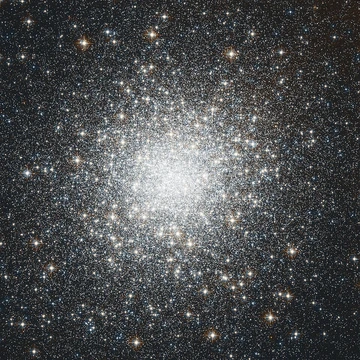
NGC 6441
Massive, metal-rich globular cluster with unusual variable stars.

NGC 6441, sometimes called the Silver Nugget Cluster, is a globular cluster located in the southern constellation Scorpius. Scottish astronomer James Dunlop discovered it on May 13, 1826, describing it as "a small, well-defined rather bright nebula, about 20″ in diameter." It sits about 5 arc minutes east-northeast of the star G Scorpii, roughly 43,000 light-years from the Sun.
This cluster ranks among the Milky Way's most massive and luminous globular clusters, containing an estimated 1.6 million solar masses of stars. It lies in the galactic bulge, about 13,000 light-years (3.9 kiloparsecs) from the galaxy's core, and is considered metal-rich—meaning it has a relatively high abundance of elements heavier than helium. Its core spans an angular size of 0.11 arc minutes, while its half-mass radius is 0.64 arc minutes. The core's stellar density, measured by luminosity density, is 5.25 solar luminosities per cubic parsec. The cluster's half-light radius is 7.1 light-years (2.18 parsecs).
NGC 6441 hosts an unusually large number of RR Lyrae variable stars—68 candidates as of 2006—with periods longer than typical for their metallicity. The mean period for its RRab stars is 0.759 days. It also contains several type II Cepheid stars, a rarity given the cluster's high metallicity. The color-magnitude diagram of the red giant branch suggests at least two, possibly three, distinct stellar populations. The brightest and hottest red clump stars are more concentrated toward the center, possibly indicating a helium-enriched second generation.
The cluster contains at least four millisecond pulsars, two of which are in binary systems. One binary, PSR J1750−37A, has a highly eccentric orbit with an eccentricity of 0.71. An X-ray burster, X1746-370, resides here, exhibiting the longest period known among globular clusters and consistent with the galaxy as a whole. Additionally, NGC 6441 contains a planetary nebula, JaFu 2—one of only four such nebulae known in Milky Way globular clusters.
A 2021 study suggests the cluster's core may harbor an intermediate-mass black hole with a mass up to 13,200 solar masses.
Quick Facts
- Epoch
- J2000
- Class
- III
- Constellation
- Scorpius
- Ra
- 17 · 50 · 13.06
- Dec
- −37 · 03 · 05.2
- Dist Ly
- 13.1 ±
- Appmag V
- 7.2
- Mass Msol
- 1.6e6
- Radius Arcminsec
- 4.8
- Radius Tidal Ly
- 27.23 pc
- Metal Fe
- −0.53
- Age
- 13−13.7 Gyr
Facts from the source article.
Lore & Background
NGC 6441 was discovered by Scottish astronomer James Dunlop on May 13, 1826, who described it as 'a small, well-defined rather bright nebula, about 20″ in diameter'. It lies 5 arc minutes east-northeast of the star G Scorpii, some 43,000 light-years from the Sun. The cluster is located in the bulge of the Milky Way at a distance of 13 kilolight-years (3.9 kpc) from the core and is considered metal 'rich', meaning it has a relatively high abundance of elements heavier than helium. The core region subtends an angle of 0.11 arc minutes, while the half-mass radius is 0.64 arc minutes; the luminosity density in the core is 5.25 L☉ pc−3, and the half-light radius is 7.1 ly (2.18 pc).
The cluster has an abnormally large number of RR Lyrae variables—68 candidates as of 2006—with periods longer than typical for their metallicities; the mean period for its RRab stars is 0.759 day. It also contains several type II Cepheid stars, unusual given the high metallicity. Examination of the red giant branch suggests at least two and possibly three distinct populations; the brightest, higher-temperature red clump stars are more concentrated toward the center, possibly a helium-enriched second generation. The cluster contains at least four millisecond pulsars, two in binary systems, including PSR J1750−37A with a highly eccentric orbit (eccentricity 0.71). It also hosts an X-ray burster, X1746-370, which has the longest period known in any globular cluster. Finally, it contains a planetary nebula, JaFu 2, one of only four such nebulae known in Milky Way globular clusters.
Reader's Guide
NGC 6441 is significant as one of the most massive and luminous globular clusters in the Milky Way, with a high metallicity that sets it apart from many other clusters. Its unusual variable star populations—including an abnormally large number of RR Lyrae variables with longer-than-typical periods and several type II Cepheid stars—challenge standard models of stellar evolution in metal-rich environments. The presence of at least two distinct stellar populations, possibly including a helium-enriched second generation, adds to its importance for understanding cluster formation and chemical enrichment. The cluster's four millisecond pulsars, including a binary with a highly eccentric orbit, and its X-ray burster with the longest known period in any globular cluster, make it a key object for studying compact objects and binary interactions. Additionally, the planetary nebula JaFu 2 is one of only four known in Milky Way globular clusters, providing a rare opportunity to study late-stage stellar evolution in such environments. A 2021 study suggested the core may contain an intermediate-mass black hole with a mass of up to 13,200 M⊙, though this remains uncertain.
Did You Know?
- NGC 6441 was discovered by James Dunlop on May 13, 1826.
- The cluster contains 68 candidate RR Lyrae variables as of 2006.
- It hosts one of only four planetary nebulae known in Milky Way globular clusters, JaFu 2.
More in Globular Clusters, Part 2 1-24
Spotted an error? Know more?
Reader corrections go straight into our review queue. Suggest an edit · How this site is sourced