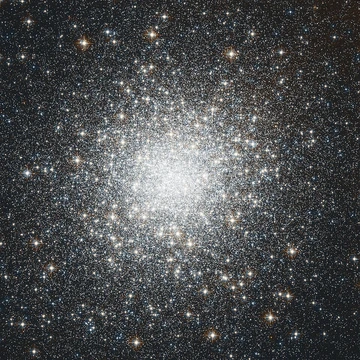
NGC 6426
An ancient, metal-poor globular cluster in Ophiuchus.

NGC 6426 is a globular cluster of stars located in the equatorial constellation of Ophiuchus. It is notable as one of the oldest and most metal-poor clusters in the Milky Way system, with an estimated age of 13.0±1.5 billion years. Its chemical abundances suggest at least two generations of stars, with evidence of hypernova enrichment.
Quick Facts
- Epoch
- J2000
- Constellation
- Ophiuchus
- Ra
- 17 · 44 · 54.71
- Dec
- +03 · 10 · 12.5
- Dist Ly
- 20.6 kpc
- Class
- IX
- Metal Fe
- –2.34
- Appmag V
- 10.9
Facts from the source article.
Lore & Background
NGC 6426 was discovered by the German-English astronomer William Herschel on 3 June 1786. It is located in the equatorial constellation of Ophiuchus, at a distance of 67,000 light years from the Sun. The cluster orbits in the outer galactic halo, 47 kly (14.4 kpc) from the Galactic Core. With an apparent visual magnitude of 10.9 and an angular diameter of 4.2′, it is difficult to observe with a small telescope. Its angular half-light radius is 0.92′ and its tidal radius is 13.0′, with a Shapley–Sawyer Concentration Class of IX. Based on the spectra of a dozen identified RR Lyrae variables, it is classified as an Oosterhoff type II cluster. In 2012, a carbon star was discovered near the center of the cluster.
Reader's Guide
NGC 6426 is significant as one of the oldest and most metal-poor globular clusters in the Milky Way, with an estimated age of 13.0±1.5 billion years. Its chemical abundances, derived from four members at the tip of the red giant branch, indicate at least two generations of stars, with older stars enriching a younger generation with elements including Mg, Si, and Zn. There is also some indication of hypernova enrichment of the pre-cluster medium by lighter alpha process elements. This cluster provides insight into early stellar populations and chemical evolution in the galactic halo. Its classification as an Oosterhoff type II cluster, based on RR Lyrae variables, further characterizes its stellar population. The discovery of a carbon star near its center in 2012 adds to its interest as a site of evolved stellar phenomena.
More in Globular Clusters, Part 2 1-24
Spotted an error? Know more?
Reader corrections go straight into our review queue. Suggest an edit · How this site is sourced