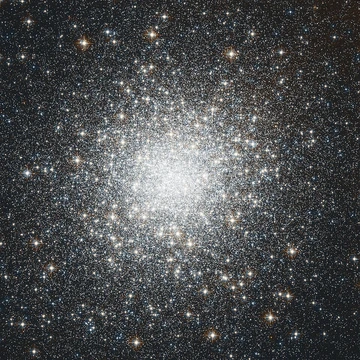
NGC 6401
Old globular cluster in Ophiuchus, possibly trapped in Milky Way's bar.

NGC 6401 is a globular cluster found in the equatorial constellation Ophiuchus. It was first spotted in 1784 by William Herschel, who mistakenly recorded it as a bright nebula; his son John Herschel later made the same error, as the telescopes of the time could not resolve its individual stars. The cluster is visible through a small telescope, with an apparent magnitude of 7.4 and an angular diameter of 4.8 arcminutes.
Lying about 25,100 light-years from the Sun, NGC 6401 orbits within the Milky Way’s galactic bulge, close to the inner part of the galaxy. Its high mass suggests it may be gravitationally trapped inside the Milky Way’s bar. From Earth, it sits just 5.3 degrees from the Galactic Center, and its light is heavily reddened by interstellar dust. The cluster is very old, with an estimated age of 13.2 billion years (plus or minus 1.2 billion), but it has not undergone core collapse. Its radius is 2.4 arcminutes.
Within the cluster’s core radius, astronomers have identified 23 RR Lyrae variables of class ab and 11 of class c. This makes NGC 6401 an Oosterhoff type I (Oo I) cluster. During the total lunar eclipse of June 2011, the Moon occulted the cluster over Europe, North Africa, and Southwest Asia; the next such occultation will occur during the June 2076 lunar eclipse, visible from eastern North America, Cuba, the Atlantic Ocean, southeastern Europe, and the northern half of Africa.
Quick Facts
- Epoch
- J2000
- Constellation
- Ophiuchus
- Ra
- 17 · 38 · 36.93
- Dec
- −23 · 54 · 31.5
- Dist Pc
- 7.70 kpc
- Appmag V
- 7.4
- Metal Fe
- −1.15 · 0.20
Facts from the source article.
Lore & Background
NGC 6401 was discovered by German-English astronomer William Herschel in 1784, but he mistakenly classified it as a bright nebula. His son John Herschel later came to the same conclusion because the technology of the day did not allow the individual stars to be visually resolved. It is visible in a small telescope, with an apparent visual magnitude of 7.4 and an angular diameter of 4.8′.
The cluster is located at a distance of 25.1 kly (7.70 kpc) from the Sun and is orbiting in the galactic bulge, in the inner part of the Milky Way galaxy. Because of its high mass, it may be gravitationally trapped inside the Milky Way's bar. From the perspective of Earth, this cluster is situated 5.3° from the Galactic Center and is strongly reddened due to extinction from interstellar dust. NGC 6401 is a very old cluster with an estimated age of 13.2±1.2 Gyr, but has not undergone core collapse. It has a cluster radius of 2.4′.
23 class ab and 11 class c RR Lyrae variables have been identified within a cluster radius of the core. From this, it is deduced that this is an Oosterhoff type I (Oo I) cluster. During the June 2011 lunar eclipse, a Total Lunar Eclipse, it was occulted by the Moon over Europe, North Africa and Southwest Asia. This will happen again during the June 2076 lunar eclipse over Eastern North America, Cuba, the Atlantic Ocean, Southeast Europe and the northern half of Africa.
Reader's Guide
NGC 6401 is significant as a very old globular cluster (13.2±1.2 Gyr) located in the galactic bulge, offering insights into the early history of the Milky Way. Its high mass suggests it may be gravitationally trapped inside the galaxy's bar, making it a key object for studying the dynamics of the inner galaxy. The identification of 34 RR Lyrae variables (23 ab and 11 c) and its classification as an Oosterhoff type I cluster provide important data for understanding stellar populations and the cluster's metallicity. The strong reddening from interstellar dust highlights the challenges of observing objects near the Galactic Center. Its occultation by the Moon during total lunar eclipses in 2011 and 2076 adds a rare observational event, linking the cluster to transient celestial phenomena. The cluster's history of being misidentified as a nebula by both William and John Herschel underscores the limitations of 18th- and 19th-century telescopes.
Did You Know?
- It is located 5.3° from the Galactic Center and is strongly reddened by interstellar dust.
- The cluster has an estimated age of 13.2±1.2 Gyr and has not undergone core collapse.
- It was occulted by the Moon during the June 2011 total lunar eclipse and will be again in June 2076.
More in Globular Clusters, Part 2 1-24
Spotted an error? Know more?
Reader corrections go straight into our review queue. Suggest an edit · How this site is sourced