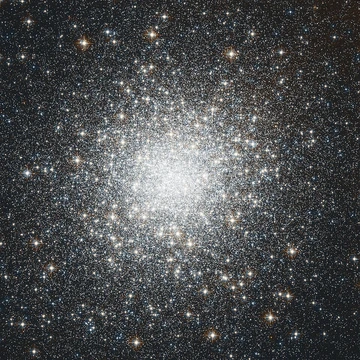
NGC 6397
A nearby globular cluster with a collapsed core and debated black hole content.

NGC 6397 (also known as Caldwell 86) is a globular cluster in the constellation Ara, discovered by French astronomer Nicolas-Louis de Lacaille in 1752. It is one of the two nearest globular clusters to Earth, located about 7,800 light-years away, and contains around 400,000 stars. The cluster is notable for being one of at least 20 Milky Way globular clusters that have undergone a core collapse, resulting in a very dense stellar agglomeration at its center.
Quick Facts
- Epoch
- J2000
- Class
- IX
- Constellation
- Ara
- Ra
- 17 · 40 · 42.09
- Dec
- –53 · 40 · 27.6
- Dist Ly
- 7.8 kly
- Appmag V
- +6.68
- Radius Ly
- 36 ly
- V Hb
- 14.2
- Metal Fe
- –1.76
- Age
- 13.4 ± 0.8 Gyr
- Notes
- Second closest globular cluster
Facts from the source article.
Lore & Background
NGC 6397 was discovered in 1752 by French astronomer Nicolas-Louis de Lacaille. It lies about 7,800 light-years from Earth, making it one of the two nearest globular clusters, alongside Messier 4. The cluster contains roughly 400,000 stars and is visible to the naked eye under good conditions. It is one of at least 20 Milky Way globular clusters that have undergone core collapse, meaning its core has contracted into a very dense stellar agglomeration.
In 2004, astronomers used the UV-Visual Echelle Spectrograph of the Very Large Telescope to measure beryllium in two stars of NGC 6397, estimating the age of the Milky Way at about 13.6 billion years. A 2006 Hubble Space Telescope study of the cluster revealed a lower brightness limit among its faint stars, indicating a minimum mass for stellar fusion of roughly 0.083 solar masses.
In February 2021, Hubble and Gaia data suggested a dense concentration of compact objects (white dwarfs, neutron stars, black holes) in the cluster's core. A subsequent group argued that core collapse would have ejected most black holes, and simulations showed white dwarfs could explain the observations. A 2022 study, involving scientists from both groups, confirmed that the central mass excess matched simulations of hundreds of massive white dwarfs with essentially no black holes.
Reader's Guide
NGC 6397 has played a significant role in several astronomical studies. In 2004, it was used to estimate the age of the Milky Way Galaxy at about 13.6 billion years by measuring beryllium in two of its stars, assuming the cluster is not older than the Galaxy. A 2006 Hubble Space Telescope study of the cluster established a lower mass limit for stars capable of fusion—roughly 0.083 solar masses—by observing a clear brightness cutoff among faint stars. The cluster also became a focal point for debate about the presence of black holes in globular clusters. Initial 2021 observations suggested a dense concentration of compact objects, possibly including black holes, but subsequent simulations and a 2022 collaborative study indicated that the central mass excess is best explained by hundreds of massive white dwarfs, with essentially no black holes remaining. This work highlights how core collapse can dynamically eject black holes, refining our understanding of stellar evolution and cluster dynamics. Additionally, Hubble images have revealed many distant globular clusters in galaxies far behind NGC 6397, underscoring its value as a foreground object for deep-field studies.
Did You Know?
- NGC 6397 is one of the two nearest globular clusters to Earth, at about 7,800 light-years away.
- The cluster contains around 400,000 stars and can be seen with the naked eye under good conditions.
- A 2022 study concluded that its core contains hundreds of massive white dwarfs and essentially no black holes.
Frequently Asked Questions
What is NGC 6397?
NGC 6397, also cataloged as Caldwell 86, is a globular cluster sitting in the southern constellation Ara. It ranks among the two closest such clusters to the Solar System, at a distance of roughly 7,800 light-years.
Who discovered NGC 6397 and when?
French astronomer Nicolas-Louis de Lacaille first recorded the cluster in 1752. That early sighting makes it one of the longer-known globular clusters in the southern sky.
How many stars does NGC 6397 contain?
The cluster holds approximately 400,000 stars packed into its volume. That places it in the moderate-to-large range among Milky Way globular clusters.
What is special about NGC 6397's core?
It is one of at least twenty Milky Way globular clusters that have gone through a core collapse, producing an extraordinarily dense knot of stars at its center. This central agglomeration is the cluster's most distinctive structural feature.
Is there a black hole in NGC 6397?
Because of its collapsed core, astronomers have debated whether a central black hole may be hidden inside the cluster. No definitive detection has been confirmed, so the question of a stellar-mass or intermediate-mass black hole at its heart remains open.
More in Globular Clusters, Part 2 1-24
Spotted an error? Know more?
Reader corrections go straight into our review queue. Suggest an edit · How this site is sourced