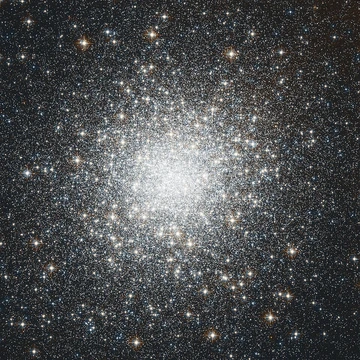
NGC 6388
A massive Milky Way globular cluster with multiple stellar populations.

NGC 6388 is a globular cluster of stars located in the southern constellation of Scorpius. It is one of the most massive globular clusters in the Milky Way, with an estimated mass of 2.17×10⁶ M☉, and has an age of 11.5±1.5 Gyr. The cluster was discovered by Scottish astronomer James Dunlop on May 13, 1826 using a 20 cm reflector telescope, and was later resolved into individual stars by English astronomer John Herschel.
Quick Facts
- Epoch
- J2000
- Class
- III
- Constellation
- Scorpius
- Ra
- 17 · 36 · 17.461
- Dec
- −44 · 44 · 08.34
- Dist Ly
- 10.90 ±
- Appmag V
- 6.8
- V Hb
- 16.85
- Metal Fe
- −0.55
Facts from the source article.
Lore & Background
NGC 6388 was discovered by Scottish astronomer James Dunlop on May 13, 1826 using a 20 cm reflector telescope. It was later determined to be a globular cluster by English astronomer John Herschel, who was able to resolve it into individual stars. The cluster is located at a distance of approximately 35,600 light-years from the Sun and has an apparent visual magnitude of +6.8, requiring binoculars or a small telescope to view.
The cluster has an age of 11.5±1.5 Gyr and a core radius of 7.2″. Its central velocity dispersion is 18.9 km/s, and its central density is 2.19×10⁵ L☉·pc⁻³. With an estimated mass of 2.17×10⁶ M☉, it is one of the most massive globular clusters in the Milky Way. Multiple stellar populations have been detected. In the past it was proposed that this cluster was accreted into the Milky Way, but the abundance of stellar elements from a large sample of cluster members strongly indicates it was formed within the galaxy.
The Hertzsprung–Russell diagram for NGC 6388 shows that the main-sequence turnoff is similar to that of 47 Tucanae, suggesting similar age and chemical abundances. However, the RR Lyrae variables and hotter members of the horizontal branch appear overluminous, possibly due to a central intermediate mass black hole (IMBH). X-ray observations rule out an accreting IMBH but not a quiescent one, and stellar density and velocity dispersion profiles rule out an IMBH with mass greater than about 2,000 M☉.
Reader's Guide
NGC 6388 is notable as one of the most massive globular clusters in the Milky Way, with a mass of 2.17×10⁶ M☉. Its significance lies in its multiple stellar populations and the debate over its origin: while it was once proposed to have been accreted into the Milky Way, elemental abundances from a large sample of cluster members strongly indicate it formed within the galaxy. The cluster's extended horizontal branch, with overluminous RR Lyrae variables and hotter members, has been suggested to result from a central intermediate mass black hole, though X-ray observations rule out an accreting IMBH while not excluding a quiescent one. The radial distribution of blue straggler stars is bimodal, similar to other globulars, but dynamic friction appears less efficient at segregating them toward the core. Examination by the Chandra observatory revealed 61 X-ray sources within a half-mass radius, five of which appear to be X-ray binaries. The cluster's similarity to 47 Tucanae in main-sequence turnoff suggests comparable age and chemical abundances, making it a valuable object for studying stellar evolution and dynamics.
Frequently Asked Questions
What is NGC 6388?
NGC 6388 is a dense ball of ancient stars sitting in the southern sky constellation Scorpius, roughly 35,600 light-years from our Sun. It ranks among the heaviest globular clusters known in the Milky Way, with a total mass around 2.17 million times that of our Sun.
Who discovered NGC 6388 and when?
Scottish astronomer James Dunlop first spotted the cluster on May 13, 1826, using a modest 20-centimeter reflector telescope. English astronomer John Herschel later succeeded in breaking the fuzzy smudge apart into its individual component stars.
How old is NGC 6388?
The stars in this cluster are estimated to be about 11.5 billion years old, give or take roughly 1.5 billion years. That places its formation very early in the history of the Milky Way, nearly as old as the galaxy itself.
Why is NGC 6388 considered special among globular clusters?
Beyond its exceptional mass, NGC 6388 hosts multiple distinct stellar populations, meaning its stars were not all born in a single burst but formed over several episodes. This makes it a valuable laboratory for studying how star formation and chemical enrichment unfold inside a dense stellar system.
Can you see NGC 6388 with the naked eye?
With an apparent visual magnitude of +6.8, it sits right at the threshold of naked-eye visibility under very dark, moonless skies. Most observers will need at least a small pair of binoculars or a modest telescope to resolve it from the surrounding star field in Scorpius.
More in Globular Clusters, Part 2 1-24
Spotted an error? Know more?
Reader corrections go straight into our review queue. Suggest an edit · How this site is sourced