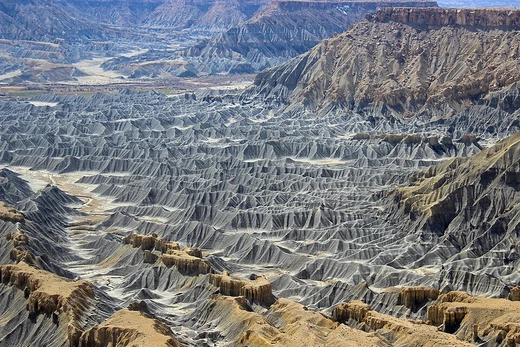
Scree
Broken rock fragments at cliff bases from periodic rockfall.

Scree is broken rock that piles up at the base of cliffs or steep rock faces after repeated rockfalls. These piles are often called talus deposits. The word can refer either to the unstable, steep slope made of this debris or to the debris itself, and it's roughly interchangeable with "talus."
The term comes from the Old Norse *skriða*, meaning landslide, while "talus" is French for a slope or embankment. In the outdoor community, people sometimes distinguish them: scree is small, loose rock no bigger than a fist, while talus is larger—from football-sized to boulder-sized—and may be loose or stable. You can boot-ski down scree but must boulder-hop across talus.
Talus deposits usually have a concave shape, with the steepest part matching the angle of repose for the average rock size. Scree slopes are often thought to be at this angle of repose—the point where a pile of granular material becomes unstable—but most are actually less steep, especially near the bottom, unless they're rapidly gaining or losing material. Large boulders in scree can create talus caves: human-sized gaps between rocks.
Scree forms through physical and chemical weathering of rock faces, plus erosion that moves material downhill. In high-altitude arctic and subarctic areas, scree slopes often sit next to hills and river valleys, typically originating from late-Pleistocene periglacial processes. The evolution of a scree slope is complex and varies by location, with no single widely accepted classification of stages.
Inside a scree slope, sediment is sorted by size—larger particles often accumulate at the top or middle due to kinetic sieving and travel farther downslope. Fine material fills gaps, cementing the debris together; clay binds faster than sand. If weathering outpaces new sediment, plants may take root, and their roots weaken the slope by reducing cohesion between coarse and fine parts. The main processes that degrade a rock slope depend on climate, as well as thermal and topographic stresses in the parent rock. These include physical weathering, chemical weathering, biotic processes, thermal stresses, and topographic stresses.
Physical weathering often involves ice forming inside rock cracks. Water from precipitation, groundwater, or runoff seeps into joints and fractures.
- Field
- Geology, Geomorphology
- Known for
- Formation through rockfall, distinction from colluvium, and role in slope evolution
- Related terms
- Talus, colluvium, talus deposit
- Etymology
- From Old Norse skriða, meaning landslide; talus from French for slope or embankment
Lore & Background
Scree is formed by rockfall, which distinguishes it from colluvium, the latter being rock fragments or soil deposited by rainwash, sheetwash, or slow downhill creep. However, the terms scree, talus, and sometimes colluvium tend to be used interchangeably. Within the outdoor community, talus and scree are often described as two distinct things: scree being small, loose pieces no bigger than a fist, while talus is any rock that is bigger, from football-sized to boulder-sized, which can be loose or not. One way to tell them apart is that a person can boot-ski scree and boulder hop talus.
The formation of scree and talus deposits results from physical and chemical weathering acting on a rock face, and erosive processes transporting material downslope. In high-altitude arctic and subarctic regions, scree slopes and talus deposits are typically adjacent to hills and river valleys, often originating from late-Pleistocene periglacial processes. There are five main stages of scree slope evolution: accumulation, consolidation, weathering, encroaching vegetation, and slope degradation. Scree slopes form as accumulated loose, coarse-grained material, with good sorting by size—larger particles accumulate more rapidly at the bottom.
Scree formation is commonly attributed to ice formation within mountain rock slopes. Freeze-thaw processes may generate large forces that create new cracks or wedge blocks into unstable positions, though the efficiency of this process is debated. Some researchers argue that ice formation in large open fracture systems cannot generate high enough pressures, suggesting frost heaving may play an important role. Eventually, a rock slope may be completely covered by its own scree, becoming 'mantled' with debris, though the deposit slopes themselves may still fail if particles exceed the angle of repose.
Reader's Guide
Scree is significant in geomorphology as a key indicator of ongoing rockfall and weathering processes on steep slopes. Its study helps understand slope stability, landscape evolution, and the role of freeze-thaw cycles in cold environments. The distinction between scree and talus, though often blurred in scientific literature, is important for practical field identification, especially in outdoor recreation where the terms describe different scales of debris. Scree slopes are often assumed to be near the angle of repose, but careful examination shows only those rapidly accumulating or losing material are close to this limit; most are less steep and concave. The formation of talus caves in boulder-sized scree provides unique habitats and geological features. Scree also interacts with glaciers, affecting energy balance and melting rates; debris cover can insulate glacier ice from incoming radiation, depending on thermal conductivity and thickness. The ongoing debate about freeze-thaw efficiency highlights the complexity of scree production, with alternative mechanisms like frost heaving proposed. Overall, scree represents a dynamic interface between rock weathering, transport, and deposition, with implications for hazard assessment, climate studies, and landscape management.
Did You Know?
- The term scree comes from the Old Norse word for landslide, skriða.
- Scree slopes often show a concave shape, with the foot less steep than the top.
- Scree with large boulder-sized fragments may form talus caves, human-sized passages between boulders.
More in Geomorphology 1-24
Spotted an error? Know more?
Reader corrections go straight into our review queue. Suggest an edit · How this site is sourced