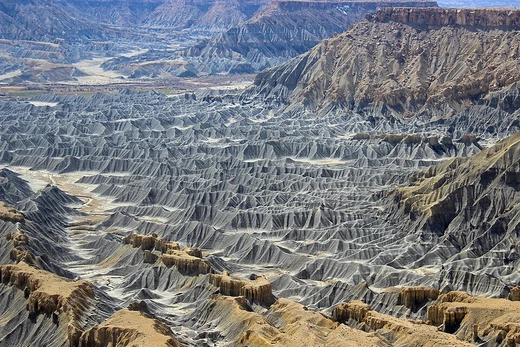
Fold mountains
Mountains formed by crustal folding at convergent plate boundaries.

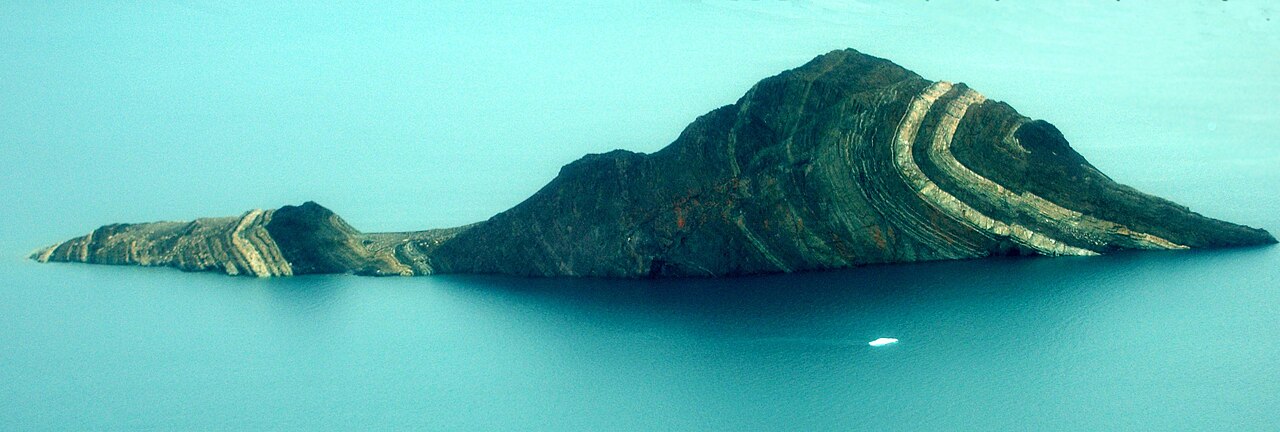
Sten · CC BY-SA 3.0
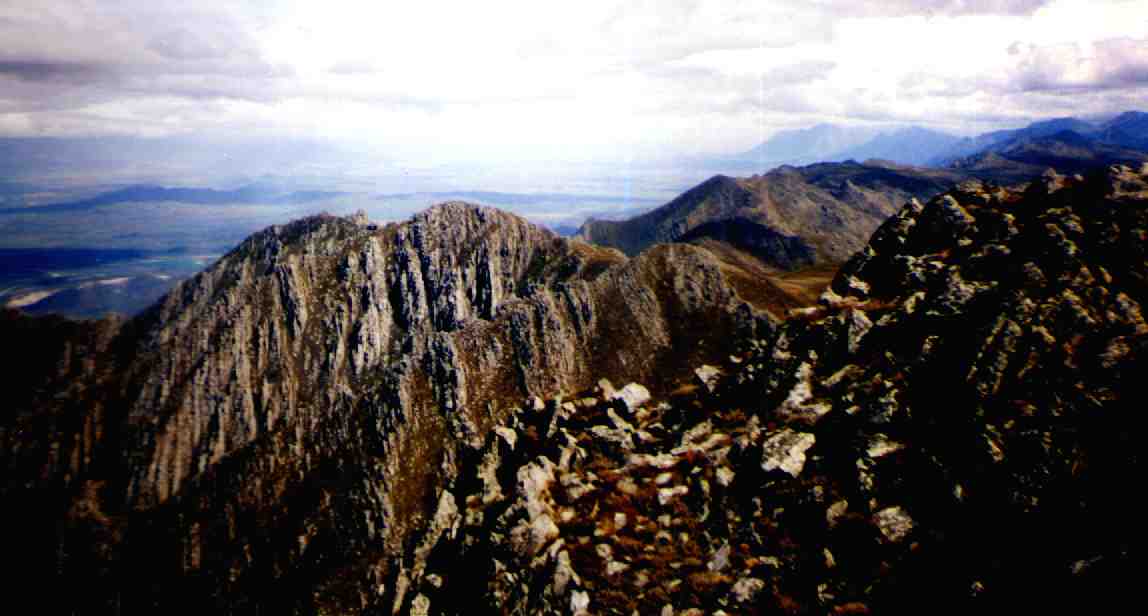
Fold mountains arise when layers in the upper crust are compressed and buckle. This term was once widely applied to most mountain ranges, but it became less common after the rise of plate tectonics and a clearer picture of how thrust belts work.
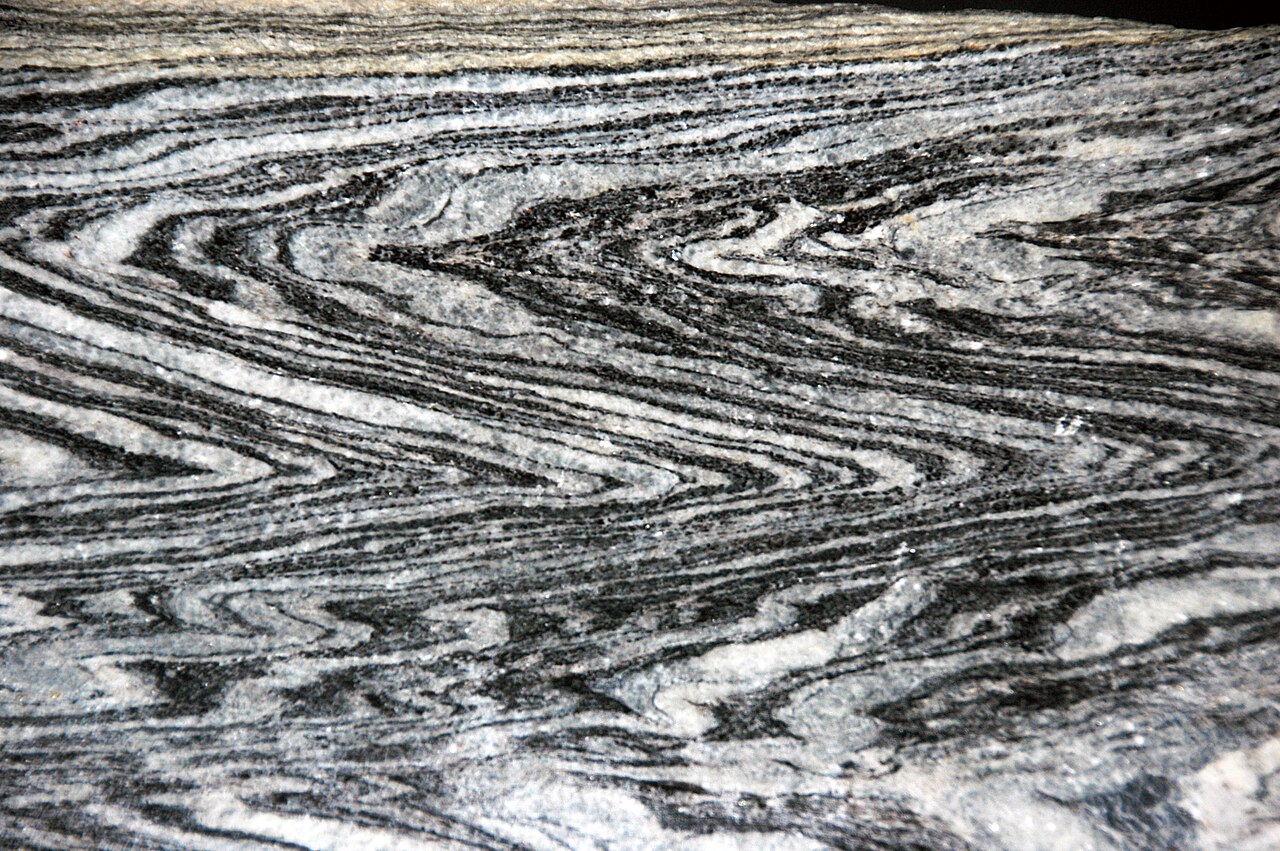
These mountains typically form in zones of thrust tectonics, especially where two tectonic plates converge. As plates—and the continents riding them—collide or one slides beneath the other, accumulated rock layers can crumple and fold, much like a tablecloth pushed across a table. This folding is more likely if a mechanically weak layer, such as salt, is present. Because continental crust is less dense than the mantle beneath, any crust forced upward into hills or mountains must be balanced by a much larger volume pushed downward into the mantle. As a result, the crust is normally much thicker under mountains than under lowlands. Folds can be symmetric or asymmetric. Upward folds are anticlines; downward folds are synclines. Severely folded and faulted rocks are called nappes. Asymmetric folding can also produce recumbent and overturned folds. Mountains formed this way tend to be much longer than they are wide.
Examples include the Jura mountains, a series of sub-parallel ridges folded over a Triassic evaporite layer due to thrust movements in the Alps’ foreland; the Simply Folded Belt of the Zagros Mountains, made of elongated anticlinal domes formed as detachment folds above thrusts, typically over a basal decollement in the Hormuz Formation’s evaporites; the Akwapim-Togo ranges in Ghana; the Ridge-and-Valley Appalachians in the eastern United States; and the Ouachita Mountains of Arkansas and Oklahoma.
See also: Fault-block mountain, Mountain formation, Aravalli Range.
- Formation process
- Folding in areas of thrust tectonics at convergent plate boundaries
- Key structures
- Anticlines, synclines, and nappes
- Mechanical condition
- Often involves a mechanically weak layer such as salt
- Crustal effect
- Continental crust is normally much thicker under mountains
- Examples
- Jura mountains, Zagros Simply Folded Belt, Akwapim-Togo ranges, Ridge-and-Valley Appalachians, Ouachita Mountains
Lore & Background
Fold mountains form in areas of thrust tectonics, such as where two tectonic plates move towards each other at a convergent plate boundary. When plates and the continents riding on them collide or undergo subduction, accumulated layers of rock may crumple and fold like a tablecloth pushed across a table, particularly if a mechanically weak layer such as salt is present. Since less dense continental crust floats on denser mantle rocks, the weight of crustal material forced upward must be balanced by a much greater volume forced downward into the mantle, making continental crust normally much thicker under mountains.
Reader's Guide
The concept of fold mountains was historically used to describe most mountain belts before the theory of plate tectonics and the internal architecture of thrust belts became well understood. Although the term has since fallen out of use, the processes it describes remain central to understanding mountain formation. Fold mountains typically exhibit greater length than breadth, with rock folding either symmetrically or asymmetrically. Examples include the Jura mountains, the Simply Folded Belt of the Zagros Mountains, the Akwapim-Togo ranges, the Ridge-and-Valley Appalachians, and the Ouachita Mountains. These formations illustrate how thrust movements and detachment folds over underlying thrusts create elongated anticlinal domes and sub-parallel ridges, often above basal decollements in evaporite layers.
Did You Know?
- The upfolds in folded rock are called anticlines and the downfolds are called synclines.
- The Jura mountains formed by folding over a Triassic evaporite decollement due to thrust movements in the foreland of the Alps.
The Mechanics of Continental Collision
When two continental tectonic plates converge—either slamming directly into one another or sliding beneath each other in a process called subduction—the immense compressive forces cause the crust to buckle and fold. This is the fundamental mechanism behind fold mountains. Unlike volcanic arcs, which develop along oceanic-continental boundaries where a sinking oceanic plate melts and drags water downward, fold mountains are the signature product of continental-continental collisions. The result is a landscape shaped by thrusting and folding, a process geologists call orogenesis. The majority of the world's great continental mountain ranges owe their existence to this kind of deep crustal deformation. The Balkan Mountains, the Jura range, and the Zagros Mountains all stand as prominent examples of terrain sculpted by this slow, grinding compression of one continental plate against another.
A Distinct Category in Mountain Classification
Geologists recognize five principal categories of mountains: volcanic, fold, plateau, fault-block, and dome. Fold mountains occupy a unique position among these, defined not by erupted lava or fractured crustal blocks but by the progressive buckling of rock layers under sustained compression. An older, more granular classification system that predates the acceptance of plate tectonics once added further subdivisions to these basic types, but the five-category framework remains the standard reference. What sets fold mountains apart from their volcanic counterparts is the boundary type involved: where volcanic arcs build up near subduction zones at oceanic-continental margins, fold mountains emerge specifically where two continental plates meet. They also differ from block mountains—such as the Sierra Nevada, where delamination produced a 650-kilometer-long tilted slab—or from uplifted passive margins like the Scandinavian Mountains, for which no single geophysical model has yet gained wide acceptance.
From Geosyncline to Plate Tectonics
For nearly two centuries, from the late 1700s until the 1960s, the dominant explanation for how mountains like the fold ranges were built rested on geosyncline theory. This framework attempted to account for mountain-building by describing the subsidence and subsequent uplift of vast sedimentary basins. The arrival of plate tectonics in the 1960s fundamentally reshaped the field, replacing geosyncline reasoning with a model grounded in the movement and interaction of tectonic plates. Today, the discipline of tectonic geomorphology bridges the gap between surface landforms and the deep processes that create them, while neotectonics focuses specifically on geologically young or still-active deformation. The broader orogenic process that produces fold mountains is not limited to folding alone; it encompasses faulting, volcanic activity, igneous intrusion, and metamorphism, all of which may operate simultaneously during a single mountain-building episode.
Beyond the Surface: Orogenesis and Erosion
A crucial insight in the study of fold mountains is that the geological structures visible on a mountain's surface do not necessarily reflect the processes that originally built it. Mountain formation is driven by large-scale movements of Earth's crust, and the resulting landscape is the product of an extended orogenic episode involving multiple mechanisms working in concert. Folding is only one thread in a tapestry that also includes faulting, volcanic eruptions, the intrusion of igneous rock, and the transformation of existing rock through metamorphism. Over time, the cycle of erosion further reshapes these ranges, modifying the original structures into the landforms we observe today. Related concepts such as 3D fold evolution, continental collision dynamics, and even isolated features like inselbergs or submerged seamounts all connect to the same underlying tectonic forces. Understanding fold mountains therefore requires looking well beyond their present-day silhouette to the deep, slow, and often invisible forces that continue to shape the planet's crust.
Gallery
Frequently Asked Questions
What are fold mountains and how do they actually form?
Fold mountains are ranges created when tectonic compression crumples rock layers at convergent plate boundaries. The process unfolds in thrust-tectonic zones where colliding or subducting plates push crustal strata into buckled shapes, much like a tablecloth wrinkling when you shove it across a surface.
What structures do you typically see in a fold mountain range?
The hallmark features are anticlines (upward arches), synclines (downward troughs), and large-scale nappes (thrust sheets). These structures often develop more readily when a mechanically weak layer such as salt sits within the sequence, letting overlying strata slide and buckle with less resistance.
Why isn't the term 'fold mountains' used as much anymore?
Before plate tectonics was well understood, geologists casually labeled almost every major range a 'fold mountain.' Once the mechanics of thrust belts and subduction became clearer, the community shifted to more precise terminology, making the old blanket label feel outdated.
How does crustal thickness relate to fold mountains?
Beneath any major mountain range the continental crust is significantly thicker than in surrounding lowland areas. This thickening is a direct consequence of the compression and stacking of rock layers during the folding and thrusting process.
Can you name some well-known fold mountain examples?
Classic examples include the Jura Mountains, the Zagros Simply Folded Belt, and the Ridge-and-Valley Appalachians. Other ranges formed through the same folding mechanism include the Akwapim-Togo ranges and the Ouachita Mountains.
More in Geomorphology 1-24
Spotted an error? Know more?
Reader corrections go straight into our review queue. Suggest an edit · How this site is sourced