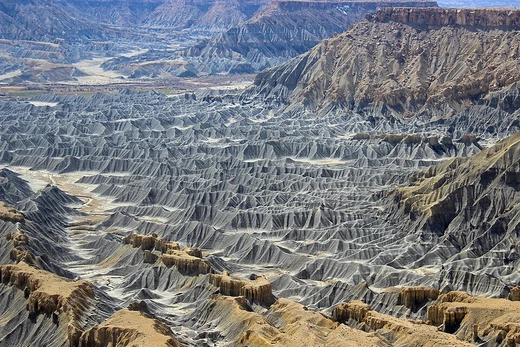
Rockslide
A rapid, en masse downslope movement of solid rock.

A rockslide is a specific kind of landslide where solid rock, rather than loose dirt or sediment, breaks away and moves down a slope as a single mass. This happens when a failure plane cuts through compacted rock, causing the entire section to collapse together rather than as separate blocks. As the rocks tumble, they dislodge more rocks along the way and destroy anything in their path. When these slides move very fast, they act like snow avalanches and are sometimes called rock avalanches.
In a rockslide, the rock mass slides along a roughly flat surface with little rotation or backward tilting, making it a type of translational slide. These events are especially dangerous because they involve a sudden, extremely fast release of bedrock along a uniform weak plane. Unlike slumps, flows, or falls, the failed material moves in a consistent direction over a layer of solid rock. Rocks may break apart as they fall. The combination of sudden release, large size, and heavy weight gives rockslides the potential to cause severe damage to people and structures. They are common in steep canyons and drainages, such as Idaho’s Salmon River Canyon, where elevation differences between ridge tops and canyon bottoms can exceed 5,000 feet.
Rockslides happen when gravity’s pull on the rock becomes stronger than the slope’s ability to resist it. Anything that weakens that resistance—such as erosion, earthquakes, or human activities like excavation—can trigger a slide. Water is a major factor: it adds weight to the material and fills pores, pushing grains apart and reducing the material’s resistance to movement. The steepness of the slope largely determines how fast and destructive a rockslide will be.
As rural populations grow, the risk from rockslides increases. Geologists and engineers work to detect, assess, and warn about potential slides. New tools like sequential InSAR and LiDAR data allow for regional monitoring of slope movement. Once a hazardous area is identified, detailed analysis estimates how much material might be released and how fast it will travel.
- **Wire meshing**: Corrosion-resistant mesh installed at the top and bottom of a slope to catch falling debris. - **Retaining walls**: Built to hold back unstable slopes and protect roads and structures from fallen rock and soil.
- Type
- Geologic mass-wasting event
- Subtype
- Translational slide
- Primary cause
- Gravitational force exceeding slope resistance
- Key agent
- Water as the most effective geologic agent
- Common location
- Over steepened canyons and drainages of Idaho, such as Salmon River Canyon
- Hazard level
- Most dangerous form of mass-wasting due to sudden, rapid release of bedrock
Lore & Background
Rockslides are a type of translational event since the rock mass moves along a roughly planar surface with little rotation or backward tilting. They are the most dangerous form of mass-wasting because they incorporate a sudden, incredibly fast-paced release of bedrock along a uniform plane of weakness. These uniform weaknesses are key to identifying rock slides because unlike slumps, flows, or falls, the failed material moves in a fairly uniform direction over a layer of solid, pre-existing rock. Rock may break down while falling during rockslides.
The sudden, rapid release of material found in rock slides combined with the sheer size and weight of the material that is falling gives these events the potential to have devastating effects on human life and infrastructure. Rock slides are very common in the over steepened canyons and drainages of Idaho, particularly in those areas like the Salmon River Canyon where more than 5,000 feet of elevation may exist between the ridge tops and the canyon bottoms.
Mass-wasting occurs whenever the gravitational force on the rock exceeds the ability of the slope to resist that force. While a major event such as an earthquake can cause large rockslides to happen, a majority of slides occur due to a combination of gravitational pressure and erosional influences. Anthropogenic activities, such as altering the geometry of a hill through excavation, can also change the stress state, contributing to slope instability. Water is arguably the most effective geologic agent that causes mass-wasting events to occur.
Reader's Guide
Rockslides represent a significant natural hazard due to their sudden onset, high speed, and immense destructive potential. Unlike other forms of mass wasting, rockslides involve the coherent movement of solid rock along a planar surface, which allows large volumes of material to travel great distances rapidly. Their behavior, similar to snow avalanches, makes them particularly dangerous for human settlements and infrastructure in mountainous regions. The article notes that with increasing populations in rural areas, the hazards presented by potential rock slides are becoming an increasingly pressing issue. Detection and assessment have improved through new earth observation tools such as sequential InSAR and LiDAR data, which provide a regional view of slope movement. Once susceptible areas are discovered, detailed analysis determines the amount of material that will be released and the speed of transport. Mitigation techniques include wire meshing, retaining walls, soil nailing, and rock bolting, all designed to stabilize slopes or contain falling debris. The significance of rockslides lies in their capacity for catastrophic damage, driving ongoing efforts in geologic science and engineering to perfect methods of detection, assessment, and warning.
Did You Know?
- Fast-flowing rock slides behave similarly to snow avalanches and are sometimes referred to as rock avalanches.
- Water is considered the most effective geologic agent causing mass-wasting events, adding weight to soil and filling pores to decrease resistance.
More in Geomorphology 1-24
Spotted an error? Know more?
Reader corrections go straight into our review queue. Suggest an edit · How this site is sourced