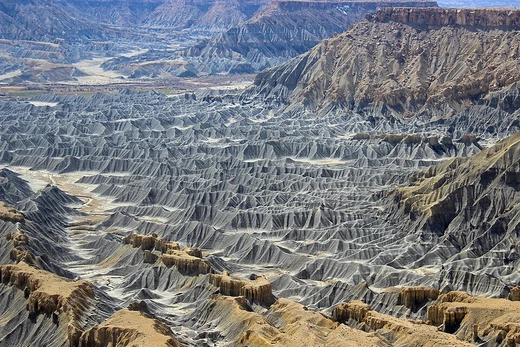
Rift valley
Linear lowland formed by tectonic pulling apart of the lithosphere.

A rift valley is a linear lowland between highlands or mountain ranges, formed by the pulling apart of the lithosphere due to extensional tectonics. These valleys can occur at all elevations on Earth, from the sea floor to continental plateaus, and are often associated with subsidiary valleys. Rift valleys are significant because they represent zones where tectonic plates are actively breaking apart, and they host many of the world's largest lakes.
- Active examples
- East African Rift, Baikal Rift Zone, West Antarctic Rift System (possibly)
Lore & Background
Rift valleys are produced by the action of a geologic rift, where extensional tectonics pull the lithosphere apart. The resulting linear depression may be deepened by erosion and is often filled with sedimentary deposits from the rift flanks. Many rift valleys contain lakes, such as Lake Baikal, the deepest and most voluminous freshwater lake on Earth, and Lake Tanganyika, second by both measures, located in the Albertine Rift of the East African Rift. The most extensive rift valley on Earth lies along the crest of the mid-ocean ridge system, created by sea floor spreading, with examples including the Mid-Atlantic Ridge and the East Pacific Rise.
Continental rift valleys can result from failed arms of triple junctions, but three are currently active: the East African Rift, the Baikal Rift Zone, and the West Antarctic Rift System (possibly), while the Rio Grande rift is generally considered inactive or dormant. In these active rifts, entire tectonic plates are breaking apart, and if they continue, they will eventually become oceanic rifts. Other rift valleys form from bends or discontinuities in strike-slip faults; for instance, the Dead Sea lies in a rift from a rightward step in the left-lateral Dead Sea Transform fault. Fault-caused extension can also occur where a fault splits into two strands, producing smaller features like sag ponds or landslides.
Rift valleys are not unique to Earth. The 4,000 km long Valles Marineris on Mars is believed to be a large rift system. On Venus, features such as Devana Chasma and parts of western Eistla have been interpreted as rift valleys. In the Saturn system, Ithaca Chasma on Tethys is a prominent example, and Charon's Nostromo Chasma is the first confirmed rift in the Pluto system. A recent study suggests a complex system of ancient lunar rift valleys, and the Uranus system has large chasma believed to be giant rift valleys, including Messina Chasma on Titania.
Reader's Guide
Rift valleys are fundamental to understanding plate tectonics and the evolution of planetary surfaces. On Earth, they mark zones where continents are actively splitting, such as the East African Rift, which may eventually form a new ocean. The presence of deep rift lakes like Baikal and Tanganyika highlights their role in hosting unique ecosystems and significant freshwater reserves. The study of rift valleys also extends to other planets and moons, providing insights into geological processes across the solar system. For example, Mars's Valles Marineris and the chasma on Saturn's moon Tethys and Uranus's moons suggest that extensional tectonics is a common planetary phenomenon. The article notes that some interpretations of extraterrestrial features remain disputed, such as the giant rifts on Charon and certain features on Venus. Understanding rift valleys helps geologists reconstruct past tectonic events, such as the ancient Midcontinent Rift that now contains Lake Superior, and assess seismic hazards in active rift zones. Their formation through both plate-scale extension and local fault bends illustrates the diverse mechanisms that shape planetary crusts.
Did You Know?
- Lake Baikal in Siberia is both the deepest lake in the world and holds 20% of all liquid freshwater on Earth.
- The 4,000 km long Valles Marineris on Mars is believed by planetary geologists to be a large rift system.
More in Geomorphology 1-24
Spotted an error? Know more?
Reader corrections go straight into our review queue. Suggest an edit · How this site is sourced