Ridge
Elevated landform with steep sides and narrow crest.

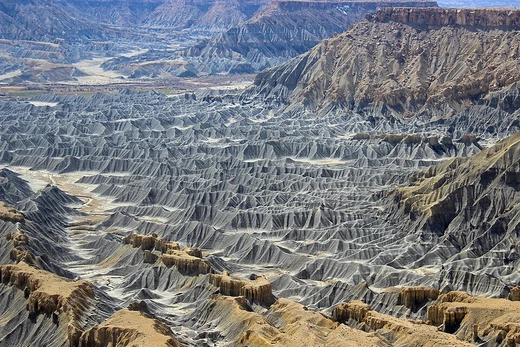
A ridge is a long, narrow, elevated geomorphologic landform or structural feature separated from surrounding terrain by steep sides. Its crest, if narrow, is called a ridgeline, and its height can range from less than a meter to hundreds of meters. Ridges can be depositional, erosional, tectonic, or a combination, and may consist of bedrock, loose sediment, lava, or ice. They occur as isolated features or as part of larger geomorphological or structural features, and can be subdivided into smaller elements.
- Classification system
- Schoeneberger and Wysocki (used by USA National Cooperative Soil Survey Program)
- Major groups
- Geomorphic Environments and Other Groupings (16 subgroups)
- Subgroups including ridges
- Aeolian, Coastal Marine and Estuarine, Lacustrine, Glacial, Volcanic and Hydrothermal, Tectonic and Structural, Slope, Erosional
- Height range
- Less than 1 meter to hundreds of meters
- Origin types
- Depositional, erosional, tectonic, or combination
- Composition possibilities
- Bedrock, loose sediment, lava, or ice
Lore & Background
Ridges are defined by their narrow top and steep sides, with no fixed dimensional limits. They can be formed by wind (aeolian dune ridges), waves and currents (beach ridges), differential erosion (strike ridges, dendritic ridges), glacial activity (moraines, eskers, arêtes), tectonic spreading (oceanic spreading ridges), volcanic processes (pressure ridges, crater rims, subglacial tindars), or asteroid impacts (impact crater rims). A shutter ridge is a ridge displaced along a fault that blocks or diverts drainage.
Reader's Guide
Ridges are fundamental landforms in geomorphology, appearing across diverse environments from deserts to coastlines, glacial terrains, and volcanic regions. Their classification remains without universal agreement, but systems like that of Schoeneberger and Wysocki group them by dominant geomorphic process or setting into 16 subgroups, with ridges appearing in eight of them. This flexibility reflects the variety of ridge origins—depositional, erosional, tectonic, or combined—and their composition, which can include bedrock, sediment, lava, or ice. Ridges serve as key indicators of geological processes: strike ridges reveal tilted rock layers and differential erosion; oceanic spreading ridges mark tectonic plate boundaries; and pressure ridges in ice or lava document deformation under compression. Their study aids in understanding landscape evolution, natural hazards, and resource distribution, though no single classification is universally accepted.
Did You Know?
- A ridge can be less than a meter or hundreds of meters high above surrounding terrain.
- Ridges can consist of bedrock, loose sediment, lava, or ice depending on origin.
- A strike ridge has a gentle dip slope and a steep scarp slope, formed by differential erosion of dipping rock layers.
- Ice pressure ridges form when ice floes collide and compress their edges, averaging 5 to 30 meters in height.
More in Geomorphology 1-24
Spotted an error? Know more?
Reader corrections go straight into our review queue. Suggest an edit · How this site is sourced