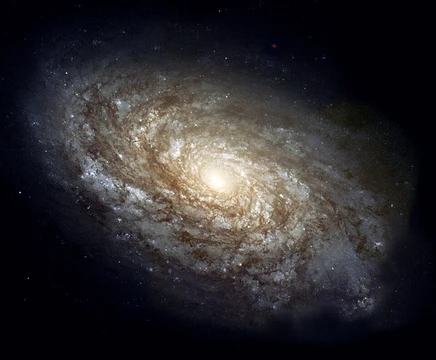
Small Magellanic Cloud
A dwarf irregular galaxy and naked-eye object near the Milky Way.

The Small Magellanic Cloud (SMC) is a dwarf irregular galaxy near the Milky Way, classified as a dwarf irregular galaxy. It is among the nearest intergalactic neighbors of the Milky Way and is one of the most distant objects visible to the naked eye. The SMC forms a pair with the Large Magellanic Cloud (LMC) and is a member of the Local Group.
Quick Facts
- Epoch
- J2000
- Ra
- 00 · 52 · 44.8
- Dec
- -72 · 49 · 43
- Dist Ly
- 203.7 ± 1.5 kly (62.44 ± 0.47 kpc)
- Z
- 0.000527
- Appmag V
- 2.7
- Stars
- 3 billion
- Constellation Name
- Tucana and Hydrus
- Notes
- Companion dwarf to the / Milky Way
- Names
- SMC, NGC 292, PGC 3085, Nubecula Minor
Facts from the source article.
Lore & Background
The Small Magellanic Cloud has long been included in the lore of native inhabitants of the southern hemisphere, including south sea islanders and indigenous Australians. Persian astronomer Al Sufi mentions it in his Book of Fixed Stars, repeating a quote by the polymath Ibn Qutaybah, but had not observed it himself. European sailors may have first noticed the clouds during the Middle Ages when they were used for navigation. Portuguese and Dutch sailors called them the Cape Clouds. During Ferdinand Magellan's circumnavigation, Antonio Pigafetta described them as dim clusters of stars. In Johann Bayer's Uranometria (1603), he named the smaller cloud Nubecula Minor.
Between 1834 and 1838, John Frederick William Herschel observed the Nubecula Minor with his 14-inch reflector, describing it as a cloudy mass of light with an oval shape and a bright center, cataloguing 37 nebulae and clusters within it. In 1891, the Harvard College Observatory opened an observing station at Arequipa, Peru, and between 1893 and 1906 the 24-inch telescope there was used to survey both Magellanic Clouds photographically. Henrietta Swan Leavitt used the plates to study variable stars in the SMC, and in 1908 published results showing a relationship between the variability period and apparent brightness for Cepheid variables, establishing the period-luminosity relation. In 1913, Ejnar Hertzsprung used this relation to estimate the distance to the SMC as 10,000 parsecs (30,000 light years), later found to be a gross underestimate.
The SMC contains a central bar structure and is thought to have once been a barred spiral galaxy disrupted by the Milky Way. A bridge of gas connects it to the LMC, evidence of tidal interaction, and the two galaxies share a common envelope of neutral hydrogen. In 2017, a stellar over-density associated with the SMC was discovered, probably resulting from interactions with the LMC. The SMC is currently a satellite of the Milky Way but is likely a former satellite of the LMC.
Reader's Guide
The Small Magellanic Cloud holds a significant place in astronomy due to its role in establishing the period-luminosity relation for Cepheid variables. Henrietta Swan Leavitt's 1908 study of variable stars in the SMC revealed a definite relationship between variability period and apparent brightness, which, because all stars in the SMC are at roughly the same distance, implied a similar relation between period and absolute brightness. This allowed Cepheid variables to be used as standard candles for measuring cosmic distances, leading to many astronomical discoveries. Ejnar Hertzsprung's 1913 distance estimate, though inaccurate, demonstrated the technique's potential.
The SMC also contains a large and active population of X-ray binaries, particularly high-mass X-ray binaries (HMXBs) of the Be type, which account for 98% of HMXBs in the SMC. Monitoring surveys with NASA's Rossi X-ray Timing Explorer (RXTE) have counted 50 X-ray pulsars in outburst by the end of 2008. Recent studies with XMM-Newton and Chandra have cataloged several hundred X-ray sources in the direction of the SMC, about half considered likely HMXBs. The SMC X-1 source was detected by Uhuru in 1971. The galaxy's X-ray population provides insights into binary evolution and neutron star accretion processes.
Did You Know?
- The Small Magellanic Cloud has a D25 isophotal diameter of about 5.78 kiloparsecs (18,900 light-years).
- Henrietta Swan Leavitt discovered the period-luminosity relation for Cepheid variables using photographic plates of the SMC.
- In 2023, it was reported that the SMC is actually two separate structures with distinct chemical compositions, separated by about 5 kiloparsecs.
More in Elliptical and Irregular Galaxies, Part 5 1-24
Spotted an error? Know more?
Reader corrections go straight into our review queue. Suggest an edit · How this site is sourced