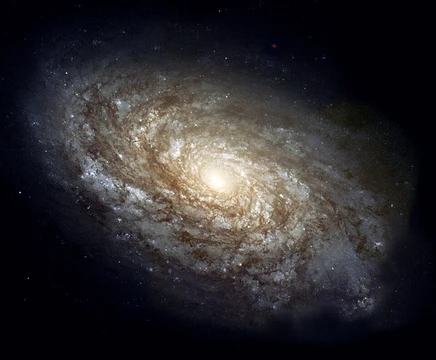
NGC 5982
Elliptical galaxy with shells and a decoupled nucleus from a merger.

NGC 5982 is an elliptical galaxy located in the constellation Draco, approximately 130 million light-years from Earth. It is notable for its kinematically decoupled nucleus, extensive system of shells, and membership in the NGC 5982 group, which includes the Draco Trio.
Quick Facts
- Epoch
- J2000
- Ra
- 15 · 38 · 39.8
- Dec
- +59 · 21 · 21
- Dist Ly
- 123 ± 34 Mly (37.6 ± 10.5 Mpc)
- Z
- 0.010064 ± 0.000031
- H Radial V
- 3,017 ± 9 km/s
- Appmag V
- 11.0
- Constellation Name
- Draco
- Names
- UGC 9961, CGCG 297-024, MCG +10-22-029, PGC 55674
Facts from the source article.
Lore & Background
NGC 5982 was discovered by William Herschel on May 25, 1788. It features a kinematically decoupled nucleus, where the major axis is nearly perpendicular to the galaxy's rotation. The galaxy contains about 26 shells in its envelope, forming circular arcs; the outermost shell lies at a radius of 150 arcseconds along the major axis, while the innermost is 8 arcseconds from the nucleus. These shells and the decoupled nucleus are the result of a merger with a small elliptical galaxy.
The galaxy hosts two populations of globular clusters—red and blue—both with ages exceeding 5 billion years. Its luminosity is dominated by light from old stars. At its center lies a supermassive black hole with an estimated mass of 8.3×10^8 M☉, based on the M–sigma relation. The nucleus may display low-level activity and has been categorized as a possible LINER.
NGC 5982 belongs to the NGC 5982 group, which also includes NGC 5976, NGC 5981, NGC 5985, NGC 5987, and NGC 5989. NGC 5981 (an edge-on spiral) lies 6.3 arcminutes away, and NGC 5985 (a face-on spiral) lies 7.7 arcminutes away. These three galaxies are known as the Draco Trio or Draco Group, though there is no evidence they form a compact group.
Reader's Guide
NGC 5982 is significant as a nearby elliptical galaxy that preserves clear evidence of a past merger with a smaller elliptical galaxy. Its 26 concentric shells and kinematically decoupled nucleus provide direct observational clues to the merger process, which is a key mechanism in galaxy evolution. The presence of two globular cluster populations (red and blue) with ages over 5 billion years indicates a complex star formation history, while the dominance of old stars suggests that the merger did not trigger substantial new star formation. The supermassive black hole at its center, with mass estimated via the M–sigma relation, and the possible low-level LINER activity place NGC 5982 in the context of active galactic nuclei studies. As part of the NGC 5982 group and the Draco Trio, it offers a laboratory for studying galaxy interactions and group dynamics, even though the trio is not a compact group. Its legacy lies in illustrating how elliptical galaxies can form and evolve through hierarchical merging, with observable features that persist for billions of years.
Did You Know?
- NGC 5982 has a kinematically decoupled nucleus whose major axis is nearly perpendicular to the galaxy's rotation.
- The galaxy contains about 26 shells in its envelope, formed from a merger with a small elliptical galaxy.
- NGC 5982 is part of the Draco Trio along with NGC 5981 and NGC 5985, though there is no evidence they form a compact group.
Frequently Asked Questions
What is NGC 5982?
NGC 5982 is an elliptical galaxy situated in the northern constellation Draco, roughly 130 million light-years from Earth. It stretches about 100,000 light-years across and harbors a supermassive black hole with a mass near 830 million solar masses.
What makes NGC 5982's core unusual?
Its nucleus is kinematically decoupled, meaning the central stars spin on an axis that is misaligned with the rotation of the outer galaxy. This odd behavior, along with the galaxy's extensive shell system, is widely interpreted as a fossil record of a major merger in its past.
What is the Draco Trio and how does NGC 5982 fit in?
The Draco Trio is a small gravitationally bound collection of galaxies in the constellation Draco, and NGC 5982 serves as a prominent member of the broader NGC 5982 group that encompasses the trio. The group's members share a common local environment and are often studied together.
Who discovered NGC 5982 and when?
William Herschel first catalogued NGC 5982 on May 25, 1788, during his extensive surveys of the northern sky. Nearly two and a half centuries later, modern observations have revealed its shell structures and decoupled core, making it a far more interesting object than its original entry suggests.
How does NGC 5982 compare in size to the Milky Way?
At roughly 100,000 light-years in diameter, NGC 5982 is comparable in overall scale to our own galaxy. However, its smooth elliptical profile means it has no disk, spiral arms, or prominent star-forming regions like the Milky Way.
More in Elliptical and Irregular Galaxies, Part 5 1-24
Spotted an error? Know more?
Reader corrections go straight into our review queue. Suggest an edit · How this site is sourced