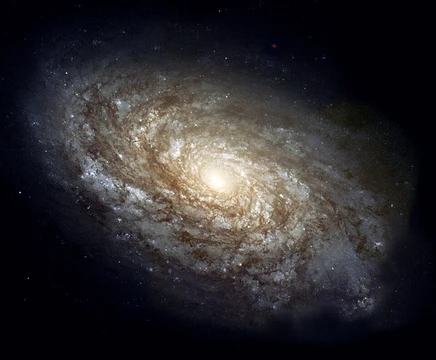
NGC 1602
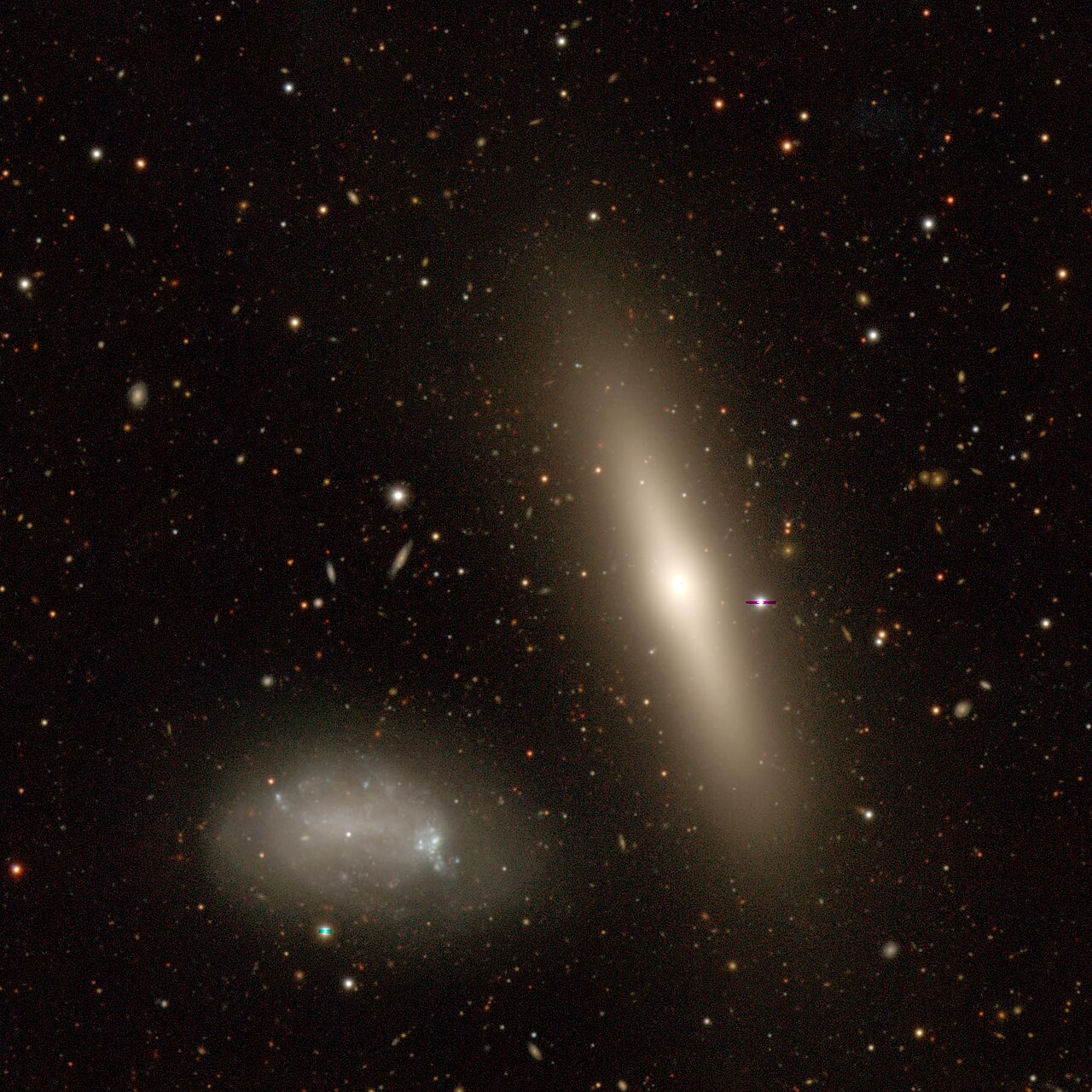
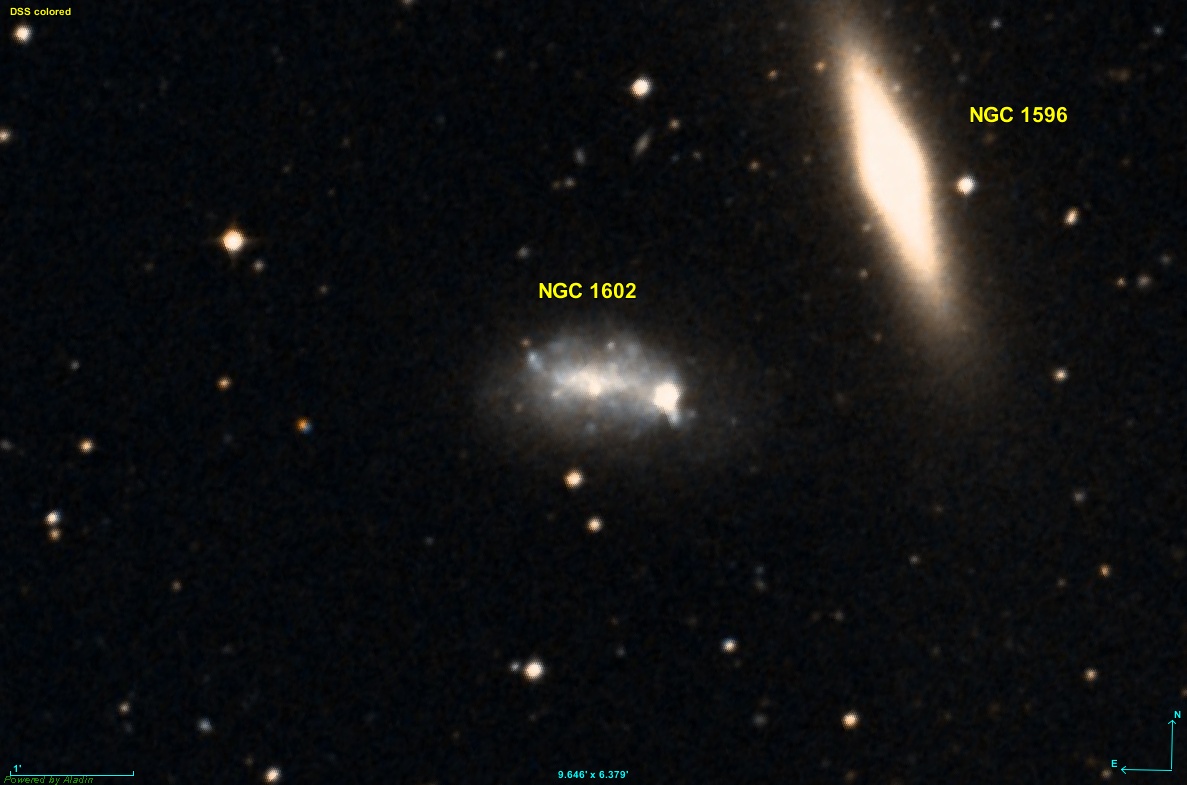
Barred irregular galaxy in Dorado interacting with NGC 1596.

Legacy Surveys / D.Lang (Perimeter Institute) & Meli thev · CC BY-SA 4.0
NGC 1602 is a barred irregular galaxy in the constellation Dorado, located approximately 65 million light years from Earth. It is a member of the Dorado Group and spans about 50,000 light years across. The galaxy is notable for its classification as a magellanic spiral galaxy in The Carnegie Atlas of Galaxies and for its clear signs of interaction with the nearby galaxy NGC 1596.
Quick Facts
- Epoch
- J2000
- Ra
- 04 · 27 · 54.9
- Dec
- -55 · 03 · 28
- Dist Ly
- 66.2 ± 4.2 Mly (20.3 ± 1.3 Mpc)
- Z
- 0.005230 ± 0.000027
- H Radial V
- 1,568 ± 8 km/s
- Appmag V
- 12.9
- Constellation Name
- Dorado
- Group Cluster
- Dorado Group
- Notes
- Interacting with NGC 1596
- Names
- ESO 157-32, AM 0426-550, IRAS04267-5510, PGC 15168
Facts from the source article.
Lore & Background
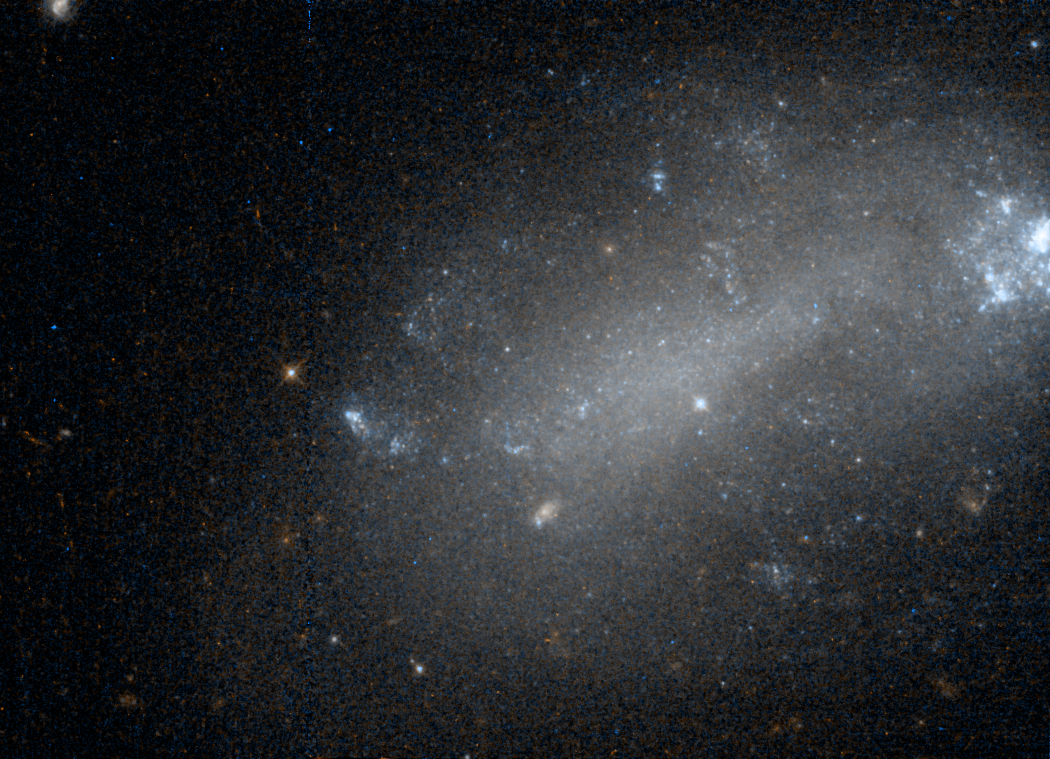
NGC 1602 was discovered by John Herschel on December 5, 1834. It has been categorised as a magellanic spiral galaxy in The Carnegie Atlas of Galaxies. The galaxy features many knots that correspond to bright HII regions, and its shape in ultraviolet appears as irregular as the optical one. In radiowaves, NGC 1602 appears distorted, with its halo extending to and nearly overlapping with nearby NGC 1596; the separation of the two galaxies is 3 arcminutes. In H-alpha + [N II] a ring and a large complex of HII regions are visible west of the nucleus. The hydrogen morphology and kinematics are regular within the stellar disk.
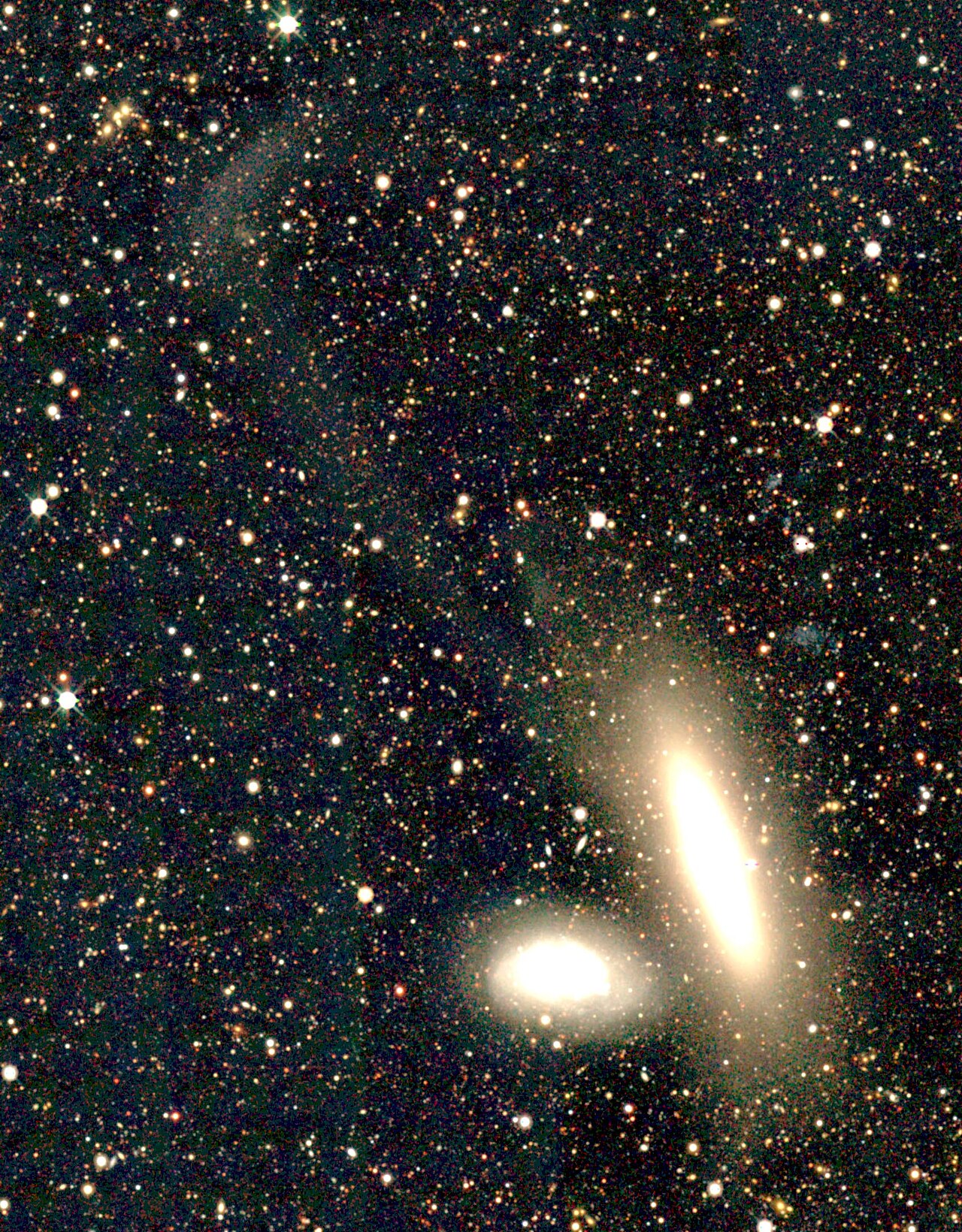
NGC 1602 is surrounded by an extended hydrogen envelope measuring 11.9 by 13.4 arcminutes across as imaged in the hydrogen line, with an estimated total mass of (2.5±0.1)×10⁹ M☉. Hydrogen imaging reveals two tidal tails, one to the north north-west and the other to the north north-east of NGC 1602, indicative of interaction with NGC 1596. The interaction started less than one billion years ago, and NGC 1596 has accreted some of the hydrogen.
Reader's Guide
NGC 1602 is significant as a barred irregular galaxy that exhibits clear morphological and kinematic evidence of a recent tidal interaction with its neighbor NGC 1596. Its classification as a magellanic spiral in The Carnegie Atlas of Galaxies highlights its transitional nature between irregular and spiral types. The galaxy's bright HII regions and ring-like structure in H-alpha + [N II] provide insight into ongoing star formation triggered by the interaction. The extended hydrogen envelope and two tidal tails, imaged in the hydrogen line, directly trace the gravitational disturbance that began less than one billion years ago. The fact that NGC 1596 has accreted some of this hydrogen underscores the material exchange between the pair. The regular hydrogen kinematics within the stellar disk, despite the external distortion, suggest that the internal dynamics of NGC 1602 remain largely intact. Its membership in the Dorado Group places it within a larger environment of interacting galaxies, making it a useful case study for understanding how minor mergers and tidal encounters affect gas distribution and star formation in irregular systems.
Did You Know?
- It has two tidal tails, one to the north north-west and one to the north north-east, indicating interaction with NGC 1596.
- The interaction with NGC 1596 started less than one billion years ago.
The Myth of the Sacrificed Tresses
The story behind Coma Berenices reaches back to the Ptolemaic court of Egypt, where Queen Berenice II made a solemn vow during the Third Syrian War. If her husband, Ptolemy III Euergetes, returned safely from battle, she would sacrifice her long hair as a votive offering to the gods. Modern scholars debate the exact timing—whether the act occurred before or after his return—but the prevailing view places it around 245 BC, after Ptolemy's safe homecoming. The court astronomer Conon of Samos, working alongside the poet Callimachus, presented the new asterism to the public during an evening ceremony. In Callimachus' collection Aetia, Berenice dedicated her tresses to all the gods, while other sources, including Catullus' Latin rendering and Hyginus' De Astronomica, name Aphrodite specifically, with the hair placed in the temple of Arsinoe II at Zephyrium. By the following morning, the tresses had vanished. Conon interpreted this as Aphrodite's acknowledgment, lifting the hair into the heavens. To this day, Coma Berenices remains the sole modern constellation bearing the name of a real historical individual.
A Treasury of Deep-Sky Wonders
Beyond its mythological charm, Coma Berenices shelters a remarkable collection of deep-sky objects and stellar phenomena. The three principal stars—Alpha, Beta, and Gamma—arrange themselves into a half-square pattern, with the luminous Coma Star Cluster tracing the diagonal as Berenice's flowing tresses. Beta Comae Berenices, the constellation's brightest member, is a 4.2-magnitude main-sequence star closely resembling our own Sun. The region also contains the North Galactic Pole and hosts the Coma Cluster, one of the richest galaxy groupings known, embedded within the larger Coma Supercluster. Among its residents, galaxy Malin 1 holds the distinction of being the first identified giant low-surface-brightness galaxy. Supernova SN 1940B marked a milestone as the first type II supernova caught mid-eruption by scientific observation. FK Comae Berenices gave its name to an entire class of variable stars. Even the meteor sky is affected: the Coma Berenicids shower, radiating from this region, produces some of the fastest meteors recorded, streaking at speeds reaching 65 kilometres per second.
From Ancient Asterism to Modern Constellation
Although the asterism was recognized as early as the Hellenistic period, its formal entry into Western celestial cartography was a gradual process spanning centuries. Conon of Samos introduced it in the third century BC, and both Hipparchus and Geminus acknowledged it as a distinct grouping. Yet Eratosthenes subsumed it under Leo, calling it Berenice's Hair or Ariadne's Hair, and Ptolemy's Almagest likewise excluded it from his canonical forty-eight constellations, referring to it merely as Plokamos. The turning point came in the sixteenth century. Johannes Schöner's 1515 gores labelled the region Trica; Caspar Vopel's 1536 celestial globe and Petrus Apianus's map of the same year gave it independent status. Gerardus Mercator's 1551 globe listed five alternative names, cementing its place on Dutch sky globes from 1589 onward. Tycho Brahe's 1602 catalogue recorded fourteen stars, a count Hevelius later raised to twenty-one and Flamsteed to forty-three. Bayer's 1603 Uranometria further solidified its standing. Together with the now-obsolete Antinous, Coma Berenices became one of the first post-Ptolemaic constellations to appear on a celestial globe, signaling the end of strict reliance on ancient authorities.
Names Across Cultures and Centuries
Long before European cartographers formalized the region, diverse cultures across the globe identified and named the stars of Coma Berenices. The Akkadians knew it as Ḫegala, while Babylonian records reference a star, ḪÉ.GÁL-a-a, tentatively placed within its boundaries. Egyptian Ramesside star clocks may have depicted it as sbꜣw ꜥšꜣw, meaning many stars. In the Arabic astronomical tradition, the constellation carried several names: Al-Dafira (braid), Al-Hulba, and Al-Thu'aba (tuft), the latter two translating Ptolemy's Plokamos. Al-Sufi folded it into Leo, whereas Ulugh Beg identified Al-Dafira with just two stars, 7 and 23 Comae Berenices. The North American Pawnee people rendered the asterism as ten faint stars on a tanned elk-skin star map dating to at least the seventeenth century. In South American Kalina mythology it was called ombatapo, meaning face. Polynesian traditions were equally rich: Tongan speakers used four distinct names—Fatana-lua, Fata-olunga, Fata-lalo, and Kapakau-o-Tafahi—while the Boorong people of Australia envisioned a small flock of birds drinking rainwater from a puddle.
Gallery
Frequently Asked Questions
What is NGC 1602?
NGC 1602 is a barred irregular galaxy sitting roughly 65 million light years away in the southern sky. It stretches about 50,000 light years across and belongs to the Dorado Group of galaxies.
What type of galaxy is NGC 1602?
It is classified as a barred irregular galaxy, though The Carnegie Atlas of Galaxies gives it the more specific label of a magellanic spiral. That means it has a central bar structure but lacks the orderly, flat disk you see in a typical spiral galaxy.
Who discovered NGC 1602?
John Herschel spotted it on December 5, 1834, during his extensive southern-sky survey. His cataloguing work in the 1830s added thousands of deep-sky objects to what would become the NGC list.
What is NGC 1602's notable interaction?
NGC 1602 shows clear signs of gravitational interaction with its neighbor NGC 1596. This ongoing encounter is thought to be distorting the galaxy's structure and is a major reason it appears irregular rather than neatly spiraled.
Where can I find NGC 1602 in the sky?
It sits in the constellation Dorado, the Southern Fish, making it a target for southern-hemisphere observers. At roughly 65 million light years out, it is a challenging deep-sky object even for moderate-sized telescopes.
More in Elliptical and Irregular Galaxies, Part 5 1-24
Spotted an error? Know more?
Reader corrections go straight into our review queue. Suggest an edit · How this site is sourced