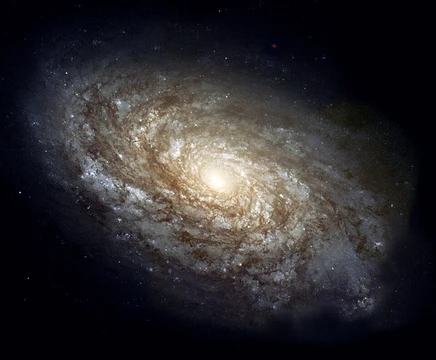
NGC 87
A diffuse irregular galaxy in Robert's Quartet.

ESO · CC BY 4.0
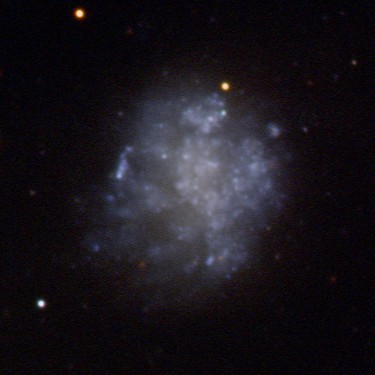
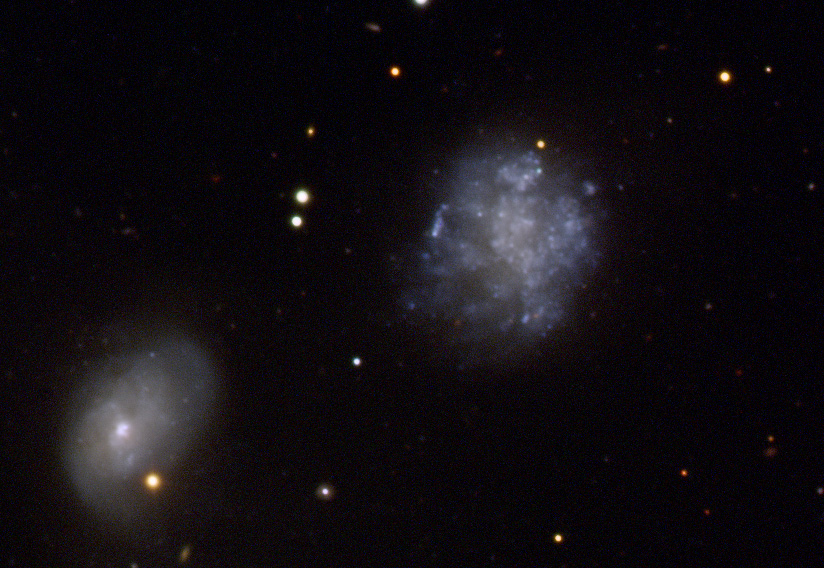
NGC 87 is a diffuse irregular galaxy in the southern constellation Phoenix, roughly 155 million light-years from Earth. It belongs to Robert's Quartet, a tight cluster of four galaxies that also includes NGC 88, NGC 89, and NGC 90. These four galaxies occupy a region about 150,000 light-years across and show clear signs of gravitational interaction.
The galaxy lacks a distinct nucleus or organized spiral structure. Its physical diameter is about 42,000 light-years—roughly 40 percent the size of the Milky Way. NGC 87 holds large amounts of cold neutral hydrogen gas and contains active H II regions. Its asymmetric shape and chaotic star-forming areas result from tidal forces exerted by its nearby companions.
Quick Facts
- Epoch
- J2000
- Ra
- 00 · 21 · 14.2133
- Dec
- -48 · 37 · 42.81
- Dist Ly
- 47.44 ± 3.36 Mpcned
- Z
- 0.011391
- H Radial V
- 3415 ± 23 km/sned
- Appmag V
- 14.1
- Constellation Name
- Phoenix
- Names
- ESO 194-G008, PGC 1357
Facts from the source article.
Lore & Background
NGC 87 was discovered on September 30, 1834, by the English astronomer John Herschel. It is classified morphologically as a diffuse irregular galaxy, displaying a lack of a distinct central nucleus or organized spiral structure. At its distance of 155 million light-years, its angular size corresponds to a physical diameter of roughly 42,000 light-years, making it about 40% the size of the Milky Way.
Unlike its spiral and lenticular companions, NGC 87 contains significant reservoirs of cold neutral hydrogen gas and active H II regions. Its asymmetric appearance and chaotic star-forming areas are driven by tidal interactions with nearby galactic companions.
The galaxy is a member of Robert's Quartet, a compact galaxy group located in Phoenix that also includes NGC 88, NGC 89, and NGC 90. The four member galaxies reside within a region spanning roughly 150,000 light-years across and exhibit active gravitational interactions.
Reader's Guide
NGC 87's significance lies in its role within Robert's Quartet, a compact group where gravitational interactions shape the evolution of its members. As a diffuse irregular galaxy, it lacks the organized structure of spiral or elliptical galaxies, instead showing chaotic star formation fueled by tidal forces. Its reservoirs of cold neutral hydrogen and active H II regions highlight ongoing star formation, contrasting with the more quiescent companions in the group. The quartet's proximity—spanning only about 150,000 light-years—makes it a valuable laboratory for studying galaxy interactions and their effects on morphology and star formation. NGC 87's relatively small size, about 40% of the Milky Way's diameter, underscores the diversity of galaxies in such groups. Its discovery by John Herschel in 1834 adds historical context to the study of southern sky objects. The galaxy's legacy is tied to understanding how tidal interactions drive irregular morphology and fuel star formation in dense environments.
Did You Know?
- NGC 87 is about 40% the size of the Milky Way, with a diameter of roughly 42,000 light-years.
- It was discovered by John Herschel on September 30, 1834.
Physical Composition & Structure
A galaxy is fundamentally a gravitationally bound physical system containing stars, planetary systems, stellar remnants, substellar objects, interstellar gas, dust, and dark matter. For any catalogued object like NGC 87, this framework means the visible light we detect represents only a small fraction of its true mass. Most of a typical galaxy's mass exists in the form of dark matter, with just a few percent of that total showing up as stars and nebulae. Supermassive black holes are a common feature found at the centers of galaxies. Galaxies range enormously in size, from dwarfs with fewer than a thousand stars all the way to supergiants hosting a hundred trillion. The average galaxy holds around 100 million stars, all orbiting the system's center of mass. The word itself derives from the Greek galaxias, meaning 'milky,' a reference to the Milky Way galaxy that contains our Solar System.
Nomenclature & Cataloguing
Millions of galaxies have been catalogued, yet only a handful carry well-known names such as Andromeda, the Magellanic Clouds, the Whirlpool, or the Sombrero. The vast majority, including NGC 87, are identified through numerical designations drawn from various catalogues. These include the Messier catalogue, the New General Catalogue (NGC), the Index Catalogue, the CGCG, the Morphological Catalogue of Galaxies, the Uppsala General Catalogue, and the PGC (also known as LEDA). A single well-known galaxy might appear under multiple numbers across different catalogues simultaneously. For instance, Messier 109 is also NGC 3992, UGC 6937, CGCG 269-023, MCG +09-20-044, and PGC 37617. Fainter objects are often known only by their identifiers in sky surveys like the Sloan Digital Sky Survey. In the astronomical literature, the capitalised word 'Galaxy' is often reserved specifically for the Milky Way to distinguish it from all other galaxies in the universe.
Historical Discovery & the 'Island Universe' Debate
When astronomers first turned telescopes toward objects like NGC 87, they identified them as spiral nebulae. Throughout the 18th and 19th centuries, most observers debated whether these were unresolved star clusters or extragalactic nebulae, with their true nature remaining a mystery. Larger telescopes eventually resolved nearby bright examples into vast conglomerations of stars, and their apparent faintness combined with sheer stellar populations suggested they lay far beyond the Milky Way. This led to the popular term 'island universes.' Harlow Shapley championed the word 'galaxy' over 'universes' and 'nebula,' but the highly influential Edwin Hubble continued using 'nebulae' until his death in 1953. The nomenclature shift was not complete until after that date. The word 'galaxy' itself was borrowed via French and Medieval Latin from the Greek term for the Milky Way, galaxias kuklos, meaning 'milky circle,' named after its appearance as a milky band of light in the sky.
Cosmic Context & the Scale of the Universe
Galaxies do not exist in isolation. They are gravitationally organized into groups, clusters, and superclusters. The Milky Way, for example, belongs to the Local Group, which it dominates alongside Andromeda, and that group is part of the Virgo Supercluster. At the largest observable scales, these associations arrange themselves into sheets and filaments surrounded by immense voids. Individual galaxies typically span 1,000 to 100,000 parsecs in diameter, roughly 3,000 to 300,000 light years, while the distances separating them run to millions of parsecs or megaparsecs. The Milky Way itself measures at least 26,800 parsecs across, and its nearest large neighbor, Andromeda, sits just over 750,000 parsecs away. The total count of galaxies in the observable universe is estimated between 200 billion and 2 trillion. While good models describe star formation from gravitational condensation of dense gas clouds, galaxy formation itself remains less well understood, operating on timescales of a billion years. Galaxies occasionally collide during their lifetimes.
Gallery
Frequently Asked Questions
What is NGC 87?
NGC 87 is a diffuse irregular galaxy with no visible central bulge or spiral arms, making it one of the more loosely structured systems in its region. It sits roughly 155 million light-years away in the southern sky constellation Phoenix.
What is Robert's Quartet and how does NGC 87 fit in?
Robert's Quartet is a tight grouping of four galaxies—NGC 87, NGC 88, NGC 89, and NGC 90—packed into a region only about 150,000 light-years across. NGC 87 is one of the four members, and all of them display clear evidence of ongoing gravitational tugging on one another.
How large is NGC 87 compared to the Milky Way?
Its physical diameter works out to around 42,000 light-years, which puts it at roughly 40 percent the span of our own galaxy. That makes it a mid-sized irregular system, neither a tiny dwarf nor a sprawling giant.
What is inside NGC 87?
The galaxy is rich in cold neutral hydrogen gas and hosts active H II regions where new stars are being born. Despite that ongoing star formation, it never settles into a disk or a defined core, keeping its amorphous, irregular appearance.
Who discovered NGC 87 and when?
John Herschel catalogued the galaxy on September 30, 1834, during his extensive southern-sky surveys. It has carried the NGC 87 designation in the New General Catalogue ever since.
More in Elliptical and Irregular Galaxies, Part 5 1-24
Spotted an error? Know more?
Reader corrections go straight into our review queue. Suggest an edit · How this site is sourced