
Canis Major Overdensity
A disputed dwarf irregular galaxy in the Local Group.

Torsten Bronger . · CC BY-SA 3.0
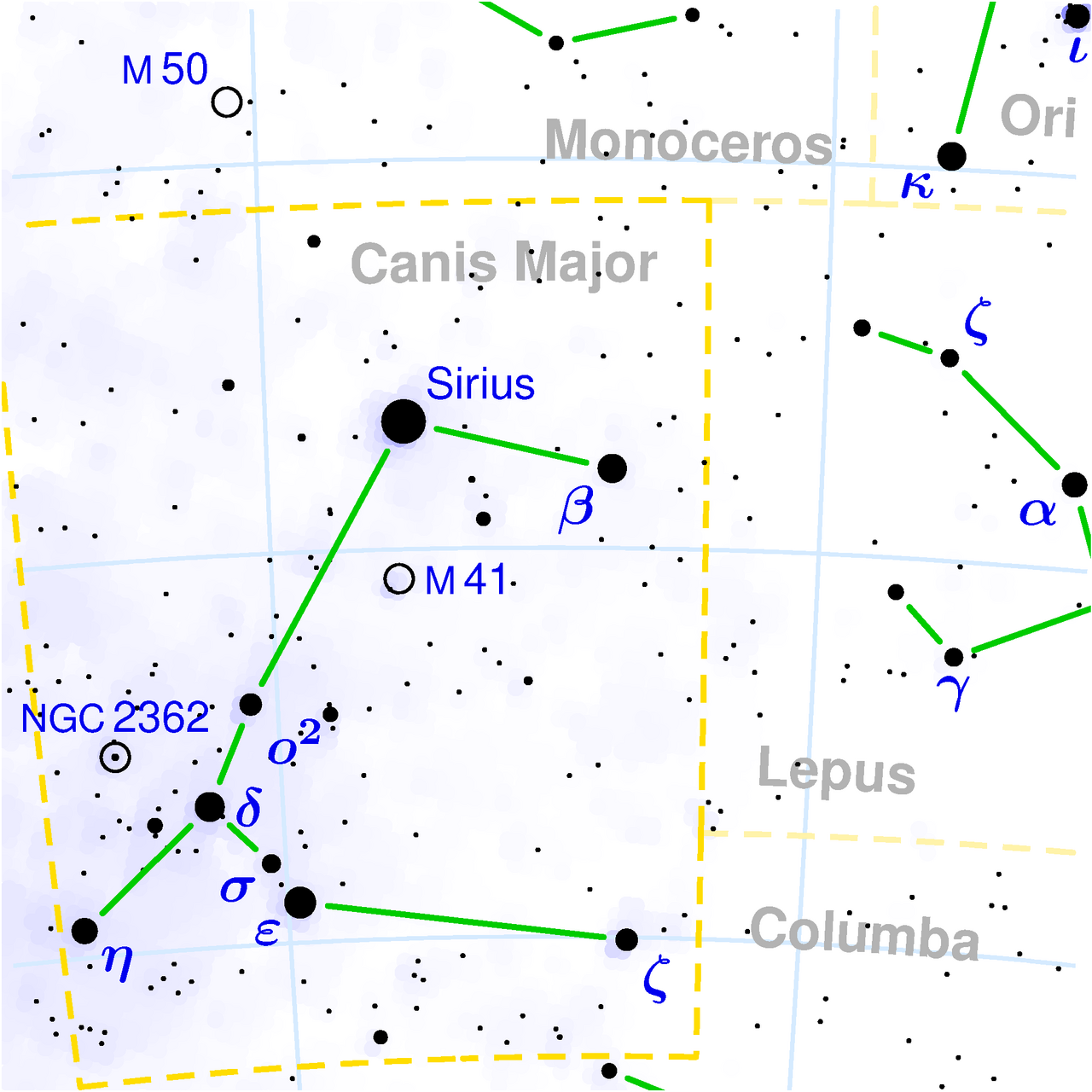
The Canis Major Overdensity (CMa Overdensity), also called the Canis Major Dwarf Galaxy (CMa Dwarf), is a disputed dwarf irregular galaxy in the Local Group, located in the same part of the sky as the constellation Canis Major. It was announced as the closest neighboring galaxy to Earth's location in the Milky Way, at about 25,000 light-years from the Solar System, though later studies disputed this conclusion. The object is notable for its roughly elliptical shape and its estimated one billion stars, including a relatively high percentage of red giants.
Quick Facts
- Epoch
- J2000
- Ra
- 07 · 12 · 35.0
- Dec
- -27 · 40 · 00
- Stars
- 1 billion
- Constellation Name
- Canis Major
- Names
- CMa Dwarf, PGC 5065047
Facts from the source article.
Lore & Background
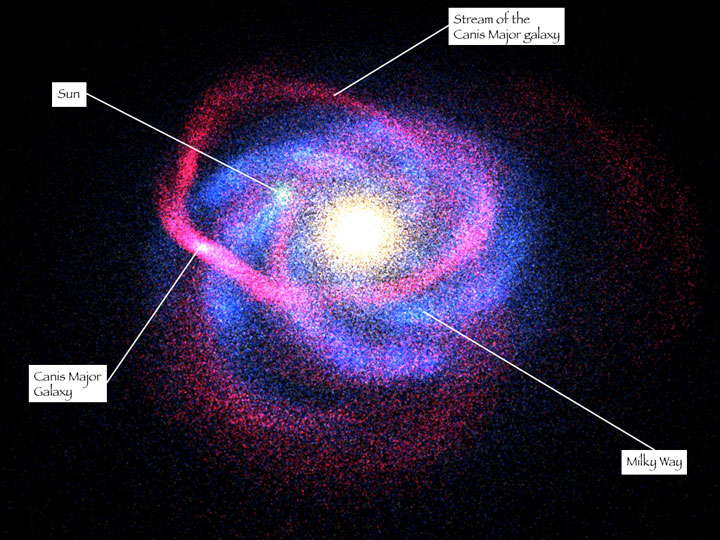
An international team of French, Italian, British, and Australian astronomers reported the existence of a strong elliptical-shaped stellar overdensity in November 2003, based on data from the Two-Micron All Sky Survey (2MASS). Using infrared light, which is not blocked by gas and dust as severely as visible light, they detected a significant overdensity of class M giant stars in the Canis Major constellation, along with several other related structures, two of which form broad, faint arcs. The main body of the CMa is extremely degraded, and some astronomers believe it is a dwarf galaxy being pulled apart by the Milky Way's gravitational field, with tidal disruption causing a filament of stars to trail behind it, forming a complex ringlike structure called the Monoceros Ring, which wraps around the Milky Way three times. The stream of stars was discovered in the early 21st century by astronomers conducting the Sloan Digital Sky Survey, and it was during the investigation of the Monoceros Ring and a closely spaced group of globular clusters that the CMa Overdensity was discovered.
Reader's Guide
The Canis Major Overdensity's significance lies in its disputed nature and its role in understanding galaxy formation and evolution. If it is a dwarf galaxy, it would have been the closest known neighbor to Earth, supporting the theory that galaxies may grow by swallowing smaller neighbors. Globular clusters thought to be associated with it include NGC 1851, NGC 1904, NGC 2298, and NGC 2808, all of which may have been part of its globular cluster system before accreting into the Milky Way. Additionally, open clusters Dolidze 25 and H18 may have formed when the dwarf galaxy perturbed material in the galactic disk, stimulating star formation. However, several studies cast doubt on its true nature, suggesting the trail of stars is part of the warped galactic thin disk and thick disk population rather than a result of collision with a dwarf spheroidal galaxy. Investigation in 2009 yielded only ten RR Lyrae variable stars, consistent with the Milky Way's halo and thick disk populations rather than a separate dwarf spheroidal galaxy. The object remains a subject of debate, with Martin et al. believing the preponderance of evidence points to the accretion of a small satellite galaxy orbiting roughly in the plane of the galactic disk.
Did You Know?
- The Canis Major Overdensity was discovered using infrared data from the Two-Micron All Sky Survey (2MASS).
- It is thought to contain as many stars as the Sagittarius Dwarf Elliptical Galaxy, the previous contender for closest galaxy to Earth.
- The Monoceros Ring, associated with the overdensity, wraps around the Milky Way three times.
- British science fiction writer Stephen Baxter included the Canis Major Overdensity in his 2004 novella Mayflower II.
Discovery Through Infrared Eyes
In November 2003, a multinational group of astronomers from France, Italy, Britain, and Australia announced the detection of a prominent elliptical stellar overdensity in the sky region of the constellation Canis Major. Their work was built on infrared data from the Two-Micron All Sky Survey (2MASS), which penetrates interstellar gas and dust far more effectively than visible-light observations. This advantage allowed the team to identify a striking concentration of class M giant stars, along with several associated structures of the same stellar type, two of which trace broad, faint arcs across the sky. The group interpreted this pattern as evidence of a previously unknown dwarf galaxy sitting roughly 7.7 kiloparsecs (about 25,000 light-years) from the Sun—closer than the Milky Way's own center. At the time of the announcement, the object was classified as an irregular galaxy and was hailed as the nearest known galactic neighbor to Earth, a distinction that would later be challenged by subsequent research.
Shredding by the Milky Way's Gravity
Many researchers view the CMa overdensity as a dwarf galaxy in the act of being shredded by the Milky Way's gravitational pull. Its main body appears severely degraded, and tidal forces have stretched a trailing filament of stars into a vast, ringlike structure that wraps around our galaxy roughly three times. This feature, often called the Monoceros Ring, was identified in the early 21st century by astronomers working with the Sloan Digital Sky Survey. It draws a natural parallel to the Virgo Stellar Stream, believed to be material torn from the Sagittarius Dwarf Spheroidal Galaxy. The CMa itself was actually found while investigators were studying the Monoceros Ring and a tight grouping of globular clusters resembling those linked to the Sagittarius system. Four globular clusters—NGC 1851, NGC 1904, NGC 2298, and NGC 2808—are thought to have once belonged to the dwarf's own cluster system before being absorbed. Two open clusters, Dolidze 25 and H18, may have been triggered into formation when the passing dwarf perturbed gas in the galactic disk.
A Galaxy or Just Disk Substructure?
Despite the initial excitement, the CMa's identity as a distinct galaxy has never been universally accepted. Multiple follow-up studies have raised serious questions about whether the overdensity truly represents a separate stellar system. One line of research argues that the trailing stream of stars is simply part of the Milky Way's own warped thin and thick disk populations, rather than debris from a colliding dwarf spheroidal. A 2009 investigation of the region found only ten RR Lyrae variable stars, a count that aligns with expectations for the Milky Way's halo and thick disk rather than with a self-contained dwarf galaxy. These findings have led some astronomers to prefer the term "overdensity" over "dwarf galaxy," and the object's status as the closest galactic neighbor to Earth—once a headline claim—has been effectively overturned. The debate underscores how difficult it is to distinguish a disrupted satellite from the complex substructure of the Milky Way's disk and halo.
A Window into How Galaxies Grow
The CMa case has become a touchstone in the broader discussion of how galaxies grow. The pattern of a small, degraded stellar body trailing a long stream of stars through the Milky Way's disk fits neatly into the accretion model, in which larger galaxies steadily absorb smaller neighbors. Martin and colleagues have argued that the weight of evidence points to the CMa being a small satellite that once orbited roughly in the plane of the galactic disk before being consumed. The presence of globular clusters that appear to have been stripped from the dwarf, together with open clusters possibly ignited by its gravitational perturbation of disk material, paints a picture of a slow, destructive merger in progress. If the accretion interpretation holds, the CMa provides a rare, nearby snapshot of the very process by which the Milky Way has built up its mass over billions of years, swallowing one small companion after another.
Gallery
Frequently Asked Questions
What is the Canis Major Overdensity?
It is a contested dwarf irregular galaxy in the Local Group, visible in the sky region of the constellation Canis Major. It first drew attention when researchers proposed it as the nearest galactic neighbor to the Solar System.
How far is the Canis Major Overdensity from Earth?
It lies approximately 25,000 light-years (roughly 7.7 kiloparsecs) from the Solar System, on the opposite side of the Milky Way's disk from the Galactic Center, which sits about 42,000 light-years away.
What does the Canis Major Overdensity look like?
The object has a roughly elliptical outline and is estimated to hold around one billion stars. A relatively high fraction of those stars are red giants, distinguishing its population from many other nearby stellar groups.
Why is the Canis Major Overdensity's status disputed?
Astronomers have debated whether it is a true separate dwarf galaxy or simply an overdensity of stars belonging to the Milky Way's own disk. Subsequent studies have challenged the original claim that it is the closest neighboring galaxy to the Sun.
Why does the Canis Major Overdensity matter to fans of galaxy astronomy?
If confirmed as a genuine satellite, it would be the closest known dwarf galaxy to the Sun, offering a rare chance to observe the tidal stripping and eventual absorption of a small galaxy by a larger one. Its elevated red-giant fraction also provides useful clues about the age and evolution of its stellar population.
More in Elliptical and Irregular Galaxies, Part 5 1-24
Spotted an error? Know more?
Reader corrections go straight into our review queue. Suggest an edit · How this site is sourced