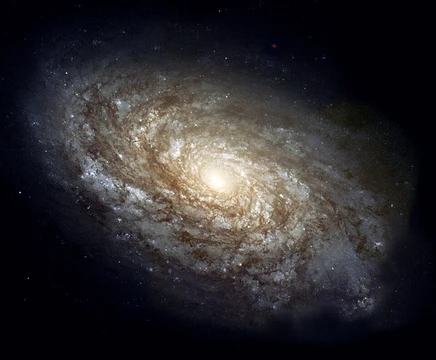
NGC 3396
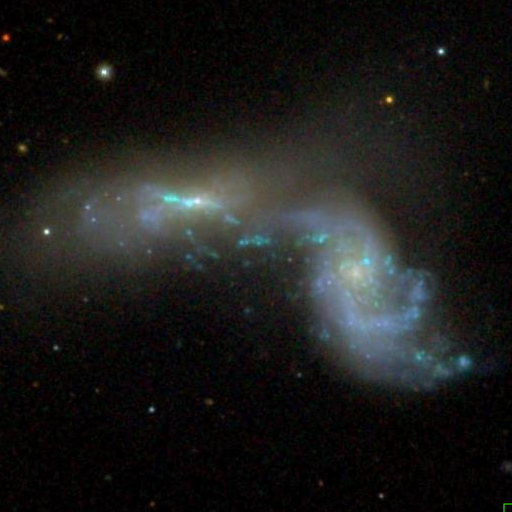
A barred irregular galaxy interacting with spiral NGC 3395.

Sloan Digital Sky Survey · CC BY 4.0
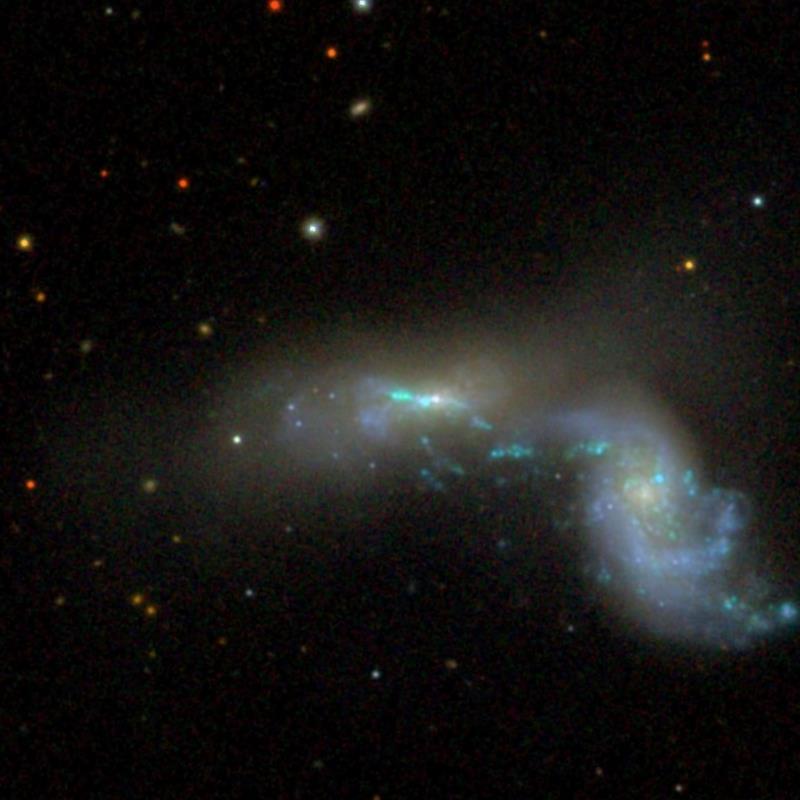
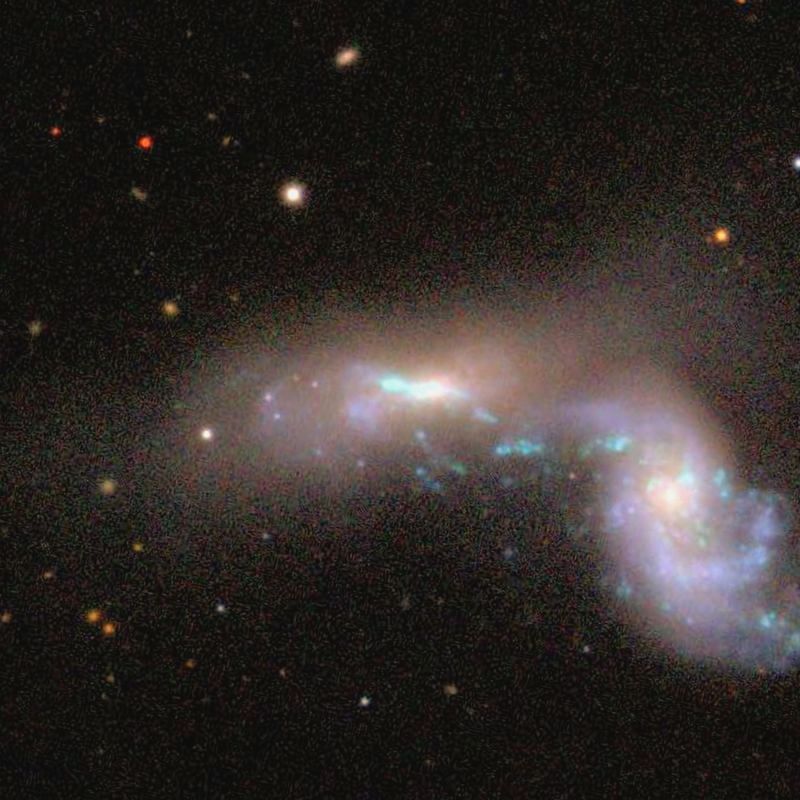
NGC 3396 is a peculiar barred irregular galaxy located in the constellation Leo Minor, approximately 80 million light years from Earth. It is notable for its interaction with the spiral galaxy NGC 3395, forming a closely bound pair that exhibits tidal features and ongoing starburst activity.
Quick Facts
- Epoch
- J2000
- Ra
- 10 · 49 · 55.1
- Dec
- +32 · 59 · 27
- Dist Ly
- 81 ± 23 Mly (24.9 ± 4.4 Mpc)
- Z
- 0.005537 ± 0.000002
- H Radial V
- 1,660 ± 1 km/s
- Appmag V
- 12.0
- Constellation Name
- Leo Minor
- Notes
- Interacting galaxy
- Names
- UGC 5935, Arp 270, VV 246b, MCG +06-24-018, PGC 32434
Facts from the source article.
Lore & Background
NGC 3396 was discovered by William Herschel on December 7, 1785. It lies about 80 million light years away and spans roughly 85,000 light years across. The galaxy forms an interacting pair with NGC 3395, a spiral galaxy located 1.5 arcminutes away. The mass ratio of the two galaxies is about 1.5 to 1, with NGC 3395 being the more massive. Although they appear separate, a bridge of material connects them, and tidal tails are observed. Dynamical modeling suggests the pair had a first close encounter in the past, which stripped gas from NGC 3395 and formed a tidal tail to the southeast. A second close encounter occurred about 50 million years ago, triggering starburst activity. The two galaxies are expected to merge within the next 500 million years.
The galaxy hosts numerous HII regions that are actively forming stars, with the most intense star formation occurring in its center. The average size of the star-forming knots in NGC 3396 is an order of magnitude larger than those in NGC 3395. The central region is estimated to contain 1,000 to 2,000 Wolf-Rayet stars and tens of thousands of O-type stars. The star formation rate in the circumnuclear region is 0.15 M☉ per year, while the rest of the galaxy forms stars at a rate of 0.39 M☉ per year. The nucleus is active and has been classified as a LINER. Kinematic analysis of the gas reveals inflow toward the center along the bar and a biconal outflow component, possibly a galactic wind from a supermassive black hole in the nucleus.
Reader's Guide
NGC 3396 is significant as a member of an interacting galaxy pair that provides a clear example of tidal interactions and induced starbursts. The system's dynamical history, including two close encounters and an eventual merger, offers insights into the processes that drive galaxy evolution. The presence of a LINER nucleus and evidence for gas inflow and outflow suggest an active central engine, likely a supermassive black hole, influencing the galaxy's evolution. The pair is part of the NGC 3430 Group (LGG 218), which includes NGC 3381, NGC 3424, NGC 3430, NGC 3442, and IC 2604. This group belongs to the Leo II groups, which are part of the Virgo Supercluster. The galaxy's high star formation rate and large Wolf-Rayet population make it a valuable laboratory for studying massive star formation and feedback in an interacting system.
Did You Know?
- NGC 3396 forms an interacting pair with the spiral galaxy NGC 3395, located 1.5 arcminutes away.
- The galaxy's central region hosts an estimated 1,000 to 2,000 Wolf-Rayet stars.
- A second close encounter with NGC 3395 about 50 million years ago triggered starburst activity.
- The nucleus of NGC 3396 is classified as a LINER and shows evidence of a biconal outflow.
Gallery
Frequently Asked Questions
What is NGC 3396?
NGC 3396 is a peculiar barred irregular galaxy sitting in the constellation Leo Minor, roughly 80 million light-years away from us. Unlike a tidy spiral or smooth elliptical, it has a bar structure but lacks a clean disk, giving it a lopsided, chaotic appearance.
What makes NGC 3396 stand out among other galaxies?
Its close gravitational partnership with the spiral galaxy NGC 3395 is the headline feature, producing visible tidal distortions and triggering intense bursts of new star formation. This tightly bound pair makes it a favorite target for astronomers studying galactic interactions.
How does NGC 3396 compare in size and mass to its neighbor NGC 3395?
NGC 3396 spans about 85,000 light-years across, yet its companion NGC 3395 carries roughly 1.5 times the mass of NGC 3396. Despite being the lighter member of the pair, NGC 3396's irregular shape and starburst activity make it the more visually dramatic of the two.
Who first spotted NGC 3396 and when?
William Herschel recorded the galaxy on December 7, 1785, during his sweeping surveys of the night sky. That makes it over two centuries old as a catalogued object, long before modern imaging revealed its ongoing interaction with NGC 3395.
Why do astronomers care about the NGC 3395–NGC 3396 pair?
The pair offers a real-time laboratory for watching how gravitational tugs between two galaxies reshape their structures and ignite star formation. Because they are still in the early-to-mid stages of their dance, they help researchers model what will eventually happen when galaxies fully merge.
More in Elliptical and Irregular Galaxies, Part 5 1-24
Spotted an error? Know more?
Reader corrections go straight into our review queue. Suggest an edit · How this site is sourced