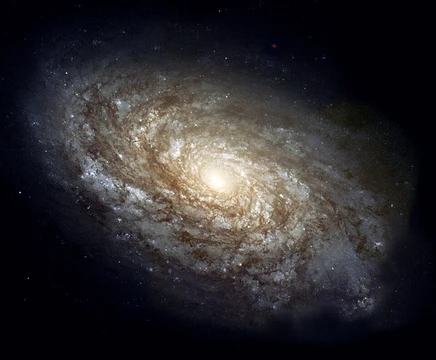
IC 1613
Irregular dwarf galaxy key to Cepheid calibration and distance accuracy.

Internet Archive Book Images · No restrictions
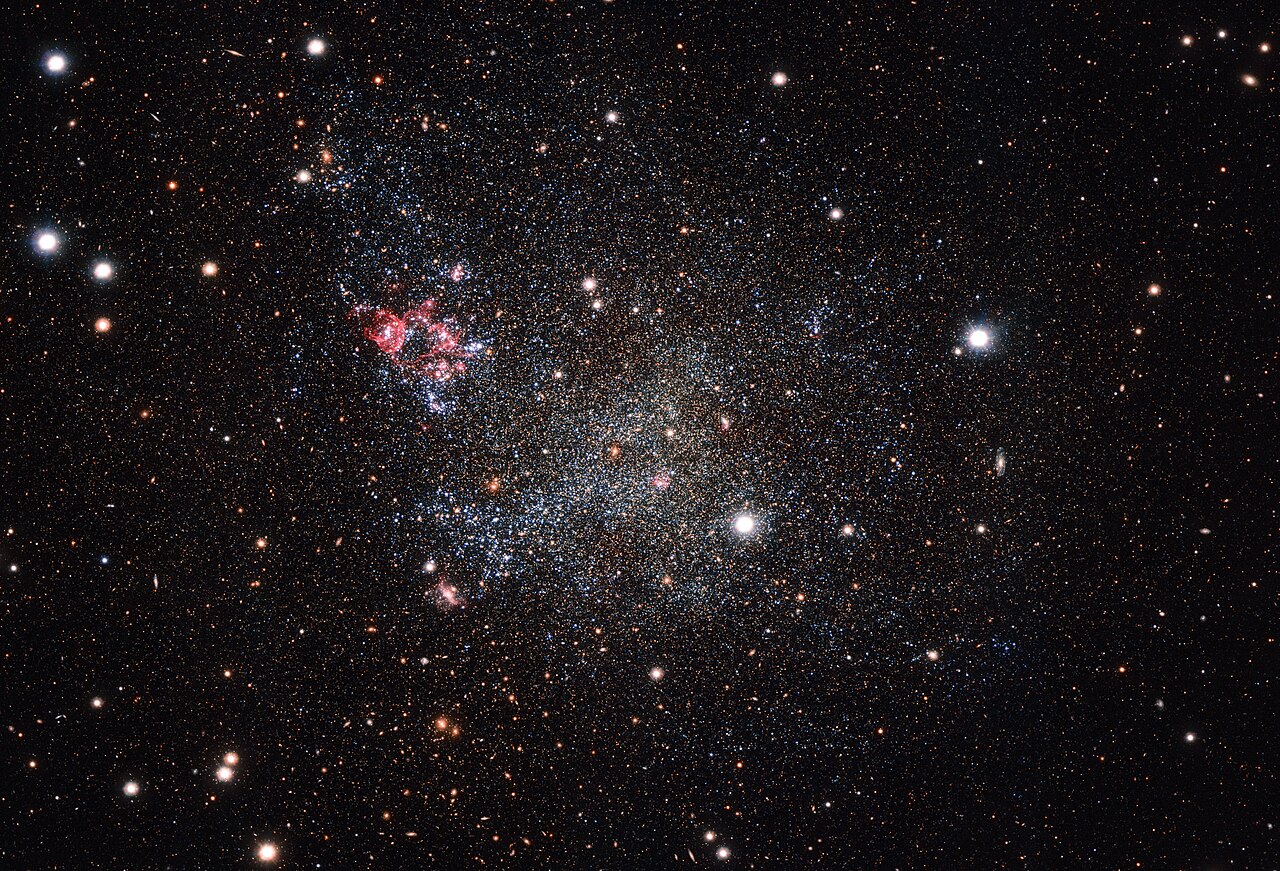
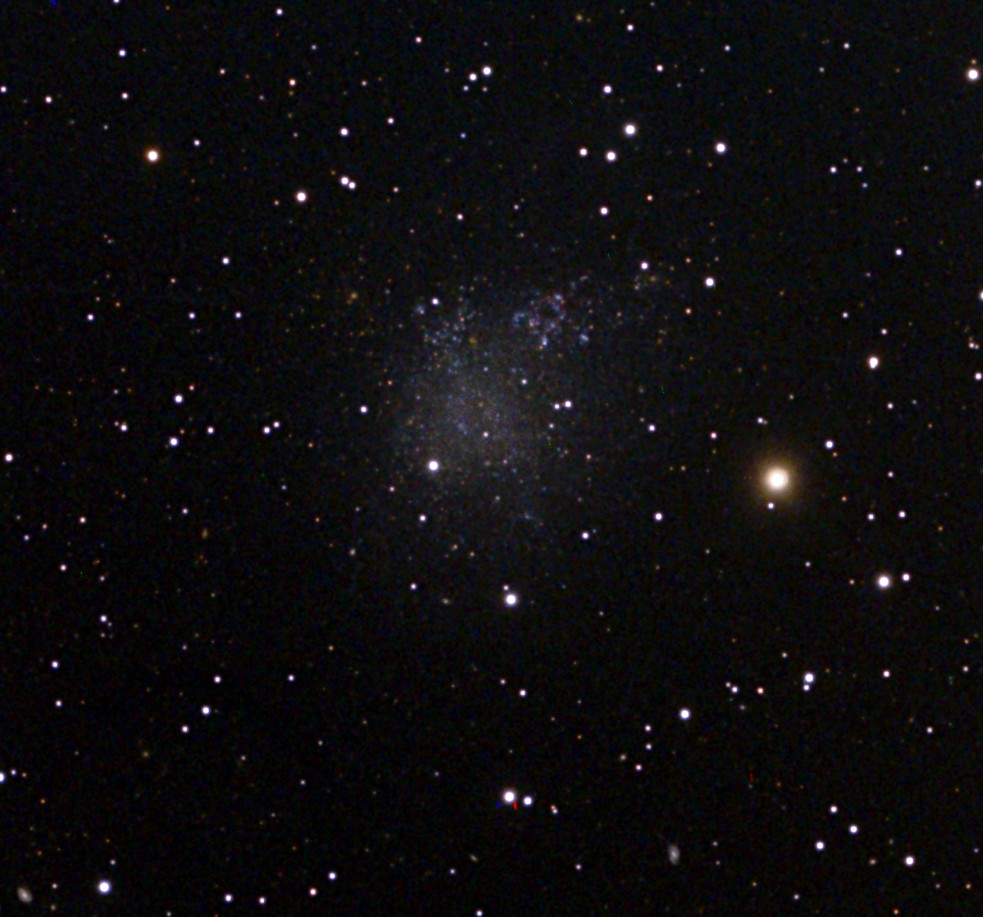
IC 1613 (Caldwell 51) is an irregular dwarf galaxy on the outskirts of the Local Group, located about 730 kiloparsecs from Earth in the constellation Cetus near the star 26 Ceti. It has a low mass of around 108 solar masses and is notable for its role in calibrating the Cepheid variable period-luminosity relation for distance estimation. Along with the Magellanic Clouds, it is one of the few Local Group dwarf irregular galaxies where RR Lyrae-type variables have been observed, and its unusually low interstellar dust content—both within the galaxy and along the line of sight—enables especially accurate distance measurements.
Quick Facts
- Group Cluster
- Local Group
- Epoch
- J2000
- Ra
- 01 · 04 · 47.8
- Dec
- +02 · 07 · 04
- Appmag V
- 9.9
- Absmag V
- −15.2
- Constellation Name
- Cetus
- Names
- UGC 668, DDO 8, PGC 3844, Caldwell 51
Facts from the source article.
Lore & Background
IC 1613 was discovered in 1906 by Max Wolf. It is approaching Earth at 234 km/s. The galaxy hosts a rich population of OB-type stars and OB associations, and contains a WO star known as DR1, possibly the only Wolf–Rayet star in the galaxy, though a candidate WC+O binary, SPIRITS14bqe, has also been found. A luminous blue variable candidate was proposed but later revised to a B2.5 III type. The star GHV-62024, an O6-type star in IC 1613, shows characteristics of F-type stars and has a fast rotation that likely causes strong CNO mixing, contaminating its surface.
In 1999, Cole et al. used the Hubble Space Telescope to find that the dominant stellar population has an age of about 7 Gyr. The galaxy's Hess diagram suggests its evolutionary history may be similar to that of the Pegasus Dwarf Irregular Galaxy; both are classified as Ir V in the DDO system. Also in 1999, Antonello et al. found five Population II Cepheids, supporting the existence of a very old stellar component. That same year, King, Modjaz, and Li discovered the first nova ever detected in IC 1613.
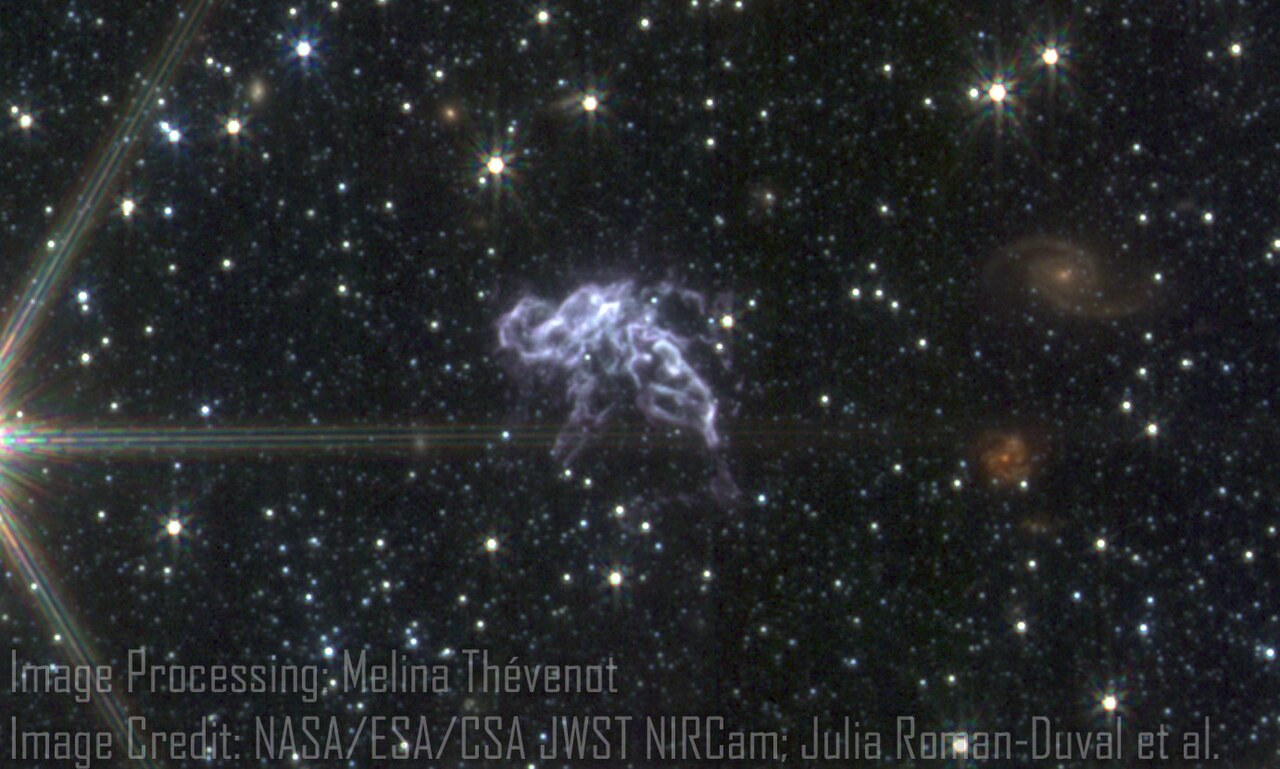
The interstellar medium has been studied through H I and H II complexes. One recognized supernova remnant, named S8, was first identified by Allan Sandage in 1971 as emission nebula no. 8 using the 200-inch Hale reflector. S8 is a very young supernova remnant with an estimated mass of 119±34 M☉ and an age between 2700 and 4400 years. A possible second remnant with a shell-like structure and a diameter of 55 parsecs has also been noted.
Reader's Guide
IC 1613 holds particular significance for extragalactic distance measurement. Its low dust content—both internal and along the line of sight—combined with the presence of RR Lyrae variables and Cepheids, allows unusually precise distance estimates. This has made it an important calibrator for the Cepheid period-luminosity relation, a fundamental tool for establishing the cosmic distance scale. The galaxy's stellar population, dominated by an approximately 7 Gyr old component, and its evolutionary similarity to the Pegasus Dwarf Irregular Galaxy, provide insight into the star formation histories of low-mass irregular galaxies in the Local Group. The detection of a nova and the presence of a Wolf–Rayet star (DR1) and a candidate WC+O binary add to its interest as a site of massive star evolution. The young supernova remnant S8, with its well-constrained age and mass, offers a rare opportunity to study the immediate aftermath of a supernova in a low-metallicity environment. Additionally, 14 faint galaxies catalogued as members of a yet-unnamed cluster at z≈0.20 lie close to IC 1613, placing it in a broader cosmological context.
Did You Know?
- The galaxy contains a WO star named DR1, possibly its only Wolf–Rayet star.
- The supernova remnant S8 in IC 1613 has an estimated age between 2700 and 4400 years.
Historical Recognition by Edwin Hubble
The name "Local Group" first appeared in print when Edwin Hubble dedicated Chapter VI of his 1936 volume The Realm of the Nebulae to this collection of galaxies. Hubble characterized the assembly as a typical small grouping of nebulae, isolated within the broader cosmic field, and then enumerated its constituents in order of diminishing brightness. In that luminosity ranking, IC 1613 occupied the tenth position, trailing behind the two giant spirals, the Triangulum Galaxy, both Magellanic Clouds, M32, NGC 205, NGC 6822, and NGC 185, while sitting just ahead of NGC 147. Hubble also flagged IC 10 as a possible additional member. That single passage in a 1936 monograph effectively fixed IC 1613's place in the astronomical record for the next century, anchoring it among the recognized residents of our immediate galactic neighborhood long before modern surveys could confirm the full roster of 134 known members within one megaparsec of the group's center.
Gravitational Independence from the Major Subgroups
The Local Group's two dominant subgroups—the Milky Way's satellite family and Andromeda's satellite family—account for the vast majority of the group's 134 known members. IC 1613, however, belongs to neither of these clusters. It is grouped alongside IC 10, the Phoenix Dwarf Galaxy, Leo A, the Tucana Dwarf Galaxy, the Cetus Dwarf Galaxy, the Pegasus Dwarf Irregular Galaxy, Wolf–Lundmark–Melotte, the Aquarius Dwarf Galaxy, and the Sagittarius Dwarf Irregular Galaxy as a body that is likely gravitationally secluded from the two large satellite systems. This means IC 1613 orbits the Local Group's center of mass rather than being bound to either the Milky Way or Andromeda as a satellite. Given that most of the group's 134 members are dwarf galaxies, IC 1613 fits squarely into that dominant population, drifting in the inter-lobe space between the two 800-kiloparsec-separated lobes that give the Local Group its characteristic dumbbell silhouette.
Position Within the Dumbbell Architecture
The Local Group takes the form of a dumbbell: one lobe centered on the Milky Way and its attendant dwarf galaxies, the other lobe centered on Andromeda and its own retinue of satellites. The two lobes are roughly 800 kiloparsecs apart—about three million light-years—and are closing on each other at a speed of 123 kilometers per second. The group's center of mass sits approximately 450 kiloparsecs from the Milky Way, placing it roughly 300 kiloparsecs nearer to Andromeda, consistent with Andromeda's likely greater mass. The entire structure spans 5.11 megaparsecs in diameter and carries a total mass on the order of two trillion solar masses. IC 1613, as a gravitationally independent dwarf, occupies the space between these two massive lobes rather than orbiting either one. Its position is thus defined not by proximity to a host galaxy but by its membership in the broader gravitational well of the Local Group, a well that also encompasses the Triangulum Galaxy and dozens of smaller companions.
Cosmic Context and the Long Merger
Beyond the Local Group's own boundaries, IC 1613 is nested within progressively larger structures. The Local Group is a component of the Local Volume, which in turn sits inside the Virgo Supercluster. Both the Virgo Supercluster and the Pisces–Cetus Supercluster Complex are themselves parts of the even vaster Laniakea Supercluster. Looking further back in time, the Local Group was considerably more diffuse in the early universe: roughly 700 million years after the Big Bang, its extent stretched to about seven megaparsecs, far larger than today's 5.11-megaparsec diameter. Looking forward, the mutual gravitational pull among the group's members is expected to draw them together over tens of billions of years into a single elliptical galaxy. The Andromeda–Milky Way collision will be the dominant event, though some theorists envision a persistent superspiral or a lenticular form rather than a clean elliptical outcome. IC 1613, like its fellow independent dwarfs, will ultimately be swept into that grand coalescence.
Gallery


Frequently Asked Questions
What is IC 1613 and where can I find it in the sky?
IC 1613, also catalogued as Caldwell 51, is a small irregular dwarf galaxy sitting on the outer edge of the Local Group. It lies in the constellation Cetus, close to the star 26 Ceti, and was first spotted by Max Wolf back in 1906.
How far away is IC 1613 and how fast is it moving relative to us?
The galaxy sits roughly 730 kiloparsecs from Earth, making it one of the more distant members of our local neighborhood. Its radial velocity shows it closing in on us at about 234 km/s.
Why do astronomers care so much about IC 1613 for distance work?
Because it hosts a rich population of Cepheid variable stars, it serves as a critical rung on the cosmic distance ladder, helping refine the period-luminosity relation that underpins many extragalactic distance estimates. Its unusually low dust content—both in the galaxy itself and along our line of sight—makes those Cepheid measurements exceptionally clean and reliable.
What is special about the variable stars found in IC 1613?
Besides its Cepheids, IC 1613 is one of only a handful of Local Group dwarf irregulars where RR Lyrae-type pulsating stars have been detected, adding another useful tool for cross-checking distances. This combination of variable-star populations in a single low-mass system is genuinely rare.
How massive is IC 1613 compared to other galaxies?
At roughly 100 million solar masses, IC 1613 is a true dwarf, weighing in at about a thousandth of the Milky Way's stellar mass. Its low mass and irregular shape place it firmly in the class of small, dynamically unstructured galaxies rather than the grand-design spirals or smooth ellipticals.
More in Elliptical and Irregular Galaxies, Part 5 1-24
Spotted an error? Know more?
Reader corrections go straight into our review queue. Suggest an edit · How this site is sourced