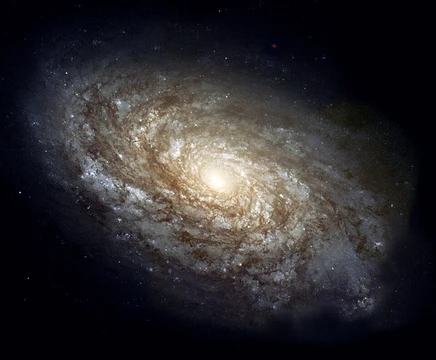
Mini Magellanic Cloud
A smaller remnant of the Small Magellanic Cloud.

ESA/NASA/JPL-Caltech/STScI · Public domain
The Mini Magellanic Cloud is a proposed smaller remnant of the Small Magellanic Cloud, split from the main body by a past interaction with the Large Magellanic Cloud. Astrophysicists D. S. Mathewson, V. L. Ford and N. Visvanathan suggested that the SMC may be split in two, with a smaller section behind the main part as seen from Earth, separated by about 30,000 light-years. This hypothesis was confirmed in 2023.
- Distance near part
- 196,000 light-years (60 kiloparsecs)
- Distance far part
- 215,000 light-years (66 kiloparsecs)
- Separation
- about 30,000 light-years
- Proposed by
- D. S. Mathewson, V. L. Ford and N. Visvanathan
- Confirmation year
- 2023
Lore & Background
The Mini Magellanic Cloud was first proposed by astrophysicists D. S. Mathewson, V. L. Ford and N. Visvanathan, who suggested that the Small Magellanic Cloud may be split in two. They argued that a past interaction with the Large Magellanic Cloud caused the SMC to split, and that the two sections are still moving apart. The smaller section, dubbed the Mini Magellanic Cloud, lies behind the main part of the SMC from Earth's perspective. This hypothesis was confirmed in 2023. The part of the SMC closer to Earth lies 196,000 light-years away, while the farther part lies 215,000 light-years away, separated by about 30,000 light-years.
Reader's Guide
The confirmation of the Mini Magellanic Cloud in 2023 provides a clearer picture of the Magellanic system's structure and history. The splitting of the Small Magellanic Cloud into two distinct sections, separated by about 30,000 light-years, indicates a violent past interaction with the Large Magellanic Cloud. This discovery helps astronomers understand how tidal forces between dwarf galaxies can reshape them, and it supports the idea that the Magellanic Clouds have a dynamic, evolving relationship. The Mini Magellanic Cloud also offers a unique laboratory for studying star formation and gas dynamics in a disrupted galaxy. Its existence underscores the complexity of the Local Group and the ongoing processes that shape its members. As the two sections continue to move apart, future observations may reveal further details about the interaction that created them and the long-term fate of the Magellanic system.
Did You Know?
- The Mini Magellanic Cloud is a smaller remnant of the Small Magellanic Cloud, split by a past interaction with the Large Magellanic Cloud.
- The hypothesis of the Mini Magellanic Cloud was proposed by astrophysicists D. S. Mathewson, V. L. Ford and N. Visvanathan.
- The two sections of the SMC are separated by about 30,000 light-years.
- The existence of the Mini Magellanic Cloud was confirmed in 2023.
Ancient Sightings and European Discovery
The Small Magellanic Cloud has been visible to human eyes for millennia, though its formal identification in Western astronomy is relatively recent. In the ninth century, the polymath Ibn Qutaybah described bright, large stars visible below Canopus in the southern sky—objects invisible from Iraq but known to people of Tihama, who called them al-a'bar. A century later, Al Sufi repeated a similar account in his Book of Fixed Stars, noting that the inhabitants of Tihama named them al-Baqar, or cows, while expressing doubt about their authenticity since Ptolemy had never mentioned them. These early references likely trace back to Abu Hanifa Dinawari's lost work on lunar stations. In Europe, the clouds first entered the record through Italian writers Peter Martyr d'Anghiera and Andrea Corsali, drawing on Portuguese voyage accounts. Antonio Pigafetta, aboard Magellan's 1519–1522 circumnavigation, also documented them. Yet the name Magellanic Clouds did not enter scientific literature until John Herschel used it in an 1847 paper.
Structure, Composition, and Stellar Content
At roughly 206 kilolight-years from Earth, the Small Magellanic Cloud spans approximately 18,900 light-years in diameter, about 70 percent smaller than its larger neighbor. Despite its modest size, the SMC displays a bar structure that has led astronomers to reclassify it as a Magellanic spiral rather than a simple irregular dwarf. Its composition sets it apart from the Milky Way in two significant respects: it is far richer in hydrogen and helium gas, and its stars are notably metal-poor, with the youngest stellar populations showing only a quarter of the Sun's metallicity. The galaxy is home to striking nebulae and active star-forming regions, yet it also contains very old stars, revealing a long and continuous history of stellar birth. A substantial fraction of its mass remains in gaseous form rather than locked into stars, and it is thought to be enveloped by a large dark matter halo. Together with the LMC, the Magellanic system presents a window into galaxy evolution at a mass scale between the Milky Way and the smallest dwarf systems.
Orbital Dynamics and Tidal Interactions
The Small Magellanic Cloud is a satellite of the Milky Way and a member of the Local Group, but its orbital history remains one of the most debated questions in nearby galactic astronomy. Evidence indicates that the SMC may have spent a very long time orbiting the LMC rather than the Milky Way directly, suggesting the Magellanic pair formed as a bound system before encountering our galaxy. Tidal forces from the Milky Way have visibly distorted both clouds, and streams of neutral hydrogen now connect the SMC to the LMC and to the Milky Way itself. Observations and theoretical models suggest that the clouds are currently at a rare pericenter, unusually close to the Milky Way compared to their typical orbital path. Hubble Space Telescope measurements announced in 2006 revealed that the Magellanic Clouds may be traveling too fast to be long-term bound companions of the Milky Way. If they are indeed in orbit, that orbit would span at least four billion years. Another possibility is that they are on a first approach, having only recently fallen under the Milky Way's gravitational influence.
Measuring Distance and Cataloguing Objects
Pinpointing the distance to the Small Magellanic Cloud was a landmark achievement in twentieth-century astronomy. In 1912, Henrietta Leavitt measured Cepheid variable stars within the SMC, and the following year Ejnar Hertzsprung used those measurements to produce the first distance estimate. Harlow Shapley later recalibrated the Cepheid period-luminosity relationship, refining the figure, and a further revision came in 1952 after additional research. These successive refinements cemented the SMC at roughly 206 kilolight-years, making it one of the most precisely calibrated extragalactic distance markers. Before the 1994 discovery of the Sagittarius Dwarf Elliptical Galaxy, the Magellanic Clouds were the closest known galaxies to the Milky Way. John Herschel, working from South Africa in the 1840s, catalogued 244 distinct objects within the SMC in his 1847 report. In 1867, Cleveland Abbe proposed that both clouds were separate satellite galaxies orbiting the Milky Way, a radical idea at the time that has since been confirmed. The SMC thus served as both a laboratory for distance measurement and a proving ground for the concept of galactic satellites.
Gallery
Frequently Asked Questions
What is the Mini Magellanic Cloud?
It is a smaller fragment that broke away from the Small Magellanic Cloud during a close gravitational encounter with the Large Magellanic Cloud. From Earth's perspective it sits behind the main body of the SMC, roughly 30,000 light-years farther away.
Who first suggested the Mini Magellanic Cloud exists?
Astronomers D. S. Mathewson, V. L. Ford, and N. Visvanathan put forward the idea that the SMC was actually two pieces rather than one. Their hypothesis gained solid observational backing in 2023.
How far away is the Mini Magellanic Cloud?
The nearer portion of the SMC sits at about 196,000 light-years (60 kiloparsecs), while the Mini Magellanic Cloud fragment lies closer to 215,000 light-years (66 kiloparsecs). That places the two sections roughly 30,000 light-years apart along our line of sight.
When did the scientific community confirm the Mini Magellanic Cloud?
The split-structure hypothesis was validated in 2023, giving the original proposal by Mathewson, Ford, and Visvanathan long-overdue confirmation.
Why does the Mini Magellanic Cloud matter to galaxy researchers?
It demonstrates that the Small Magellanic Cloud is not a single coherent system but the product of a violent tidal interaction with its larger neighbor. Understanding how the two fragments formed helps astrophysicists model how gravitational encounters reshape irregular galaxies.
More in Elliptical and Irregular Galaxies, Part 5 1-24
Spotted an error? Know more?
Reader corrections go straight into our review queue. Suggest an edit · How this site is sourced