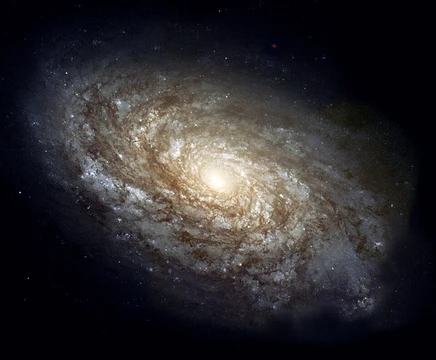
Haro 2
A blue compact galaxy with a young starburst and an expanding superbubble.

Haro 2 is a blue compact galaxy located in the constellation Ursa Major. It lies approximately 120 million light years from Earth based on redshift-independent measurements, though redshift suggests a distance of 70 million light years. The galaxy spans about 45,000 light years across. It is notable for hosting a burst of star formation that has produced large numbers of young massive stars, and its spectrum shows emission from Wolf-Rayet stars.
Quick Facts
- Epoch
- J2000
- Ra
- 10 · 32 · 32.0
- Dec
- 54 · 24 · 02
- Dist Ly
- 124 ± 58 Mly (38 ± 18 Mpc)
- Z
- 0.004796 ± 0.000007
- H Radial V
- 1438 ± 2 km/s
- Appmag V
- 13.1
- Constellation Name
- Ursa Major
- Notes
- Blue compact dwarf
- Names
- UGC 5720, Arp 233, MRK 33, MCG +09-17-070, PGC 31141
Facts from the source article.
Lore & Background
Haro 2 was first described by Guillermo Haro in a 1956 study listing 44 blue galaxies. The galaxy is undergoing a burst of star formation, with an age calculated at 5.8 ± 1.0 million years. Its spectrum features emission from Wolf-Rayet stars, indicating the presence of young massive stars. An outflow of ionised gas around the central HII region forms a shell, interpreted as a galactic wind driven by the starburst activity. The shell has been observed in X-rays with ROSAT, confirming it as a superbubble, and imaging of CO(2–1) shows that the shell has entrained molecular gas. The kinematics of the shell suggest an age of 5 to 6 million years. The galaxy emits Lyman-alpha both from the central HII region and from the shell.
Reader's Guide
Haro 2 is significant as a nearby example of a blue compact galaxy undergoing a vigorous starburst. Its well-studied outflow and superbubble provide insight into how star formation feedback drives galactic winds and enriches the interstellar medium. The detection of molecular gas entrained in the shell indicates that such outflows can remove star-forming material from the galaxy. The discrepancy between redshift-independent and redshift-based distances (120 vs. 70 million light years) highlights uncertainties in distance measurements for such galaxies. The presence of Wolf-Rayet stars and Lyman-alpha emission from both the core and the shell makes Haro 2 a valuable laboratory for studying the early phases of starbursts and their impact on galaxy evolution. Its similarity to NGC 3353 places it in a class of dwarf galaxies where intense star formation shapes the host.
Did You Know?
- Haro 2 was first cataloged by Guillermo Haro in a 1956 study of 44 blue galaxies.
- The galaxy's starburst is calculated to be 5.8 ± 1.0 million years old.
- An expanding shell of ionised gas around the central HII region has been observed in X-rays by ROSAT.
- The shell has entrained molecular gas, as shown by CO(2–1) imaging.
Frequently Asked Questions
What is Haro 2?
Haro 2 is a blue compact galaxy situated in the constellation Ursa Major, stretching roughly 45,000 light years across. It is best known for an active starburst that has generated a dense population of young, massive stars.
How far away is Haro 2?
Redshift-independent measurements place the galaxy at approximately 120 million light years, while redshift data points to a closer figure of about 70 million light years. This gap between the two distance estimates is a frequently discussed quirk among galaxy enthusiasts.
What makes Haro 2 stand out among blue compact galaxies?
Its spectrum shows clear emission from Wolf-Rayet stars, signaling an extreme burst of massive star formation. An expanding superbubble also surrounds the star-forming region, making Haro 2 a vivid natural laboratory for studying intense stellar environments.
How old is Haro 2's current starburst?
The present episode of vigorous star formation is estimated to be roughly 5.8 million years old, with an uncertainty of about one million years. This relatively recent burst is responsible for the galaxy's characteristic blue glow and its rich population of hot, massive stars.
Where can I find Haro 2 in the night sky?
Haro 2 lies within the constellation Ursa Major, making it a target for northern-hemisphere observers with modest telescopes. Its compact, blue appearance sets it apart from the surrounding field stars in that region of the sky.
More in Elliptical and Irregular Galaxies, Part 5 1-24
Spotted an error? Know more?
Reader corrections go straight into our review queue. Suggest an edit · How this site is sourced