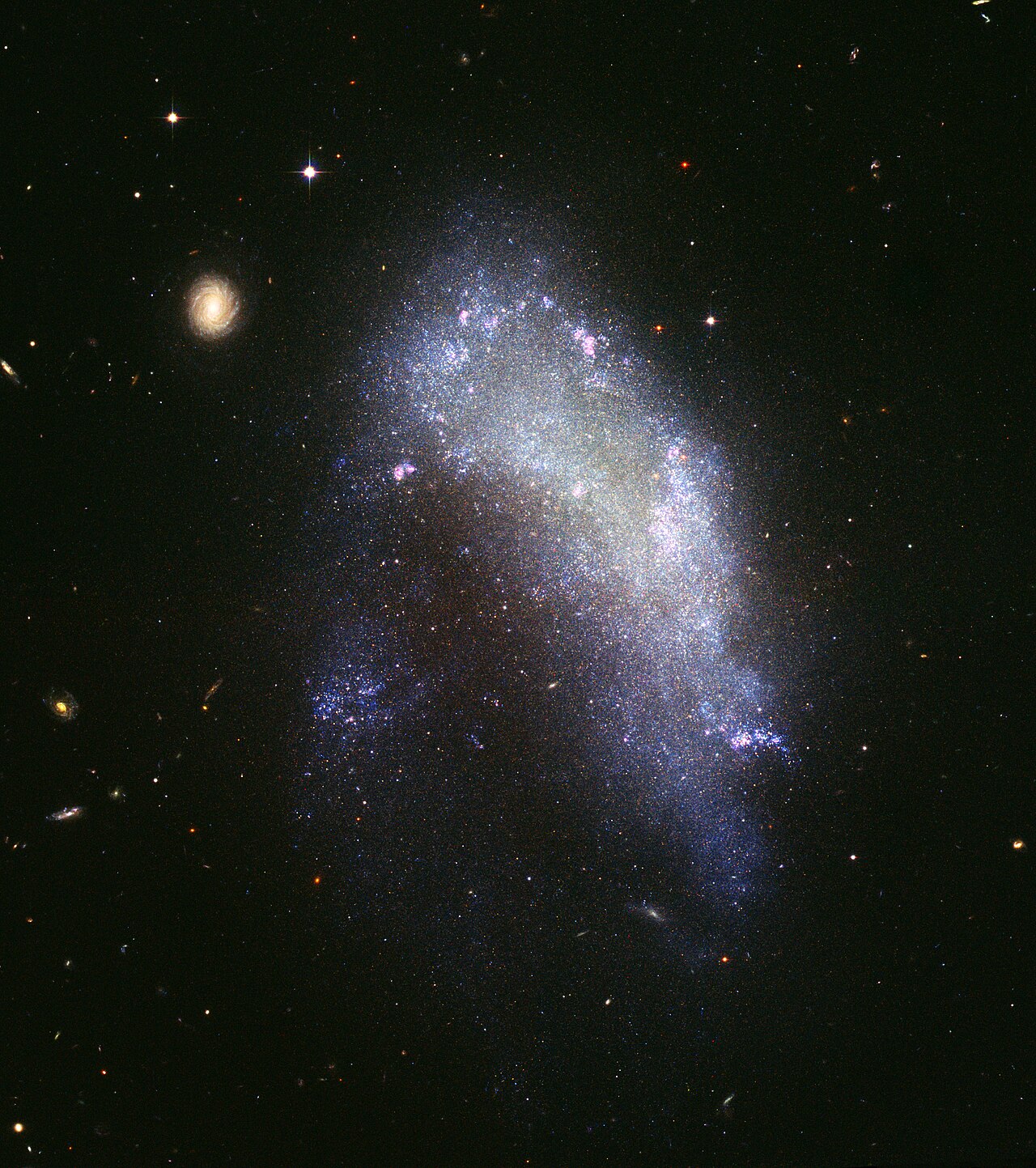
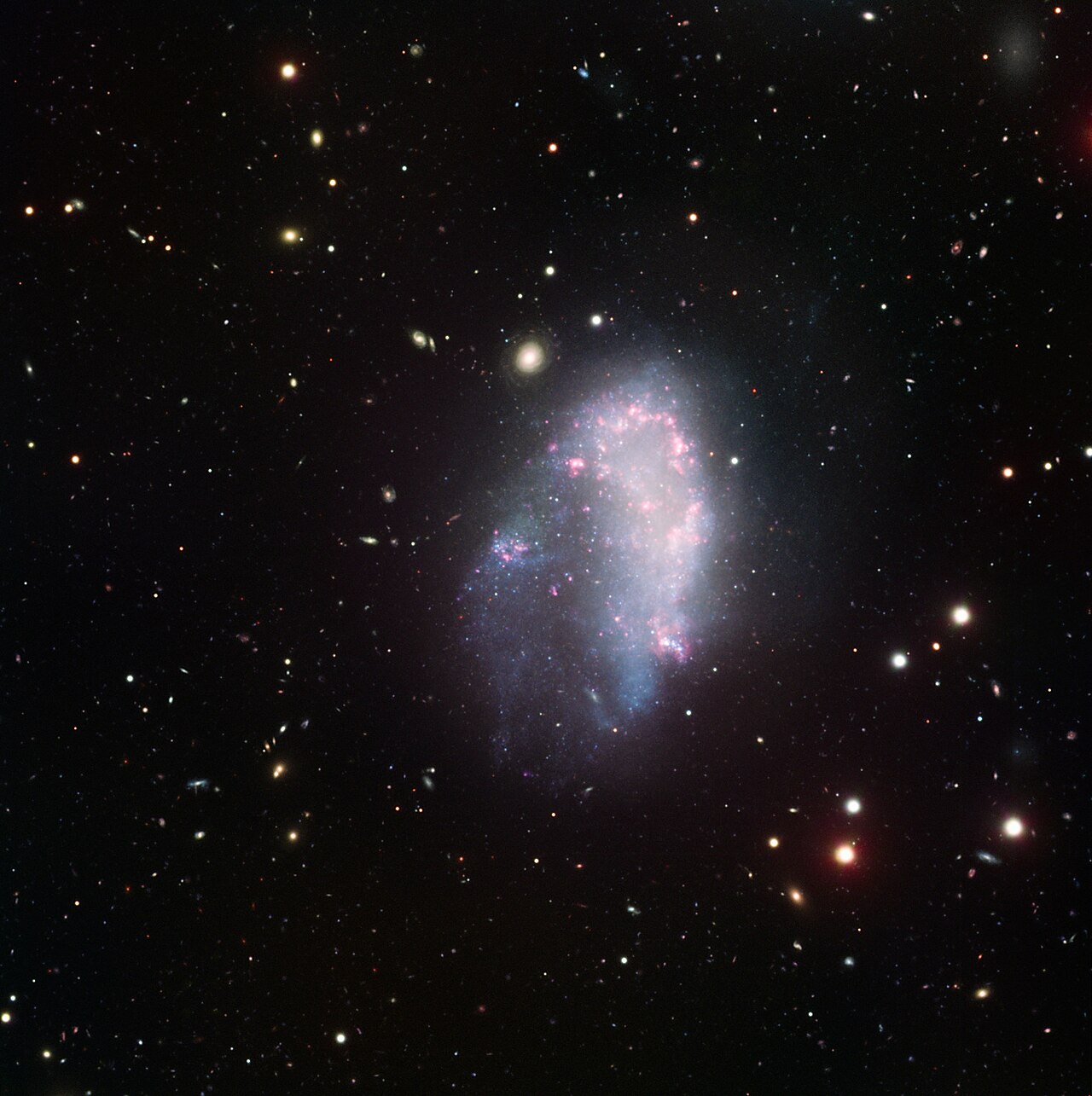
NGC 1427A
A dwarf irregular galaxy plunging into the Fornax Cluster.

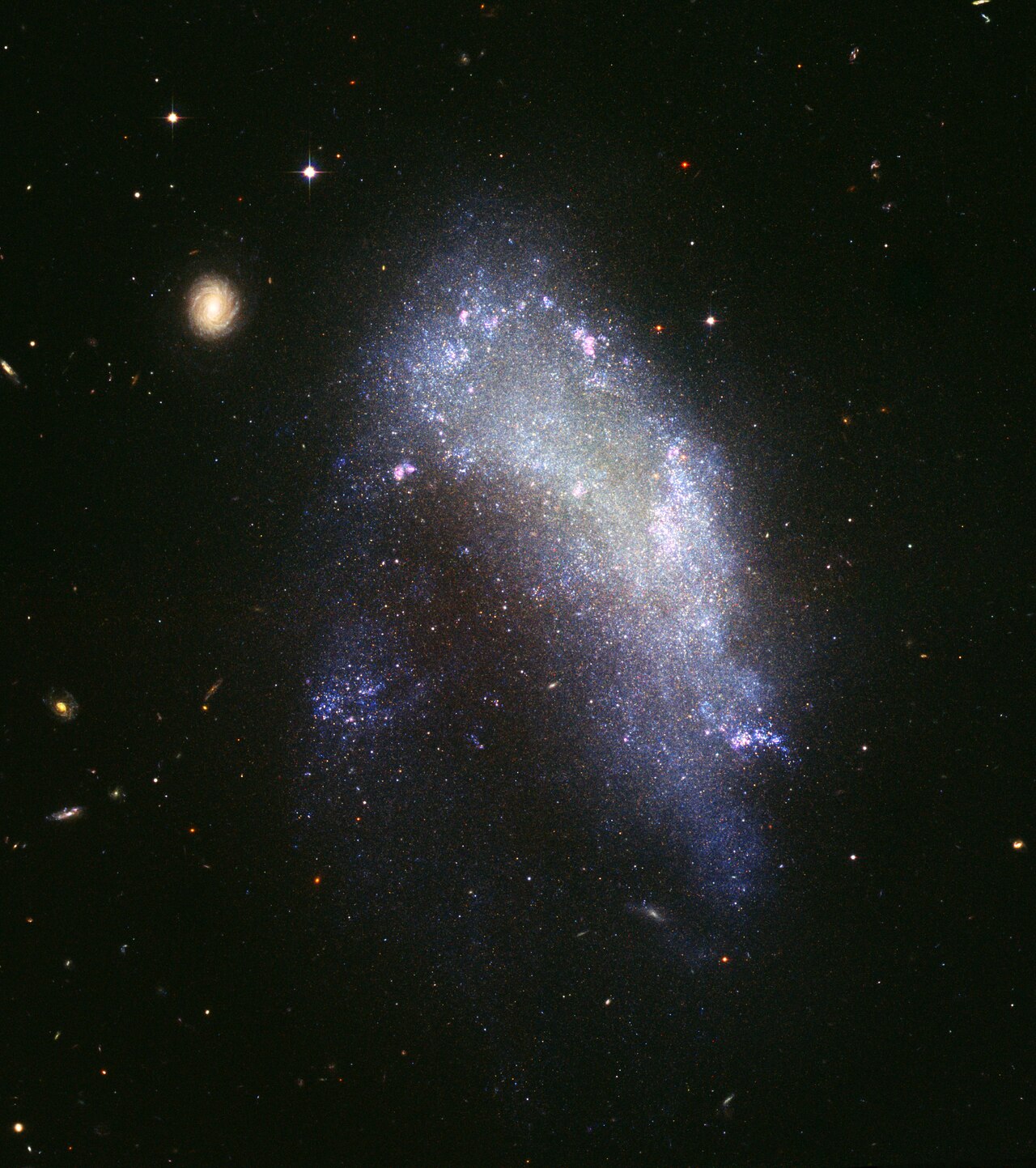
NASA, ESA, and The Hubble Heritage Team (STScI/AURA) · Public domain
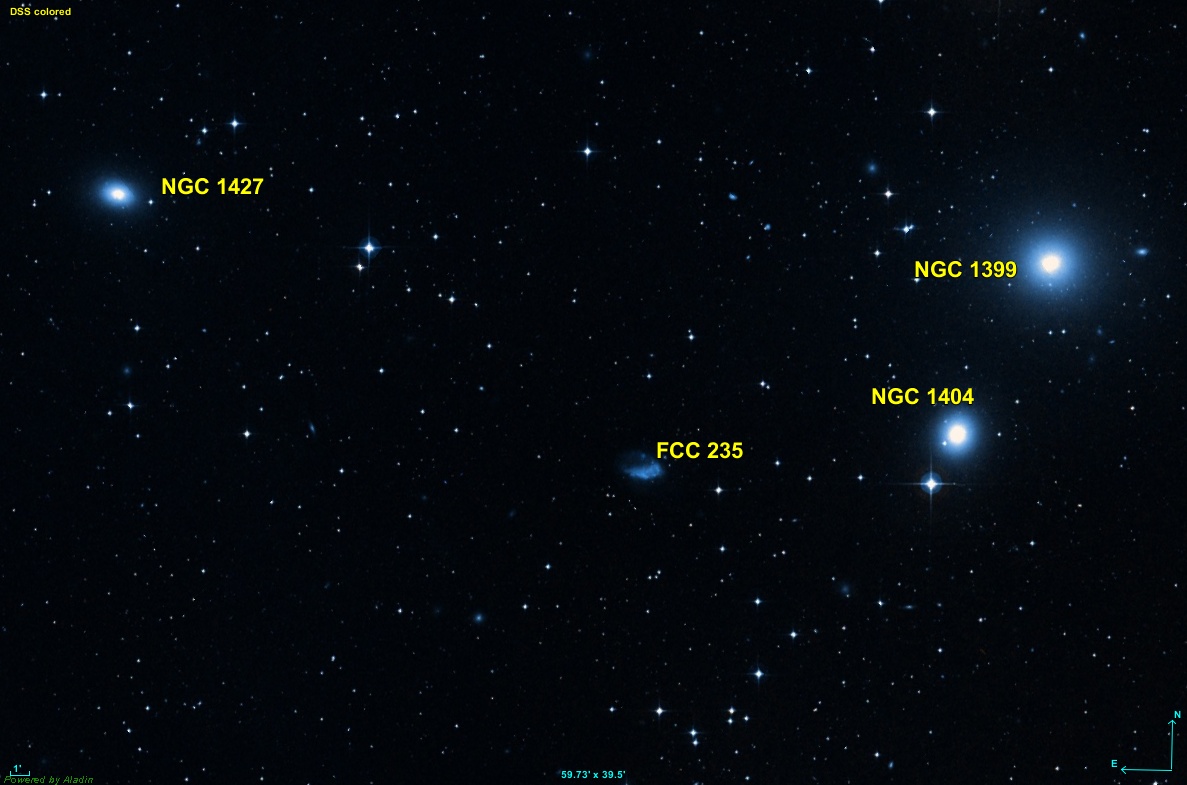
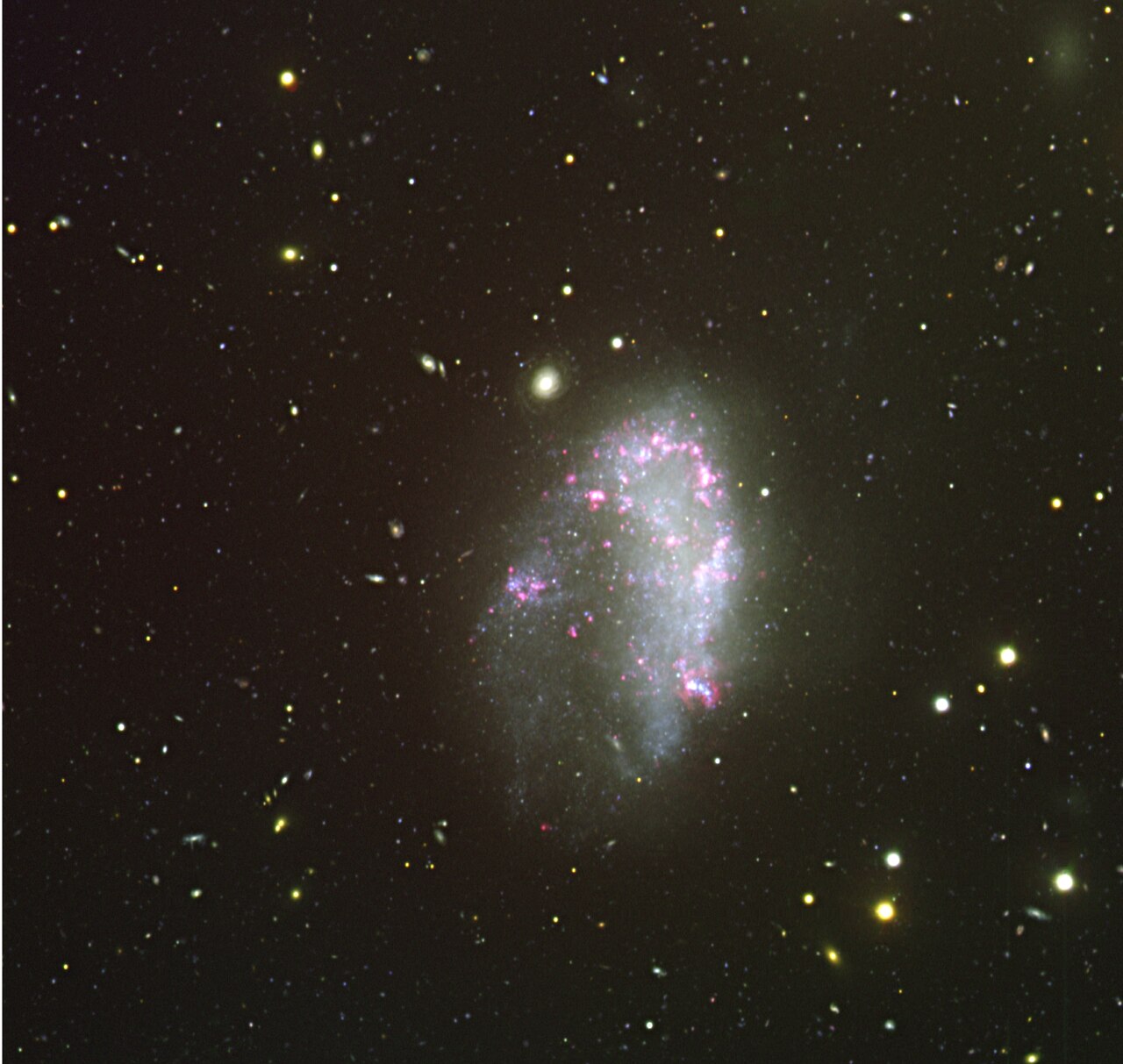
NGC 1427A, also cataloged as ESO 358-49 or ESO 358-G049, is an irregular galaxy located in the constellation Eridanus. Its distance, derived from the globular cluster luminosity function, corresponds to a distance modulus of 31.01 ± 0.21, placing it about 52 million light-years away. It is the brightest dwarf irregular member of the Fornax Cluster and sits in the foreground of the cluster’s central galaxy, NGC 1399.
Spanning more than 20,000 light-years, NGC 1427A is comparable in size to the Large Magellanic Cloud. The galaxy is moving into the center of the Fornax Cluster at roughly 600 kilometers per second, driven by galactic tides. This rapid motion has shaped it into a distinct arrowhead form, and the resulting pressure from its passage through cluster gas and galaxies is triggering bursts of star formation. Over the next billion years, this interaction will tear the galaxy apart—a process that was once common in the early universe but has become much rarer.
In January 2003, the Hubble Space Telescope’s Advanced Camera for Surveys captured images of NGC 1427A in visible (green), red, and infrared filters. The Hubble Heritage team later combined these to produce a color image. Astronomers are analyzing the data to map star-formation patterns across the galaxy, testing the idea that a star’s age relates to its position within the galaxy. This work aims to clarify how the cluster’s gravitational pull has influenced the galaxy’s internal structure and how it has responded to moving through the cluster environment. The image was featured as the picture of the day on March 4, 2005.
To the upper left of NGC 1427A, a background spiral galaxy appears along Hubble’s line of sight, but it lies about 1.3 billion light-years away—roughly 25 times farther. Unlike the irregular NGC 1427A, this galaxy is a well-defined spiral, similar to the Milky Way. Stars are forming in its symmetric, pinwheel-shaped arms, which extend into a bright nucleus. This background galaxy contains fewer very young stars than NGC 1427A, giving it a yellower overall color. Even more distant galaxies of various shapes and colors are scattered across the Hubble image.
Quick Facts
- Epoch
- J2000
- Ra
- 3 · 40 · 9.3
- Dec
- -35 · 37 · 28
- Dist Ly
- 51.95.3 · 4.7 Mly (15.91.6 · 1.4 Mpc)
- Z
- 0.006764
- Appmag V
- 13.4
- Constellation Name
- Eridanus
- Names
- ESO 358- G 049, MCG -06-09-016, FCC 235, PGC 13500
- H Radial V
- 2028 ± 1 km/s
- Absmag V
- -18.62 ± 0.64
Facts from the source article.
Lore & Background
NGC 1427A is over 20,000 light-years long and similar in size to the Large Magellanic Cloud. Its distinctive arrowhead outline is the result of pressure from its rapid, upward movement through the Fornax Cluster at a velocity of approximately 600 km per second. This interaction with cluster gases and galaxies triggers episodes of star formation throughout the object.
Under the influence of galactic tides, NGC 1427A is traveling into the center of the Fornax Cluster. The interaction with Fornax gases and galaxies during its journey will cause the disruption of the galaxy within the next billion years. Such events were common during the evolution of the Universe but have become increasingly rare.
To the upper left of NGC 1427A lies a background spiral galaxy that is about 1.3 billion light-years away, some 25 times farther. Unlike the irregular NGC 1427A, that galaxy is a magnificent spiral somewhat similar to the Milky Way, with symmetric pinwheel-shaped spiral arms and a bright nucleus. It is less dominated by very young stars than NGC 1427A, giving it an overall yellower color.
Reader's Guide
NGC 1427A serves as a nearby laboratory for studying how a dwarf irregular galaxy responds to the extreme environment of a rich galaxy cluster. Its arrowhead shape and ongoing star formation are direct consequences of ram pressure and tidal forces as it plunges inward at high speed. Astronomers used Hubble Space Telescope images obtained in January 2003 with the Advanced Camera for Surveys in visible (green), red, and infrared filters to investigate star-formation patterns throughout the object. The data are being used to verify a predicted relation between the ages of stars and their positions within the galaxy, helping to understand how the cluster's gravitational influence has affected the internal workings of this galaxy and how it has responded to passing through the cluster environment. The galaxy's impending disruption within the next billion years offers a rare glimpse of a process that was common in the early universe but is now seldom observed. The Hubble image, combined by the Hubble Heritage team, was featured as image of the day on March 4, 2005.
Did You Know?
- Its distance modulus is estimated at 31.01 ± 0.21 using the globular cluster luminosity function.
- A background spiral galaxy about 1.3 billion light-years away appears to the upper left of NGC 1427A.
Gallery
Frequently Asked Questions
Who is NGC 1427A?
NGC 1427A is a dwarf irregular galaxy cataloged under the aliases ESO 358-49 and ESO 358-G049, located in the constellation Eridanus. It belongs to the Fornax Cluster and is recognized as the brightest dwarf irregular member of that group.
What are NGC 1427A's powers/role?
Stretching over 20,000 light-years, NGC 1427A is roughly the same size as the Large Magellanic Cloud, making it a surprisingly large dwarf for its classification. It is currently plunging toward the heart of the Fornax Cluster at roughly 600 km per second, which drives dramatic morphological changes to its structure.
Why is NGC 1427A important?
It sits directly in the foreground of NGC 1399, the dominant central galaxy of the Fornax Cluster, making it a key object for studying how dwarf irregulars interact with a rich cluster environment. Its size and luminosity also give astronomers a useful benchmark for comparing dwarf irregular evolution across different galactic settings.
Where can you find NGC 1427A?
Look toward the constellation Eridanus; the galaxy lies at a distance of roughly 52 million light-years, with a distance modulus of 31.01 ± 0.21 derived from its globular cluster luminosity function. It is not a naked-eye target, so dedicated small telescopes or long-exposure imaging are needed to resolve its irregular shape.
More in Elliptical and Irregular Galaxies, Part 5 1-24
Spotted an error? Know more?
Reader corrections go straight into our review queue. Suggest an edit · How this site is sourced