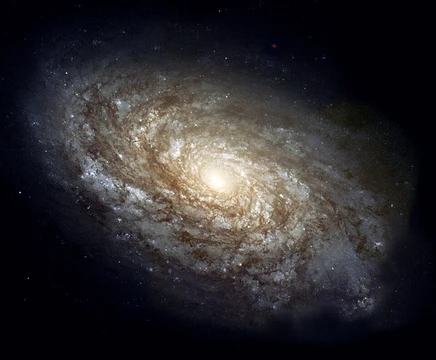
NGC 1569
A nearby dwarf irregular galaxy undergoing a powerful starburst.

NGC 1569 is a dwarf irregular galaxy located in the constellation Camelopardalis. It is notable for its intense starburst activity, forming stars at a rate roughly 100 times that of the Milky Way over the past 100 million years. The galaxy is relatively nearby, allowing the Hubble Space Telescope to resolve its individual stars easily.
Quick Facts
- Epoch
- J2000
- Ra
- 4 · 30 · 49.1
- Dec
- +64 · 50 · 53
- Dist Ly
- 10.96 ± 0.65 Mly (3.36 ± 0.20 Mpc)
- Appmag V
- 11.9
- Z
- -104 km/s
- Constellation Name
- Camelopardalis
- Notes
- Contains two super star clusters
Facts from the source article.
Lore & Background
NGC 1569 is a dwarf irregular galaxy in Camelopardalis, long thought to be about 7.8 million light-years away. In 2008, Hubble Space Telescope images revised its distance to nearly 11 million light-years, placing it as a member of the IC 342 group. The galaxy is smaller than the Small Magellanic Cloud but brighter than the Large Magellanic Cloud.
The galaxy is characterized by a large starburst, having formed stars at a rate 100 times greater than the Milky Way over the last 100 million years. It contains two prominent super star clusters with different histories. Super star cluster A, in the northwest, is actually two close clusters: NGC 1569 A1 contains young stars (including Wolf-Rayet stars) less than 5 million years old, while NGC 1569 A2 contains older red stars. Super star cluster B, near the center, contains an older population of red giants and red supergiants. Both clusters have masses similar to Milky Way globular clusters (about 6–7 × 10⁵ solar masses). Numerous smaller star clusters, with ages from 2 million to 1 billion years, have also been identified. These findings, along with those from other dwarf galaxies, indicate that star formation in dwarf galaxies occurs in short, nearly instantaneous bursts rather than continuously.
The numerous supernovae and strong stellar winds have produced filaments and bubbles of ionized hydrogen up to 3,700 and 380 light-years across, visible in large-telescope images. The starburst is believed to have been triggered by interactions with other IC 342 group galaxies, particularly a nearby neutral hydrogen cloud. A 2013 study suggested tidal tails linking NGC 1569 with IC 342 and the dwarf galaxy UGCA 92, though the nature of these structures is unclear and they may be within our own galaxy.
Reader's Guide
NGC 1569 is significant as a nearby laboratory for studying starburst processes in dwarf galaxies. Its resolved stellar populations allow detailed analysis of star formation history, revealing that star formation occurs in episodic bursts rather than continuously. The two super star clusters, with their distinct ages and compositions, provide insight into how massive star clusters form and evolve. The galaxy's blueshifted spectrum—unusual for most galaxies—indicates it is moving toward Earth, contrasting with the general expansion of the universe. Its membership in the IC 342 group and possible interactions with companions like UGCA 92 and a neutral hydrogen cloud offer a context for understanding how environmental factors trigger starbursts. The uncertainty surrounding the tidal features and their association with the Milky Way underscores the challenges in interpreting structures in nearby galaxies. Overall, NGC 1569 remains a key object for studying the lifecycle of stars in low-mass galaxies and the role of galaxy interactions in driving intense star formation.
Did You Know?
- NGC 1569 is blueshifted, meaning it is moving toward Earth, unlike most galaxies that are redshifted.
- Its distance was revised upward in 2008 from 7.8 million to nearly 11 million light-years using Hubble Space Telescope images.
- The galaxy contains two super star clusters, each with masses similar to Milky Way globular clusters.
- Star formation in NGC 1569 occurs in short, nearly instantaneous bursts rather than continuously.
More in Elliptical and Irregular Galaxies, Part 5 1-24
Spotted an error? Know more?
Reader corrections go straight into our review queue. Suggest an edit · How this site is sourced