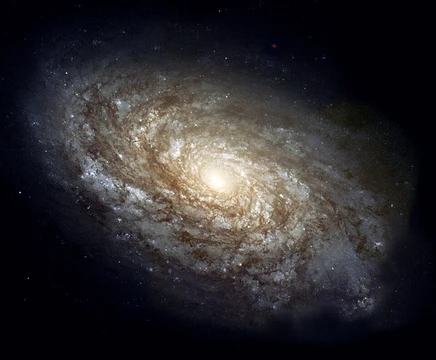
NGC 6822
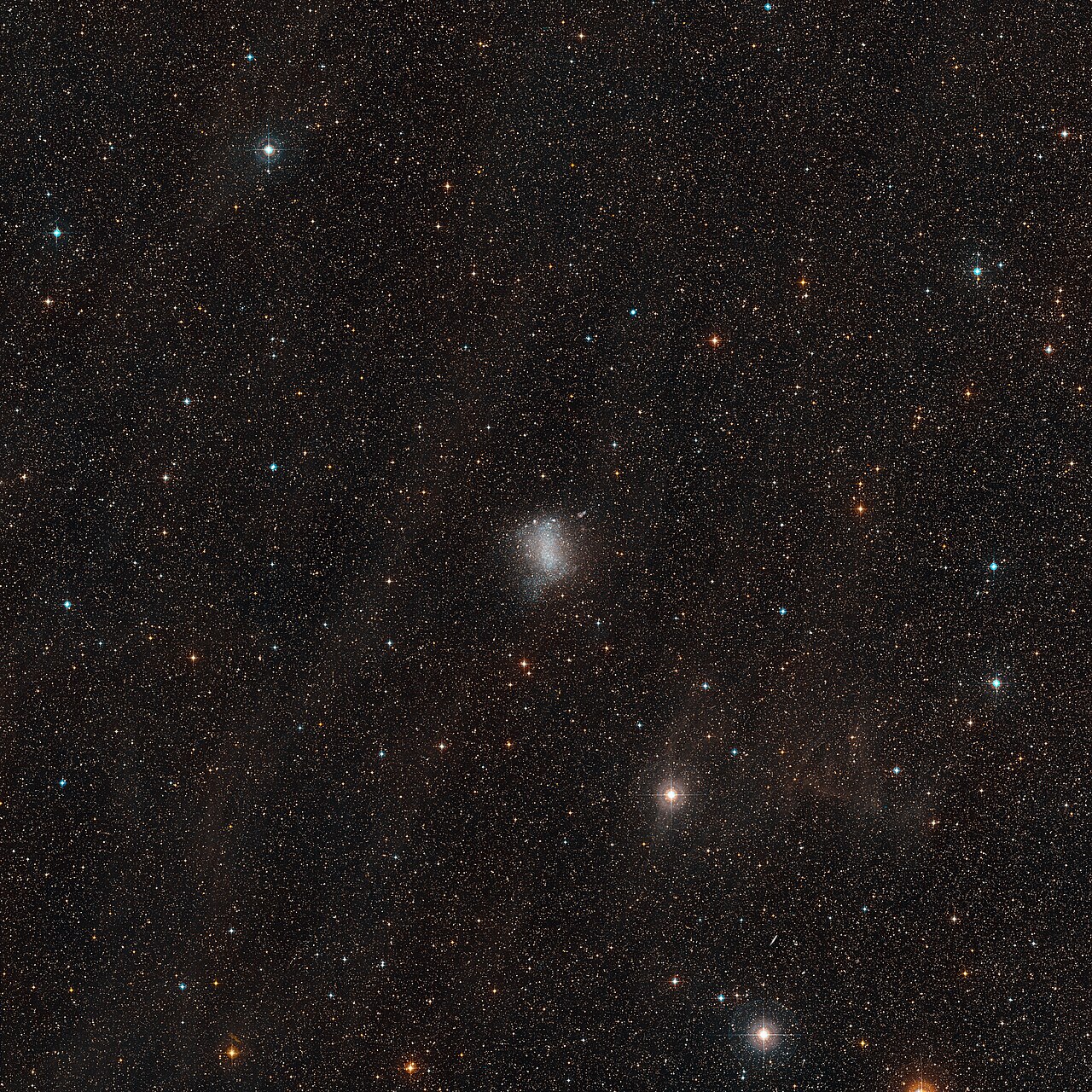
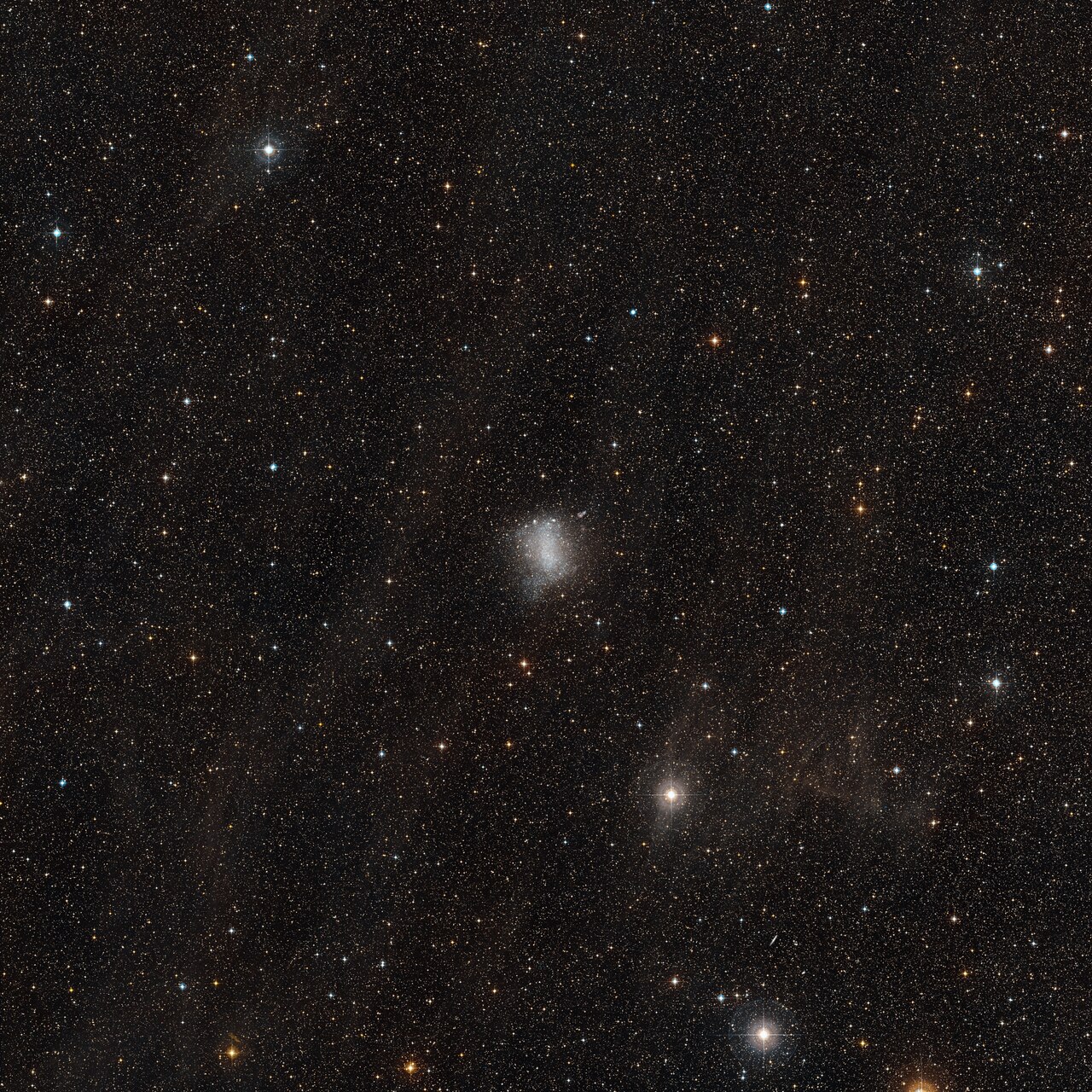
The closest non-satellite galaxy to the Milky Way.

ESO/Digitized Sky Survey 2. Acknowledgment: Davide De Martin · CC BY 4.0
NGC 6822, also known as Barnard's Galaxy, is a barred irregular galaxy approximately 1.6 million light-years away in the constellation Sagittarius. It is part of the Local Group and is the closest non-satellite galaxy to the Milky Way, lying just outside its virial radius. Similar in structure and composition to the Small Magellanic Cloud, it is about 7,000 light-years in diameter.
Quick Facts
- Epoch
- J2000
- Ra
- 19 · 44 · 57.70
- Dec
- -14 · 48 · 12.0
- Dist Ly
- 1.63 ± 0.03 Mly (500 ± 10 kpc)
- Z
- -0.000183 · 0.00000667ned
- H Radial V
- -55 ±
- Appmag V
- 9.3
- Constellation Name
- Sagittarius
Facts from the source article.
Lore & Background
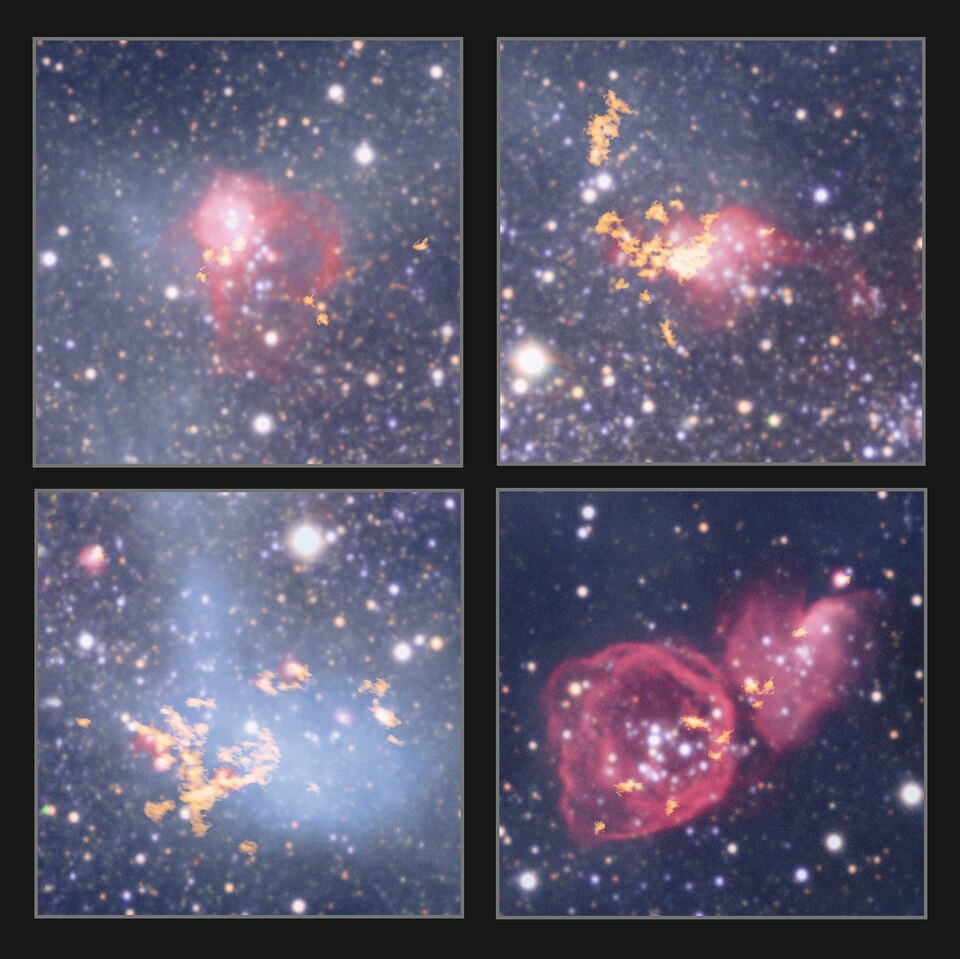
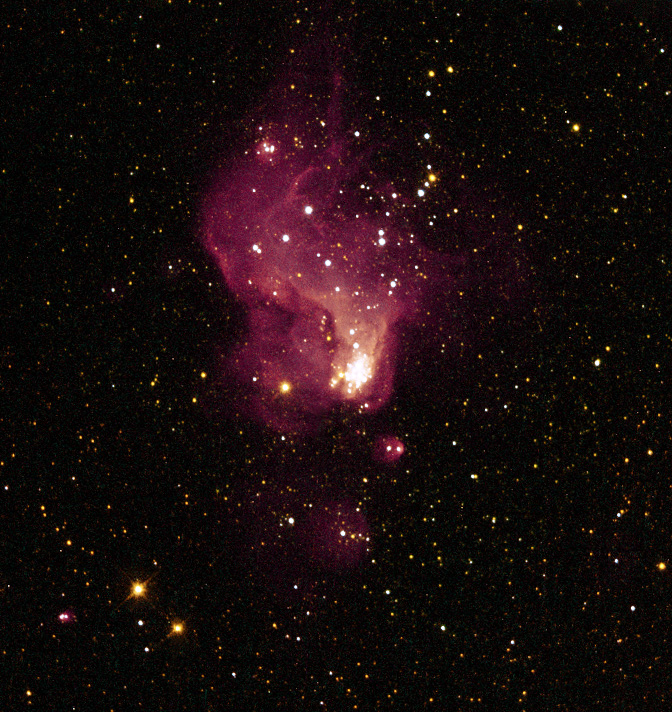
NGC 6822 was discovered by E. E. Barnard in 1884 using a six-inch refractor telescope. Edwin Hubble later studied the galaxy in his paper N.G.C. 6822, A Remote Stellar System, identifying 15 variable stars, 11 of which were Cepheids. He surveyed the galaxy's star distribution down to magnitude 19.4 and provided spectral characteristics, luminosities, and dimensions for the five brightest diffuse nebulae, including the Bubble Nebula and the Ring Nebula. Hubble's detection of eleven Cepheid variable stars was a milestone; using the Cepheid Period-Luminosity relationship, he determined a distance of 214 kiloparsecs (698,000 light-years), making this the first system beyond the Magellanic Clouds to have its distance measured. This distance far exceeded Harlow Shapley's value of 300,000 light-years for the size of the universe, and Hubble's paper concluded the 'Great Debate' of 1920 between Heber Curtis and Shapley over the scale of the universe and the nature of spiral nebulae.
An analysis of Hubble's plates by Susan Kayser in 1966 remained the most complete study of the galaxy until 2002. In 1977, Paul W. Hodge extended the list of known H II regions in Barnard to 16; today, over 150 such regions are catalogued. Observations show stars forming in the dense cores of giant molecular hydrogen clouds, cold enough to collapse under gravity. The distribution of hydrogen gas is disk-shaped but angled at about 60° relative to the stellar distribution. Most of its stars formed within the last 3 to 5 billion years. NGC 6822 has spent most of its life in relative isolation, but it likely passed within the virial radius of the Milky Way some 3 to 4 billion years ago, which may coincide with its increase in star formation.
Reader's Guide
NGC 6822 holds a significant place in the history of astronomy as the first system beyond the Magellanic Clouds to have its distance determined. Edwin Hubble's work on this galaxy, using Cepheid variable stars, provided a distance of 698,000 light-years, which was far greater than Harlow Shapley's estimate for the size of the universe. This result helped resolve the 'Great Debate' of 1920, demonstrating that spiral nebulae are galaxies far outside the Milky Way. The galaxy's proximity—the closest non-satellite galaxy to the Milky Way—makes it a valuable object for studying star formation and galactic structure. Its similarity to the Small Magellanic Cloud offers insights into irregular galaxy evolution. The discovery of over 150 H II regions and the ongoing star formation in its molecular hydrogen clouds continue to inform models of how galaxies evolve in relative isolation, with a possible past interaction with the Milky Way influencing its star formation history.
Did You Know?
- NGC 6822 was discovered by E. E. Barnard on 17 August 1884 using a six-inch refractor telescope.
- Edwin Hubble identified 11 Cepheid variable stars in this galaxy, using them to determine its distance.
- The galaxy is about 7,000 light-years in diameter, similar in structure to the Small Magellanic Cloud.
- Over 150 H II regions have been catalogued in Barnard's Galaxy.
Hubble's 1936 Cataloguing
In 1936, Edwin Hubble published The Realm of the Nebulae, and in its Chapter VI he formally introduced the term "Local Group" to describe what he called a typical small collection of nebulae isolated within the broader cosmic field. Among the members he delineated in order of decreasing luminosity—beginning with Andromeda, the Milky Way, and the Triangulum Galaxy, followed by the Magellanic Clouds, M32, and NGC 205—NGC 6822 occupied a position just before NGC 185, IC 1613, and NGC 147. Hubble also flagged IC 10 as a possible additional member. This single act of cataloguing placed NGC 6822 firmly within a defined gravitational family rather than leaving it as an isolated object in the night sky. The list Hubble compiled, though modest by modern standards, established the conceptual framework that astronomers still use today to organize the galaxies nearest to Earth. NGC 6822's inclusion in that original roster marks its formal entry into the Local Group's membership, a designation that has since been confirmed and expanded as new dwarf galaxies are discovered.
One of 134 Known Members
The Local Group's membership extends far beyond the handful of bright galaxies visible to the naked eye. Within one megaparsec of the group's center, astronomers have identified 134 member galaxies, the vast majority of which are dwarf galaxies. The exact total remains uncertain because the Milky Way's own disk obscures a portion of the sky, hiding some members from detection. NGC 6822 is one of these confirmed members, sharing its gravitational neighborhood with objects ranging from the two dominant spiral galaxies—Andromeda and the Milky Way, each carrying roughly a trillion solar masses—to the Triangulum Galaxy at about fifty billion solar masses, and further down to numerous ultra-faint dwarf spheroidals orbiting each of the two giants. Other confirmed members include IC 10, IC 1613, the Phoenix Dwarf, Leo A, the Tucana Dwarf, the Cetus Dwarf, the Pegasus Dwarf Irregular, Wolf–Lundmark–Melotte, the Aquarius Dwarf, and the Sagittarius Dwarf Irregular. For NGC 6822, this means it exists within a crowded gravitational environment where even the faintest objects are bound to the same large-scale structure.
The Dumbbell Architecture
The Local Group is not a random scatter of galaxies but possesses a distinct dumbbell geometry. One lobe is anchored by the Milky Way and its retinue of satellite galaxies; the other lobe is centered on Andromeda and its own collection of companions. The two lobes are separated by roughly 800 kiloparsecs and are closing on one another at a velocity of about 123 kilometers per second. The group's center of mass sits approximately 450 kiloparsecs from the Milky Way, placing it slightly nearer to Andromeda by around 300 kiloparsecs, consistent with Andromeda likely being the more massive of the two. The entire structure spans a diameter of about 5.11 megaparsecs and carries a total mass on the order of two trillion solar masses. NGC 6822, as a confirmed member, inhabits this dumbbell-shaped gravitational well. The group itself is nested within the Local Volume, the Virgo Supercluster, and ultimately the Laniakea Supercluster. In the early universe, roughly 700 million years after the Big Bang, the Local Group was thought to have been considerably more spread out, extending to about seven megaparsecs across.
A Shared Merger Future
Over a timescale stretching into the tens of billions of years, the mutual gravitational attraction among the Local Group's members is expected to draw them together into a single elliptical galaxy. The dominant event in this slow coalescence will be the collision and merger of Andromeda with the Milky Way, an encounter that will reshape the gravitational landscape for every other member, including NGC 6822. Astronomers debate the precise morphology of the combined object: some models predict an immediate elliptical shape, while others envision an intermediate phase where a spiraling structure persists before settling into ellipticity. A minority of theorists even propose a permanent superspiral or a transition toward a lenticular form rather than a classical ellipse. The merger will also have secondary effects on the group's boundaries. For instance, the Antlia-Sextans Group, currently sitting near or beyond the Local Group's zero-velocity surface, may become gravitationally bound to the merged system as the increased mass and density widen the group's effective radius. NGC 6822, as a confirmed member within that radius, would remain part of the evolving structure throughout this long gravitational dance.
Gallery
Frequently Asked Questions
What is NGC 6822?
NGC 6822, nicknamed Barnard's Galaxy, is a barred irregular galaxy sitting roughly 1.6 million light-years away in the constellation Sagittarius. It belongs to the Local Group and shares a structural and compositional profile with the Small Magellanic Cloud.
Why is NGC 6822 important?
It holds the distinction of being the nearest non-satellite galaxy to the Milky Way, positioned just beyond our galaxy's virial radius. This makes it a key reference point for studying how independent galaxies interact with the Milky Way's gravitational environment.
Who discovered NGC 6822 and how?
E. E. Barnard first spotted the galaxy on 17 August 1884 using a six-inch refractor telescope. His observation earned the galaxy its popular alternate name, Barnard's Galaxy.
How large is NGC 6822?
The galaxy spans roughly 7,000 light-years across, making it comparable in scale to the Small Magellanic Cloud. Its barred irregular structure sets it apart from the smooth, featureless ellipticals that dominate the Local Group.
Where is NGC 6822 located relative to the Milky Way?
It sits about 1.6 million light-years from us in Sagittarius, just outside the Milky Way's virial radius. Because it is not gravitationally bound as a satellite, it serves as a useful analog for understanding the fate of small galaxies that will eventually be consumed by larger ones.
More in Elliptical and Irregular Galaxies, Part 5 1-24
Spotted an error? Know more?
Reader corrections go straight into our review queue. Suggest an edit · How this site is sourced