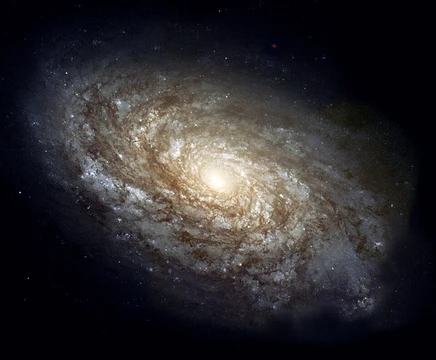
NGC 5204
A Magellanic spiral galaxy with a powerful ultraluminous X-ray source.

NGC 5204 is a Magellanic spiral galaxy located about 14.5 million light-years away in the constellation Ursa Major. It is a member of the M101 Group of galaxies and is notable for its highly irregular structure, with only a faint indication of spiral arms. The galaxy's most prominent feature is an extremely powerful ultraluminous X-ray source, NGC 5204 X-1, which has made it a target of numerous studies due to its strength and relative proximity.
Quick Facts
- Epoch
- J2000
- Constellation Name
- Ursa Major
- Ra
- 13 · 29 · 36.5
- Dec
- +58 · 25 · 07
- Z
- +201 km/s
- Dist Ly
- 4.3-4.8 Mpc / (14-14.5 million ly)
- Appmag V
- 11.73
- Names
- UGC 8490, PGC 47368, ZWG 294.39
Facts from the source article.
Lore & Background
NGC 5204 has a diameter of about 19,000 light-years, placing it between dwarf galaxies and larger spirals like Andromeda. Its overall organization is irregular, but a faint spiral arm structure at one end of the disc leads to its classification as a Magellanic spiral, similar to the Large Magellanic Cloud. The galaxy has a diffuse distribution of stars, a mass only about 10% of the LMC, and is relatively rich in gas and dust, though it lacks prominent nebulas or broad star-forming regions. It contains several clusters of hot, young stars and eleven known X-ray sources. The galaxy appears to have a larger than normal dark matter component, as the visible mass does not explain the observed rotation curve even near the center. No supernovas have been observed, but three supernova remnants have been identified, with an estimated supernova rate of about one every 2000 years.
The ultraluminous X-ray source NGC 5204 X-1 was discovered in the early 1980s by the Einstein Observatory. It has a luminosity of about 5.2 × 10^39 erg/s, too powerful for a stellar-mass black hole accretion disc, yet its location 15 arcseconds from the galaxy's center rules out an active galactic nucleus. Studies using the Chandra X-ray Observatory have ruled out the possibility that the source is multiple weaker sources. The leading theory proposes an intermediate-mass black hole of 100–100,000 M☉ with a giant companion star, supported by the Eddington limit requiring a mass of at least 25 M☉ and observed luminosity variations of up to 50% over ten years.
An optical counterpart was discovered in 2001 using Chandra and Hubble Space Telescope data. With an apparent magnitude of 19.7 (absolute magnitude -8.7), it is likely a type B or O supergiant. A 2003 spectral analysis suggested a surface temperature below 25,000 K, indicating a type B0 supergiant of about 25 M☉ and 30 R☉, similar to Deneb. Both the X-ray source and optical counterpart lie near the center of a void in the interstellar medium over 150 parsecs wide, likely carved by the star's powerful wind. The discovery of this massive star cast doubt on the black hole theory; a 2006 study found no periodic variations in X-ray luminosity, proposing instead that the X-rays come from the supergiant's corona, heated by the star's extreme and variable luminosity. The actual source remains unknown.
Reader's Guide
NGC 5204 holds significance primarily through its ultraluminous X-ray source, NGC 5204 X-1, one of the most powerful such sources known and located relatively nearby. This has made the galaxy a key laboratory for studying ULXs, which are too bright to be explained by typical stellar-mass black holes but are not active galactic nuclei. The source has been observed over decades, with its luminosity varying by up to 50%, and high-resolution Chandra observations have confirmed it is a single object. The discovery of a massive supergiant star as the optical counterpart introduced a competing theory that the X-rays may originate from the star's corona rather than a black hole accretion disc. The lack of periodic variations in the X-ray source supports this alternative, but no consensus has been reached. The galaxy itself, as a Magellanic spiral with a diffuse stellar distribution and a high dark matter component, also contributes to studies of galaxy structure and dark matter. Its membership in the M101 Group places it in a well-studied galactic environment, though it has no known close companions. The ongoing uncertainty about the nature of NGC 5204 X-1 ensures the galaxy remains a focus of astrophysical research.
Did You Know?
- The galaxy's mass is only about 10% of the Large Magellanic Cloud and 0.1% of the Milky Way.
- The optical counterpart to the X-ray source is a supergiant star with a mass of about 25 M☉ and a radius of about 30 R☉, similar to Deneb.
- No supernovas have been observed in NGC 5204, but three supernova remnants have been identified.
More in Elliptical and Irregular Galaxies, Part 5 1-24
Spotted an error? Know more?
Reader corrections go straight into our review queue. Suggest an edit · How this site is sourced