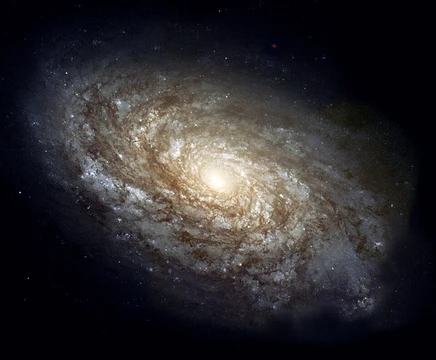
NGC 4861
A comet-like galaxy with disputed classification and two ultraluminous X-ray sources.

NGC 4861, also cataloged as Arp 266, lies in the constellation Canes Venatici. William Herschel first spotted it on May 1, 1785. Its classification has been tricky: the galaxy’s mass, size, and rotational speed suggest it could be a spiral, but its highly irregular shape points toward a dwarf irregular galaxy. Because dwarf galaxies have weaker gravity, gas and star-forming material can move around more quickly, which can turn them into a type of starburst galaxy known as a blue compact dwarf. Its appearance has also earned it the description “comet-like.”
Inside NGC 4861, astronomers have found two ultraluminous X-ray sources (ULXs). The first, NGC 4861 X1, is linked to a dense H II region. The second, NGC 4861 X2, appears to sit in a small star cluster near the galaxy’s “comet head.” If that cluster is real, it has a mass of about 400 ± 80 solar masses and an age of roughly 5 million years—quite low compared with other star clusters that host ULXs.
Quick Facts
- Epoch
- J2000
- Constellation Name
- Canes Venatici
- Ra
- 12 · 59 · 02.340
- Dec
- +34 · 51 · 33.98
- Z
- 0.002785
- H Radial V
- 835
- Dist Ly
- 10.662 +/-
- Group Cluster
- Virgo Cluster
- Appmag B
- 12.90
- Appmag V
- 12.32
- Names
- Arp 266, UGC 8098, MCG+06-29-003, PGC 44536
Facts from the source article.
Lore & Background
NGC 4861 was discovered by William Herschel on May 1, 1785. Its morphological classification has proved relatively difficult: its mass, size, and rotational velocity are consistent with it being a spiral galaxy, yet its highly irregular shape suggests it may be a dwarf irregular galaxy. Because dwarf galaxies are less massive and have lower gravitational potentials, gases and other material for star formation can move within them much faster, causing the galaxy to become a specific type of starburst galaxy called a blue compact dwarf galaxy. The galaxy has also been described as 'comet-like' due to its resemblance to a comet.
Two ultraluminous X-ray sources (ULXs) have been found within NGC 4861. The first, NGC 4861 X1, is associated with a dense H II region. The second, NGC 4861 X2, appears to be within a small star cluster near the 'comet head' of NGC 4861. Assuming it is a star cluster, it has a mass of 400±80 M☉ and an age of 5 million years. Compared to other star clusters with which ULXs are associated, its mass is quite low.
Reader's Guide
NGC 4861 is significant as an object that challenges straightforward classification, straddling the boundary between spiral and dwarf irregular galaxies. Its status as a blue compact dwarf galaxy highlights how low gravitational potentials in dwarf galaxies can accelerate gas movement and trigger starburst activity. The presence of two ultraluminous X-ray sources within it adds to its astrophysical interest: NGC 4861 X1 is tied to a dense H II region, while NGC 4861 X2 resides in a remarkably low-mass star cluster (400±80 M☉, age 5 million years) compared to typical ULX-associated clusters. This makes NGC 4861 a valuable case study for understanding ULX environments and the diversity of star formation in irregular galaxies. Its comet-like morphology further distinguishes it visually and structurally among irregular galaxies.
Did You Know?
- NGC 4861 is also known as Arp 266.
- Two ultraluminous X-ray sources have been found within NGC 4861: X1 and X2.
More in Elliptical and Irregular Galaxies, Part 5 1-24
Spotted an error? Know more?
Reader corrections go straight into our review queue. Suggest an edit · How this site is sourced