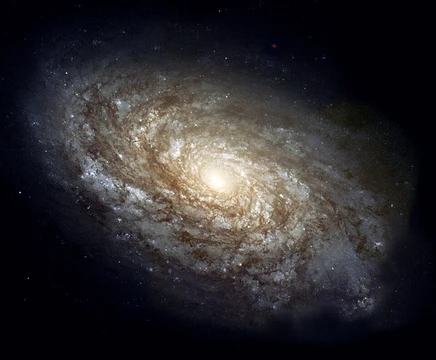
NGC 4625
A single-armed Magellanic spiral with an extended ultraviolet disk.

NGC 4625 is a distorted dwarf galaxy located in the constellation Canes Venatici. It is classified as an Sm galaxy, meaning its structure loosely resembles that of a spiral galaxy, and it is often called a Magellanic spiral because its single spiral arm is similar to that of the Large Magellanic Cloud.
Unlike most spiral galaxies, NGC 4625 has only one spiral arm, giving it an asymmetric look. One hypothesis is that this asymmetry comes from a gravitational interaction with the nearby galaxy NGC 4618, as such lopsided shapes are common in interacting galaxies. However, observations of neutral hydrogen gas in both NGC 4618 and NGC 4625 suggest that NGC 4625 has not been affected by such an interaction, implying that its single-arm structure may arise from internal processes.
Ultraviolet observations by the Galaxy Evolution Explorer (GALEX) reveal an extended disk around NGC 4625. This new spiral disk reaches 28,000 light-years from the galaxy’s center—four times the size of its optical disk. The hot blue stars in this outer disk may have formed from fresh gas and dust flowing in during interactions with its companions, NGC 4618 and NGC 4625A. The UV-to-optical colors indicate that most of the stars in NGC 4625’s disk are currently forming, offering a rare chance to study star formation under conditions similar to those when normal spiral disks, like that of the Milky Way, first developed.
NGC 4625 is interacting with NGC 4618. A similar asymmetric spiral galaxy is NGC 5713.
Quick Facts
- Epoch
- J2000
- Constellation Name
- Canes Venatici
- Ra
- 12 · 41 · 52.7
- Dec
- +41 · 16 · 26
- Z
- 609 ± 1 km/s
- Appmag V
- 13.2g
- Notes
- Asymmetric; Single spiral arm
- Names
- IC 3675, UGC 7861, PGC 42607
Facts from the source article.
Lore & Background
NGC 4625 is notable for having a single spiral arm, which gives the galaxy an asymmetric appearance. It has been hypothesized that this asymmetry may result from gravitational interaction with NGC 4618, as such structure is common among interacting galaxies. However, observations of neutral hydrogen gas in NGC 4618 and NGC 4625 show that NGC 4625 does not appear to have been affected by the interaction, suggesting the single-arm structure may be created through intrinsic processes.
Ultraviolet observations by the Galaxy Evolution Explorer (GALEX) reveal an extended disk that reaches 28,000 light-years from the galaxy center—four times the optical radius. The hot blue stars in this new disk may have formed from the inflow of fresh gas and dust from interaction with its companions, NGC 4618 and NGC 4625A. The UV-to-optical colors indicate that the bulk of the stars in the disk are currently being formed, offering a unique opportunity to study star formation under conditions similar to those when normal spiral disks like the Milky Way's first formed.
Reader's Guide
NGC 4625 is significant as a nearby laboratory for studying star formation in conditions analogous to the early formation of normal spiral disks. Its extended ultraviolet disk, discovered by GALEX, shows that star formation is ongoing over a region four times larger than the galaxy's optical extent. The fact that the galaxy's single-arm structure does not appear to be caused by gravitational interaction with NGC 4618—despite the asymmetry typical of interacting galaxies—suggests that intrinsic processes can produce such morphology. This challenges simple interpretations of asymmetric structure as solely interaction-driven. The ongoing star formation in the extended disk, likely fueled by gas inflow from interactions with NGC 4618 and NGC 4625A, provides a contemporary view of how spiral disks may have assembled in the early universe. NGC 4625 thus serves as a key object for understanding disk formation and the role of interactions versus internal dynamics in shaping galaxy structure.
Did You Know?
- NGC 4625 has only a single spiral arm, giving it an asymmetric appearance.
- Its extended ultraviolet disk reaches 28,000 light-years from the center, four times the optical radius.
- The galaxy is sometimes called a Magellanic spiral because it resembles the Large Magellanic Cloud.
- Observations of neutral hydrogen suggest the single-arm structure may arise from intrinsic processes, not gravitational interaction.
More in Elliptical and Irregular Galaxies, Part 5 1-24
Spotted an error? Know more?
Reader corrections go straight into our review queue. Suggest an edit · How this site is sourced