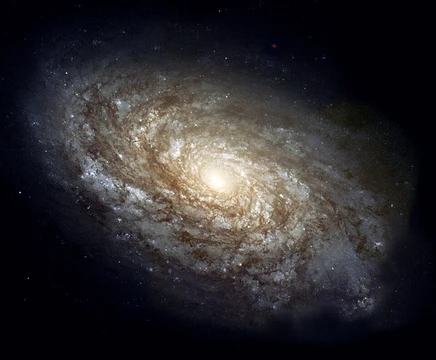
NGC 4395
A nearby dwarf Seyfert galaxy with a very low-mass black hole.

NGC 4395 is a spiral galaxy with low surface brightness, situated around 14 million light-years away in the constellation Canes Venatici. It belongs to the Seyfert Type I class, meaning its core is active, but it stands out because it has no bulge and is classified as a dwarf galaxy—an unusual combination for a Seyfert.
The galaxy’s halo spans roughly 8 arcminutes across, with several brighter patches aligned from northwest to southeast. The southeasternmost patch is the brightest. Three of these patches have their own NGC designations: 4401, 4400, and 4399, arranged from east to west.
Discovered by William Herschel on 2 January 1786, NGC 4395 was later photographed and described as a "spiral nebula" by Francis G. Pease in 1920. It is now recognized as a separate galaxy, not part of the Milky Way. In 1974, Allan Sandage and Gustav Andreas Tammann used resolved stars in NGC 4395 and other nearby galaxies to measure the Universe’s expansion rate. More recently, astronomers found that its nucleus hosts a very low-luminosity active galactic nucleus, prompting many studies to measure the mass of its central black hole.
The nucleus is one of the faintest and nearest among Seyfert galaxies. Its supermassive black hole is exceptionally small, with a well-measured mass of about 300,000 solar masses. However, newer estimates suggest it may be only 4,000 to 20,000 solar masses, placing it in the category of intermediate-mass black holes. The black hole might also have a truncated accretion disk.
NGC 4395 is a member of the NGC 4631 group (also called LGG 291), which includes at least 14 galaxies. The other members are NGC 4150, NGC 4163, NGC 4190, NGC 4214, NGC 4244, NGC 4308, NGC 4631, NGC 4656, IC 779, UGC 7605, UGC 7698, UGCA 276, and UGCA 292.
Quick Facts
- Epoch
- J2000
- Ra
- 12 · 25 · 48.8599
- Dec
- +33 · 32 · 48.711
- Constellation Name
- Canes Venatici
- Z
- 0.001064
- Dist Ly
- 4.261 ± 0.264 Mpcned
- Appmag V
- 10.6
- Group Cluster
- NGC 4631 Group (LGG 291)
Facts from the source article.
Lore & Background
NGC 4395 was discovered by German-British astronomer William Herschel on 2 January 1786. In 1920, astronomer Francis G. Pease imaged and classified it as a 'spiral nebula'; it is now known to be a galaxy distinct from the Milky Way. Along with several other nearby galaxies, resolved stars in NGC 4395 were used by Allan Sandage and Gustav Andreas Tammann in their 1974 paper to measure the expansion rate of the Universe. More recently, it was found to contain a very low-luminosity active galactic nucleus, and its nucleus has since been the subject of several academic papers and attempts to measure the mass of its central black hole.
The galaxy has a halo about 8 arcminutes in diameter, with several patches of greater brightness running northwest to southeast; the brightest patch lies furthest southeast. Three of these patches have their own NGC numbers: 4401, 4400, and 4399, running east to west. NGC 4395 is part of the NGC 4631 group (also known as LGG 291), which includes at least 14 members such as NGC 4150, NGC 4163, NGC 4190, NGC 4214, NGC 4244, NGC 4308, NGC 4631, NGC 4656, IC 779, UGC 7605, UGC 7698, UGCA 276, and UGCA 292.
Reader's Guide
NGC 4395 is significant as one of the least luminous and nearest Seyfert galaxies known, offering a unique laboratory for studying active galactic nuclei in a dwarf galaxy without a bulge. Its nucleus contains one of the smallest supermassive black holes with a well-measured mass, with estimates ranging from 300,000 solar masses down to as low as 4,000–20,000 solar masses, placing it in the category of intermediate-mass black holes. This low-mass black hole may have a truncated disk. The galaxy's proximity and low luminosity have made it a frequent target for studies of black hole masses and accretion processes. Additionally, its resolved stars contributed to early measurements of the expansion rate of the Universe, and its membership in the NGC 4631 group places it in a rich galactic environment. The ongoing uncertainty in the black hole mass underscores the challenges in measuring such objects and keeps NGC 4395 a focus of research.
Did You Know?
- NGC 4395 is a dwarf galaxy that lacks a bulge, unusual for a Seyfert galaxy.
- Its central black hole may be an intermediate-mass black hole, with recent estimates as low as 4,000 solar masses.
- Three bright patches within the galaxy have their own NGC designations: 4401, 4400, and 4399.
More in Elliptical and Irregular Galaxies, Part 5 1-24
Spotted an error? Know more?
Reader corrections go straight into our review queue. Suggest an edit · How this site is sourced