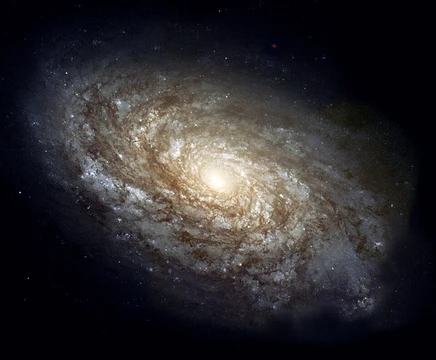
NGC 4299
A disturbed spiral galaxy interacting with NGC 4294 in Virgo.

NGC 4299 is a featureless spiral galaxy located about 55 million light-years away in the constellation Virgo. It is a member of the Virgo Cluster and forms an interacting pair with NGC 4294. The galaxy is notable for its disturbed morphology, asymmetric spiral arms, and a high global star formation rate influenced by both tidal interaction and ram-pressure.
Quick Facts
- Epoch
- J2000
- Ra
- 12 · 21 · 40.5
- Dec
- 11 · 30 · 00
- Dist Ly
- 16.8 Mpc
- Group Cluster
- Virgo Cluster
- H Radial V
- 237 km/s
- Z
- 0.000791
- Appmag V
- 12.88
- Constellation Name
- Virgo
Facts from the source article.
Lore & Background
NGC 4299 has a fairly featureless disk with a very small, weak bulge and weak, asymmetric spiral arms, along with numerous bright HII regions. At its center lies a nuclear star cluster with a diameter of about 5.9 light-years (1.8 parsecs). The galaxy may harbor an intermediate-mass black hole with an estimated mass ranging from 7,000 to 200,000 solar masses.
The galaxy exhibits a truncated Hα disk, where the outer extent of Hα emission has an irregular distribution except in the southwest, where it forms a well-defined ridge. This feature appears to be the result of ram-pressure. As a consequence of a tidal interaction with NGC 4294, NGC 4299 shows a disturbed optical and HI morphology, including asymmetric spiral arms, a small, weak bar, and a high global star formation rate that seems to have been enhanced by ram-pressure.
Chung et al. identified a one-sided tail of neutral atomic hydrogen (HI) pointing to the southwest, which may result from ram-pressure or tidal interaction with NGC 4294. This tail has no optical counterpart and is oriented parallel to the HI tail found in NGC 4294. A second, broader tail pointing to the southeast is much lower in HI surface density than the main tail.
Reader's Guide
NGC 4299 is significant as a clear example of how environmental processes—specifically ram-pressure and tidal interaction—can reshape a spiral galaxy's structure and star formation. Its truncated Hα disk and asymmetric HI tails illustrate the ongoing effects of ram-pressure stripping as the galaxy moves through the intracluster medium of the Virgo Cluster. The interaction with its companion NGC 4294 has further disturbed its morphology, creating a small, weak bar and asymmetric spiral arms while boosting its star formation rate. The presence of a nuclear star cluster and a possible intermediate-mass black hole adds to its interest for studies of galactic nuclei. The HI tails, lacking optical counterparts, provide evidence of gas being stripped from the galaxy, a process that can eventually quench star formation. NGC 4299 thus serves as a laboratory for understanding galaxy evolution in dense cluster environments, where gravitational and hydrodynamic forces compete to alter a galaxy's gas content and stellar population.
Did You Know?
- It has a one-sided HI tail pointing to the southwest with no optical counterpart.
- The galaxy may harbor an intermediate-mass black hole with a mass between 7,000 and 200,000 solar masses.
- Its Hα disk is truncated, with a well-defined ridge in the southwest likely due to ram-pressure.
More in Elliptical and Irregular Galaxies, Part 5 1-24
Spotted an error? Know more?
Reader corrections go straight into our review queue. Suggest an edit · How this site is sourced