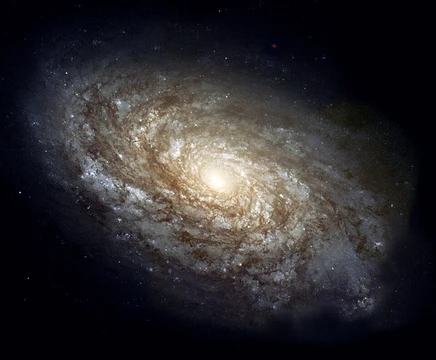
NGC 4178
A barred spiral with a low-mass black hole and no bulge.

NGC 4178 is a barred spiral galaxy in the equatorial constellation of Virgo. It is notable for hosting one of the lowest mass nuclear black holes known, detected by the Chandra X-ray Observatory, despite lacking a galactic bulge.
Quick Facts
- Epoch
- J2000
- Constellation Name
- Virgo
- Ra
- 12 · 12 · 46.443
- Dec
- +10 · 51 · 57.59
- Z
- 0.001261 ± 0.000013
- H Radial V
- +377 km/s
- Dist Ly
- 13.43 Mpc
- Group Cluster
- Virgo Cluster
- Names
- 2MASX J12124644+1051575, LEDA 38943, UGC 7215, UZC J121246.5+105206, Z 69−88, VCC 66 .
Facts from the source article.
Lore & Background
NGC 4178 was discovered by English astronomer John Herschel on April 11, 1825. It is classified as SB(rs)dm, indicating a barred core with traces of a ring-like structure and diffuse, broken, irregular spiral arms with no nuclear bulge. The galaxy is inclined 77° to the line of sight and spans 2.3 × 0.4 arc minutes. It lies about 43.8 million light years away and is a member of the Virgo Cluster, the richest nearby group of galaxies outside the Local Group and the core of the Virgo Supercluster.
Radio continuum emission along the galaxy's major axis is asymmetrical, brighter in the southwest than the northeast, with an overall low radio surface brightness. Mid-infrared spectra show indications of high ionization levels usually associated with an active galactic nucleus, but optical observations reveal no signs of an active nucleus, possibly due to heavy obscuration. The amount of ionized matter appears to increase near the core. In 2012, the Chandra X-ray Observatory detected a supermassive black hole at the core with an inferred mass of 10⁴ to 10⁵ solar masses, making it one of the lowest mass nuclear black holes known.
One supernova has been observed: SN 1963I, discovered by G. V. Zaytsheva on May 14, 1963 at the Konkoly Observatory in Budapest. It was suspected of being a Type Ia supernova, but this remains unconfirmed.
Reader's Guide
NGC 4178 holds significance as a barred spiral galaxy that challenges conventional models of black hole formation, as it hosts a supermassive black hole at its core despite lacking a galactic bulge that could supply mass. The black hole, detected by the Chandra X-ray Observatory in 2012, has an inferred mass of 10⁴ to 10⁵ solar masses, placing it among the lowest mass nuclear black holes known. This discovery suggests that black holes can grow in galaxies without classical bulges, possibly through other mechanisms such as accretion from the surrounding disk or mergers. The galaxy's asymmetrical radio continuum emission and mid-infrared signatures of high ionization, coupled with the absence of optical signs of an active nucleus, indicate that any active galactic nucleus may be heavily obscured. As a member of the Virgo Cluster, NGC 4178 contributes to the study of galaxy evolution in dense environments. The unconfirmed Type Ia supernova SN 1963I adds a transient event to its observational history, though its classification remains uncertain.
Did You Know?
- NGC 4178 was discovered by John Herschel on April 11, 1825.
- It hosts one of the lowest mass nuclear black holes known, at 10⁴ to 10⁵ solar masses.
- The galaxy has no bulge at its nucleus, yet a supermassive black hole was detected there in 2012.
- One supernova, SN 1963I, was observed in NGC 4178 but its Type Ia classification is unconfirmed.
More in Elliptical and Irregular Galaxies, Part 5 1-24
Spotted an error? Know more?
Reader corrections go straight into our review queue. Suggest an edit · How this site is sourced