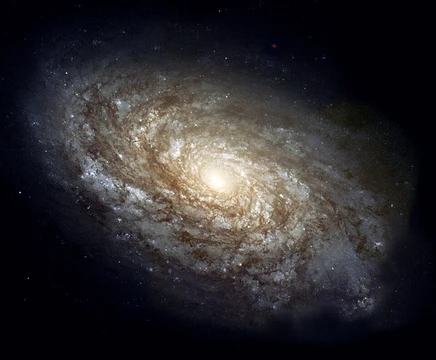
NGC 3995
A Magellanic spiral in Ursa Major, part of Arp 313.

NGC 3995 is a Magellanic spiral galaxy located in the constellation Ursa Major. Its distance is uncertain: measurements based on the Tully–Fisher relation place it about 100 million light-years away, while redshift data suggest a distance of 170 million light-years. The galaxy spans roughly 80,000 light-years across. It was discovered by Heinrich d'Arrest on February 5, 1864.
NGC 3995 is part of a triplet of galaxies, along with NGC 3994 (1.9 arcminutes away) and NGC 3991 (3.7 arcminutes away). This triplet is cataloged as Arp 313 in Halton Arp's Atlas of Peculiar Galaxies. While NGC 3995 and NGC 3991 show disturbed structures, NGC 3994 appears undisturbed. The triplet belongs to the NGC 3966 Group (also known as LGG 259), which includes NGC 3966, NGC 3935, NGC 3986, IC 2973, UGC 6892, IC 2978, and IC 2979.
The galaxy's star formation rate is estimated at 4.2 ± 0.9 solar masses per year, with higher rates near its center. Its nucleus emits light resembling an HII region, and its spectrum shows Wolf-Rayet features, indicating recent star formation. The Hubble Space Telescope has identified 46 star formation knots in NGC 3995, most of which are less than 20 million years old.
Two supernovae have been observed in NGC 3995: SN 1988ac (magnitude 16.5, type unknown), discovered by Michael Richmond on December 30, 1988; and SN 2000ez (Type II, magnitude 16.8), discovered by British amateur astronomer Mark Armstrong on November 24, 2000.
Quick Facts
- Epoch
- J2000
- Ra
- 11 · 57 · 44.1
- Dec
- +32 · 17 · 39
- Dist Ly
- 102 Mly (31.2 Mpc)
- Z
- 0.010938 ± 0.000002
- H Radial V
- 3,279 ± 1 km/s
- Appmag V
- 12.1
- Constellation Name
- Ursa Major
- Notes
- Interacting galaxy
Facts from the source article.
Lore & Background
NGC 3995 was discovered by Heinrich d'Arrest on February 5, 1864. It forms a triplet with NGC 3994 (1.9 arcminutes away) and NGC 3991 (3.7 arcminutes away), cataloged as Arp 313 in Halton Arp's Atlas of Peculiar Galaxies. Both NGC 3995 and NGC 3991 have disturbed appearances, while NGC 3994 does not. The triplet belongs to the NGC 3966 Group (LGG 259), which also includes NGC 3966, NGC 3935, NGC 3986, IC 2973, UGC 6892, IC 2978, and IC 2979.
The galaxy's distance is uncertain: the Tully–Fisher relation places it about 100 million light years away, while redshift measurements indicate 170 million light years. Its star formation rate is estimated at 4.2±0.9 M☉ per year, with higher rates near the center. The nucleus shows emission resembling an HII region, and the spectrum contains Wolf-Rayet features, indicating recent star formation. The Hubble Space Telescope detected 46 star formation knots in the galaxy, most younger than 20 million years.
Reader's Guide
NGC 3995's significance lies in its role as a member of Arp 313, a triplet of interacting galaxies that provides a laboratory for studying galaxy interactions and induced star formation. The disturbed morphology of NGC 3995 and NGC 3991, contrasted with the undisturbed NGC 3994, offers insight into how gravitational interactions trigger structural changes and star formation. The galaxy's high star formation rate, concentrated near the center, and the presence of Wolf-Rayet features point to a recent burst of stellar birth. The 46 star formation knots detected by the Hubble Space Telescope, most less than 20 million years old, further underscore the ongoing, vigorous star formation. Two supernovae have been observed: SN 1988ac (magnitude 16.5, type unknown) discovered by Michael Richmond on December 30, 1988, and SN 2000ez (Type II, magnitude 16.8) discovered by Mark Armstrong on November 24, 2000. These events add to the galaxy's legacy as an active site of stellar evolution and death. The distance discrepancy between Tully–Fisher and redshift methods highlights the challenges in measuring extragalactic distances, making NGC 3995 a useful object for calibrating such techniques.
Did You Know?
- NGC 3995 is part of the interacting triplet Arp 313, along with NGC 3994 and NGC 3991.
- The galaxy's distance is uncertain, with Tully–Fisher giving 100 million light years and redshift giving 170 million light years.
More in Elliptical and Irregular Galaxies, Part 5 1-24
Spotted an error? Know more?
Reader corrections go straight into our review queue. Suggest an edit · How this site is sourced