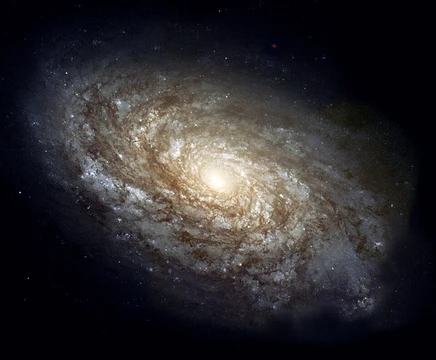
NGC 3664
Asymmetric magellanic barred spiral in the Leo II Groups.

NGC 3664 is a magellanic barred spiral galaxy located in the constellation Leo, approximately 80 million light years from Earth. It is notable for its asymmetric shape, featuring a single spiral arm and an off-centre bar, as well as an asymmetric distribution of neutral hydrogen (HI). The galaxy is a member of the NGC 3640 Group, which belongs to the larger Leo II Groups, a chain of galaxies and clusters extending from the edge of the Virgo Supercluster.
Quick Facts
- Epoch
- J2000
- Ra
- 11 · 24 · 24.2
- Dec
- +03 · 19 · 30
- Dist Ly
- 79 Mly (24.4 Mpc)
- Z
- 0.004607 ± 0.000007
- H Radial V
- 1,381 ± 2 km/s
- Appmag V
- 12.6
- Constellation Name
- Leo
- Notes
- Interacting galaxy
- Names
- UGC 6419, Arp 5, VV 251, DDO 95, CGCG 039-170, MCG +01-29-041, PGC 35041
Facts from the source article.
Lore & Background
NGC 3664 was discovered by Wilhelm Tempel on March 14, 1879. The galaxy is characterized by its asymmetric shape, which includes a single spiral arm and an off-centre bar. The distribution of HI is equally asymmetric. It has a smaller satellite galaxy, NGC 3664A (UGC 6418), located 6.2 arcminutes to the south at a projected distance of 25 to 30 kiloparsecs. The HI mass of NGC 3664A is 4.5×10^8 M☉, making the system similar in mass to the Large and Small Magellanic Cloud system. A HI bridge connecting the two galaxies has been detected in images from the Very Large Array, and the HI in NGC 3664 appears warped on the side opposite NGC 3664A, indicating an ongoing interaction. The bar of NGC 3664 may have developed due to this interaction.
Reader's Guide
NGC 3664 and its satellite NGC 3664A are members of the NGC 3640 Group, which also includes NGC 3630, NGC 3641, and NGC 3643. This group is part of the Leo II Groups, a large collection of galaxies and galaxy clusters scattered across 30 million light years of space west of the Virgo Cluster. The galaxy's asymmetric structure and the presence of a HI bridge to its satellite make it a valuable example of tidal interactions between galaxies. The system's mass similarity to the Magellanic Clouds offers a comparative case for studying dwarf galaxy interactions. NGC 3664 is also compared to NGC 4027, a similar spiral galaxy, highlighting its place among galaxies with disturbed morphologies.
Did You Know?
- Its satellite NGC 3664A has an HI mass of 4.5×10^8 M☉, similar to the Magellanic Clouds system.
- A HI bridge connects NGC 3664 and NGC 3664A, detected by the Very Large Array.
- The galaxy is a member of the NGC 3640 Group, part of the Leo II Groups in the Virgo Supercluster.
More in Elliptical and Irregular Galaxies, Part 5 1-24
Spotted an error? Know more?
Reader corrections go straight into our review queue. Suggest an edit · How this site is sourced