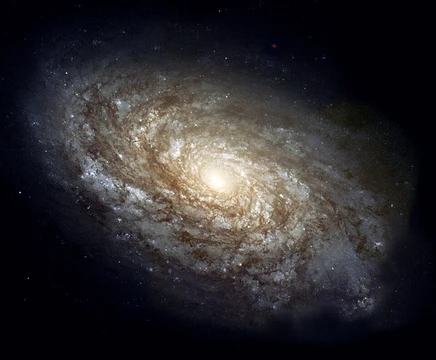
NGC 3447
Barred Magellanic spiral in Leo, host of SN 2012ht.

NGC 3447 is a barred Magellanic spiral galaxy in the constellation Leo. Its motion relative to the cosmic microwave background is measured at 1,405 ± 34 km/s, placing it at a Hubble distance of about 20.7 ± 1.5 megaparsecs, or roughly 67.5 million light-years. British astronomer John Herschel first spotted it in 1836. The galaxy emits a broad hydrogen line. With a surface brightness of 15.61 magnitudes per square arcsecond, NGC 3447 qualifies as a low surface brightness galaxy, meaning it is more diffuse than the surrounding night sky by at least one magnitude. Four non-redshift distance estimates give an average of 13.730 ± 9.802 megaparsecs (about 44.8 million light-years), a value that falls slightly outside the Hubble distance range.
A companion, NGC 3447A (also cataloged as UGC 6007), is an irregular galaxy in direct contact with NGC 3447. It has a similar apparent magnitude but a slightly lower surface brightness. Gravitational interactions have warped its shape, leaving disrupted spiral arms and hints of a former spiral structure.
On December 18, 2012, Koichi Nishiyama and Fujio Kabashima discovered a Type Ia supernova, designated SN 2012ht, within NGC 3447. It reached magnitude 18.6.
NGC 3447 is the largest galaxy in its namesake group, which includes at least four other galaxies: NGC 3447A, NGC 3457, UGC 6022, and UGC 6035.
Quick Facts
- Ra
- 10h 53m 24s
- Dec
- +16° 46 20
- Appmag B
- 14.3
- Epoch
- J2000
- Sbrightness
- 25.37 mag/arcsec^2 (3447) and 24.38 mag/arcsec^2 (3447A)
- Constellation Name
- Leo
- Names
- PGC 32694/32700, UGC 6006/6007, VV 252, IRAS 10507+1702, CGCG 095-058, KPG 255
- Z
- 0.003559
- Dist Ly
- 70 Mly (21.4 Mpc)
Facts from the source article.
Lore & Background
NGC 3447 was discovered by the British astronomer John Herschel in 1836. Its speed relative to the cosmic microwave background is 1,405 ± 34 km/s, corresponding to a Hubble distance of 20.7 ± 1.5 Mpc (~67.5 million ly). The galaxy shows a broad HI line. To date, four non-redshift measurements yield a distance of 13.730 ± 9.802 Mpc (~44.8 million ly), which is slightly outside the range values of Hubble.
NGC 3447 is in contact with an irregular companion galaxy, NGC 3447A (also known as UGC 6007). This companion has roughly the same apparent magnitude and a slightly lower surface brightness. Due to gravitational forces, NGC 3447A has become distorted, showing disrupted spiral arms and remnants of its spiral structure, hinting it might have been a spiral galaxy in the past.
The supernova SN 2012ht (Type Ia, mag. 18.6) was discovered in NGC 3447 by Koichi Nishiyama and Fujio Kabashima on December 18, 2012.
Reader's Guide
NGC 3447 is the largest galaxy in a group named after it, which includes at least four other galaxies: NGC 3447A, NGC 3457, UGC 6022, and UGC 6035. Its significance lies in its role as the dominant member of this small group and in its interaction with the distorted irregular companion NGC 3447A, which provides a case study of gravitational disruption and possible past spiral structure. The detection of a broad HI line indicates substantial neutral hydrogen content. The occurrence of a Type Ia supernova (SN 2012ht) adds to its observational interest, as such events are important for distance measurements and stellar evolution studies. The discrepancy between the Hubble distance and the non-redshift measurements (which give a slightly closer distance) highlights ongoing uncertainties in the galaxy's true distance, a common challenge in extragalactic astronomy. NGC 3447's classification as a barred Magellanic spiral places it among the less common subtypes of spiral galaxies, and its low surface brightness companion further enriches the system's astrophysical context.
Did You Know?
- It was discovered by John Herschel in 1836.
- NGC 3447 is the largest galaxy in a group that includes at least four other galaxies.
More in Elliptical and Irregular Galaxies, Part 5 1-24
Spotted an error? Know more?
Reader corrections go straight into our review queue. Suggest an edit · How this site is sourced