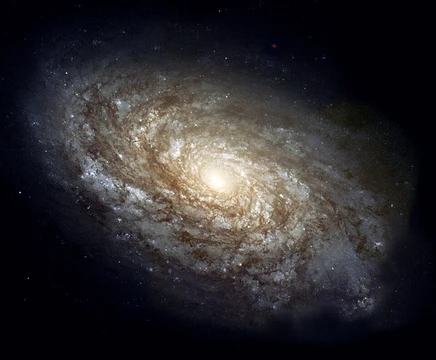
NGC 3445
A Magellanic spiral with a one-armed structure and active star formation.

NGC 3445, a Magellanic spiral galaxy, sits in the constellation Ursa Major. Discovered by William Herschel on April 8, 1793, it lies roughly 75 million light-years from Earth, with an estimated diameter of about 35,000 light-years based on its apparent size.
The galaxy appears in Halton Arp's Atlas of Peculiar Galaxies, placed in the category for one-armed spirals. Its thick spiral pattern contains many HII regions. A prominent spiral arm is visible on the southern side, while a fainter one shows up in infrared on the northern side. Radio emissions trace the arms. At the end of the main spiral arm, a smaller galaxy sits 1.2 arcminutes from NGC 3445's nucleus, connected by a weak bridge.
Infrared observations reveal four bright spots of active star formation. The brightest of these knots contains five young, massive star clusters, all born from a single giant molecular cloud. These clusters are 3 to 5 million years old, with a combined mass of about 105 solar masses. Another large star cluster lies at the galaxy's nucleus, possibly forming a bulge. The overall star formation rate is roughly one solar mass per year. Both the galaxy's shape and its star formation may stem from interactions with other galaxies.
NGC 3445 forms a triplet with NGC 3440 (9.9 arcminutes away) and NGC 3458 (14 arcminutes away), together making up the LGG 226 group. This group belongs to the same galaxy cloud as NGC 3610.
Quick Facts
- Epoch
- J2000
- Ra
- 10 · 54 · 35.5
- Dec
- +56 · 59 · 26
- Dist Ly
- 73.8 ± 20.1 Mly (22.6 ± 6.2 Mpc)
- Z
- 0.006831 ± 0.000003
- H Radial V
- 2,048 ± 1 km/s
- Appmag V
- 12.3
- Constellation Name
- Ursa Major
- Notes
- Interacting galaxy
- Names
- UGC 6021, Arp 24, VV 14a, MCG +10-16-023, IRAS 10515+5715, PGC 32772, 7C 1051+5715
Facts from the source article.
Lore & Background
NGC 3445 was discovered by William Herschel on April 8, 1793. The galaxy is included in Halton Arp's Atlas of Peculiar Galaxies in the one-armed spiral galaxies category. It has a thick arm pattern with many HII regions. A large spiral arm is visible at the south part of the galaxy while a weaker one is visible in infrared at the north. Radio emission is observed along the arms. At the end of the main spiral arm there is a smaller galaxy, lying 1.2 arcminutes from the nucleus of NGC 3445, connected with a weak bridge.
In the infrared are visible four bright locations of active star formation. The brightest of these infrared knots hosts five young massive star clusters, all being formed by a single giant molecular cloud. The age of the clusters was determined to be 3 to 5 million years and their mass to be around 105 M☉. Another large star cluster lies at the nucleus of the galaxy and could be in the process of forming a bulge. The total star formation rate of the galaxy is estimated to be around 1 M☉ per year. The star formation as well as the shape of the galaxy could be the result of interaction with other galaxies.
NGC 3445 forms a triplet with NGC 3440, which lies 9.9 arcminutes away, and NGC 3458, which lies 14 arcminutes away. These galaxies comprise the LGG 226 group. It belongs to the same galaxy cloud as NGC 3610.
Reader's Guide
NGC 3445 is significant as a Magellanic spiral galaxy that exhibits a peculiar one-armed spiral structure, earning it a place in Halton Arp's Atlas of Peculiar Galaxies. Its thick arm pattern, rich in HII regions, and the presence of a weaker infrared arm highlight its asymmetric morphology. The galaxy's interaction with a smaller companion, connected by a weak bridge at the end of the main spiral arm, is a key feature that likely drives its star formation and shape. The infrared observations reveal four bright knots of active star formation, with the brightest hosting five young massive star clusters formed from a single giant molecular cloud, aged 3 to 5 million years and with a mass around 105 M☉. A large star cluster at the nucleus may be forming a bulge. The total star formation rate of about 1 M☉ per year underscores its ongoing activity. As part of the LGG 226 group with NGC 3440 and NGC 3458, and belonging to the same galaxy cloud as NGC 3610, NGC 3445 provides insight into galaxy interactions and star formation processes in a group environment.
Did You Know?
- NGC 3445 is a Magellanic spiral galaxy about 75 million light years away.
- The galaxy has a large spiral arm at the south and a weaker infrared arm at the north.
More in Elliptical and Irregular Galaxies, Part 5 1-24
Spotted an error? Know more?
Reader corrections go straight into our review queue. Suggest an edit · How this site is sourced