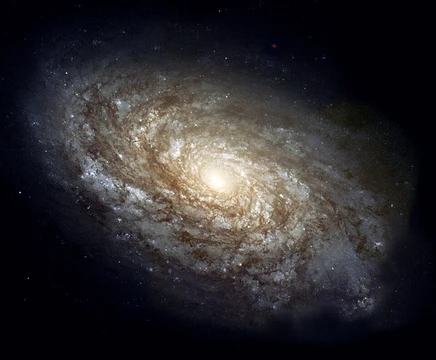
NGC 3432
Edge-on barred Magellanic spiral interacting with dwarf companion UGC 5983.

NGC 3432 is an edge-on spiral galaxy located in the northern constellation of Leo Minor. It is notable for its interaction with the dwarf galaxy UGC 5983, which has produced tidal filaments, intense star formation, and a distorted shape. The galaxy was listed in Halton Arp's Atlas of Peculiar Galaxies due to these features.
Quick Facts
- Epoch
- J2000
- Constellation Name
- Leo Minor
- Ra
- 10 · 52 · 31.132
- Dec
- +36 · 37 · 07.60
- Z
- 0.002055
- H Radial V
- 613
- Dist Ly
- 12.30 ±
- Appmag V
- 11.3
Facts from the source article.
Lore & Background
NGC 3432 was discovered by German-British astronomer William Herschel on March 19, 1787. Its morphological classification is SB(s)m, indicating a barred Magellanic spiral galaxy with no inner ring structure and an irregular appearance. The galaxy is inclined at an angle of 85°±2° to the plane of the sky, with its major axis along a positional angle of 38°, meaning it is viewed nearly edge-on. It is interacting with the dwarf galaxy UGC 5983, which has created features extending outside the galactic plane, an extended halo of radio emission, and two identified tidal tails. The galaxy hosts an active galactic nucleus of the LINER type with a nuclear HII region.
Reader's Guide
NGC 3432 is significant as a nearby example of a galaxy undergoing active interaction with a smaller companion, resulting in tidal distortions and enhanced star formation. Its inclusion in Halton Arp's Atlas of Peculiar Galaxies highlights its morphological peculiarity. The galaxy also gained attention for a candidate nova detected on May 3, 2000, located 123″ east and 180″ north of the galactic nucleus, aligned with an H II region or spiral arm. This event appeared similar to a Type IIn supernova (designated SN 2000ch) but peaked below typical luminosity, leading to classification as a supernova impostor—possibly a superoutburst of a luminous variable, comparable to the mid-nineteenth-century eruption of Eta Carinae. Multiple subsequent outbursts were observed in 2008 and 2009, and the object is expected to become a core collapse supernova in the future. The galaxy's edge-on orientation and interaction make it a valuable target for studying galactic dynamics and transient phenomena.
Did You Know?
- NGC 3432 was discovered by William Herschel on March 19, 1787.
- It is interacting with the dwarf galaxy UGC 5983, producing tidal tails and an extended radio halo.
More in Elliptical and Irregular Galaxies, Part 5 1-24
Spotted an error? Know more?
Reader corrections go straight into our review queue. Suggest an edit · How this site is sourced