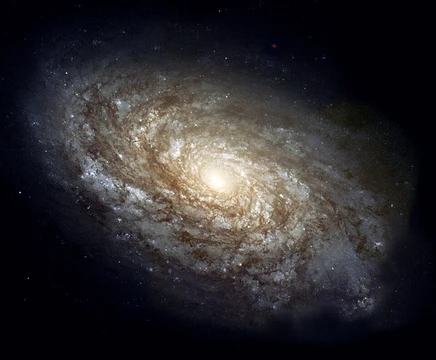
NGC 3109
A small, metal-poor galaxy on the outskirts of the Local Group.

NGC 3109 is a small galaxy of the barred Magellanic type, located about 4.35 million light-years away in the constellation Hydra. It was first observed by John Herschel on March 24, 1835, while he was in what is now South Africa. Astronomers are unsure whether it is an irregular galaxy or a small spiral galaxy; if it is a spiral, it would be the smallest such galaxy in the Local Group. Its isophotal diameter, based on the D25.5 isophote in the B-band, is about 41,700 light-years, making it slightly larger than the Large Magellanic Cloud but smaller than the Triangulum Galaxy. The galaxy has a mass of roughly 2.3 billion times that of the Sun, with about 20% of that mass in neutral hydrogen. It is seen edge-on and may have a disk and a halo: the disk contains stars of all ages, while the halo holds only very old, metal-poor stars. NGC 3109 does not appear to have a galactic nucleus. Its disk of neutral atomic hydrogen is warped, and this warp shares the same radial velocity as gas in the Antlia Dwarf galaxy, suggesting the two galaxies had a close encounter about one billion years ago.
The galaxy has a low metallicity, similar to that of the Small Magellanic Cloud, based on spectroscopy of its blue supergiants. It is one of the most metal-poor star-forming galaxies in the Local Group. NGC 3109 also contains an unusually high number of planetary nebulae for its brightness, along with a substantial amount of dark matter.
NGC 3109 lies about 4.3 million light-years away in Hydra, placing it at the very edge of the Local Group. Its membership in the Local Group has been questioned because it appears to be receding faster than the group’s estimated escape velocity. It is far enough from the Local Group’s largest members that it has not been tidally affected by them. The galaxy has two satellite galaxies: the Antlia Dwarf and Antlia B.
No supernovae have been observed in NGC 3109, but a luminous blue variable, designated AT 2018akx, was discovered there on March 22, 2018, by the All Sky Automated Survey for SuperNovae, with a magnitude of 17.5.
Quick Facts
- Epoch
- J2000
- Ra
- 10 · 03 · 06.88
- Dec
- -26 · 09 · 34.5
- Dist Ly
- 1.333 +/-
- Z
- 403 ± 1 km/s
- Appmag V
- 10.4
- Constellation Name
- Hydra
Facts from the source article.
Lore & Background
NGC 3109 was discovered by John Herschel on March 24, 1835 while he was in what is now South Africa. It is classified as a Magellanic type irregular galaxy, but it may in fact be a small spiral galaxy; if so, it would be the smallest spiral in the Local Group. Based on the D25.5 isophote at the B-band with an angular diameter of 1,980 arcseconds, its isophotal diameter is approximately 12.80 kiloparsecs (41,700 light-years) across, slightly larger than the Large Magellanic Cloud but smaller than the Triangulum Galaxy. The galaxy is oriented edge-on from our point of view and may contain a disk and a halo. The disk appears to be composed of stars of all ages, whereas the halo contains only very old and metal-poor stars. NGC 3109 does not appear to possess a galactic nucleus.
From measurements of neutral atomic hydrogen, the disk of NGC 3109 is warped. The warp has the same radial velocity as gas in the Antlia Dwarf galaxy, indicating that the two galaxies had a close encounter approximately one billion years ago. NGC 3109 has a mass of about 2.3×10^9 solar masses, of which 20% is in the form of neutral hydrogen. It has a low metallicity, similar to that of the Small Magellanic Cloud, and is one of the most metal-poor star-forming galaxies in the Local Group. It also contains an unusually large number of planetary nebulae for its luminosity and a substantial amount of dark matter.
NGC 3109 is located about 1.33 megaparsecs (4.3 Mly) away, in the constellation Hydra, placing it at the very outskirts of the Local Group. Its membership of the Local Group has been questioned because it seems to be receding faster than estimates of the Local Group's escape velocity. It is distant enough from the largest members of the Local Group that it has not been tidally influenced by them. NGC 3109 has two satellite galaxies: the Antlia Dwarf and Antlia B.
Reader's Guide
NGC 3109 holds significance as a nearby laboratory for studying galaxy formation and evolution in a low-metallicity environment. Its uncertain classification—whether it is an irregular galaxy or the smallest spiral in the Local Group—highlights the challenges in distinguishing galaxy types at the low-mass end. The galaxy's warped disk, likely caused by an encounter with the Antlia Dwarf about one billion years ago, provides evidence of tidal interactions among dwarf galaxies. Its low metallicity, comparable to the Small Magellanic Cloud, makes it a key target for understanding star formation in metal-poor conditions. The presence of an unusually large number of planetary nebulae relative to its luminosity and a substantial dark matter component further add to its astrophysical interest. Although no supernovae have been observed in NGC 3109, a luminous blue variable (AT 2018akx) was discovered there in 2018, indicating ongoing massive star activity. Its position on the outskirts of the Local Group and its questionable membership due to its high recession velocity raise questions about the dynamical boundaries of the Local Group itself. NGC 3109 thus serves as an important object for studies of dwarf galaxy structure, chemical enrichment, and the history of interactions within the Local Group's periphery.
Did You Know?
- It may be the smallest spiral galaxy in the Local Group if it is indeed a spiral.
- The galaxy's disk is warped, likely due to a close encounter with the Antlia Dwarf about one billion years ago.
- A luminous blue variable, AT 2018akx, was discovered in NGC 3109 on 22 March 2018.
More in Elliptical and Irregular Galaxies, Part 5 1-24
Spotted an error? Know more?
Reader corrections go straight into our review queue. Suggest an edit · How this site is sourced