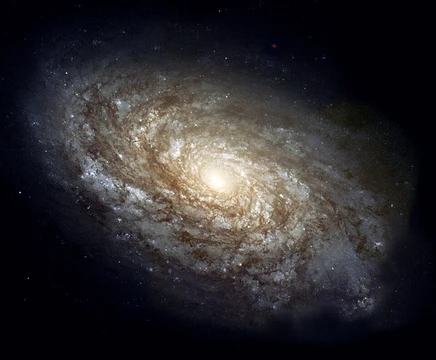
Large Magellanic Cloud
A dwarf satellite galaxy of the Milky Way, rich in gas and star formation.

The Large Magellanic Cloud (LMC) is a dwarf galaxy that orbits the Milky Way. It lies about 163,000 light-years away, making it the second or third closest galaxy to our own, behind the Sagittarius Dwarf Spheroidal and possibly the Canis Major Overdensity. Spanning roughly 32,200 light-years across, it has only about one percent of the Milky Way’s mass, which places it as the fourth-largest galaxy in the Local Group, after Andromeda, the Milky Way, and Triangulum. The LMC is a Magellanic spiral, featuring a central stellar bar that is off-center. This suggests it was originally a barred spiral galaxy whose arms were later warped, likely by gravitational tugs from the Small Magellanic Cloud and the Milky Way. It is expected to merge with the Milky Way in about 2.4 billion years.
Visible from the Southern Hemisphere and as far north as 20° N, the LMC appears as a faint cloud in the sky, straddling the constellations Dorado and Mensa. Its declination is about −70°. Under dark skies, it stretches roughly 10° across—20 times the Moon’s diameter.
Both Magellanic Clouds have been easily seen by southern observers since prehistoric times. The first confirmed written record came in 1502, when Amerigo Vespucci mentioned “three Canopi, two bright and one obscure” in a letter after his second voyage; the bright ones were the Magellanic Clouds, and the obscure one was the Coalsack. Ferdinand Magellan spotted the LMC in 1519, and his accounts brought it into common Western knowledge, leading to its name. Around 964 AD, the Persian astronomer al-Sufi may have referred to it as Al Bakr, the White Ox, but this appears to be a misunderstanding of stars south of Canopus he hadn’t seen. The galaxy and southern Dorado reach opposition around December 5, visible from sunset to sunrise near the equator. South of about 28° S—such as most of Australia and South Africa—the LMC is circumpolar, remaining above the horizon year-round. In 2006, Hubble Space Telescope measurements suggested the LMC and SMC might be moving too fast to be orbiting the Milky Way. In November 2021, astronomers using the Very Large Telescope in Chile discovered a black hole, NGC 1850 BH1, inside the LMC, whose gravity is influenced by a nearby star about five times the Sun’s mass.
Quick Facts
- Epoch
- J2000
- Ra
- 05 · 23 · 34
- Dec
- -69 · 45.4
- Dist Ly
- 49.97 kpcNature
- Appmag V
- 0.13
- Stars
- 20 billionsdick
- Constellation Name
- Dorado/Mensa
- Names
- LMC, ESO 56- G 115, PGC 17223, Nubecula Majorbuscombe
Facts from the source article.
Lore & Background
Both the Large and Small Magellanic Clouds have been easily visible for southern nighttime observers well back into prehistory. The first confirmed recorded observation was in a letter written in 1502 by Amerigo Vespucci after his second voyage, mentioning 'three Canopi, two bright and one obscure'; 'bright' refers to the two Magellanic Clouds, and 'obscure' refers to the Coalsack. Ferdinand Magellan sighted the LMC on his voyage in 1519 and his writings brought it into common Western knowledge; the galaxy now bears his name. The galaxy and southern end of Dorado are in the current epoch at opposition on about 5 December when thus visible from sunset to sunrise from equatorial points such as Ecuador, the Congos, Uganda, Kenya and Indonesia and for part of the night in nearby months. Above about 28° south, such as most of Australia and South Africa, the galaxy is always sufficiently above the horizon to be considered properly circumpolar.
The LMC has a prominent central bar and spiral arm. The central bar, with a radius of 6,900 light-years (2.13 kpc) and a position angle of about 121°, seems to be warped so that the east and west ends are nearer the Milky Way than the middle. Measurements from the Hubble Space Telescope in 2014 made it possible to determine a rotation period of 250 million years. The LMC was long considered to be a planar galaxy that could be assumed to lie at a single distance from the Solar System, but studies from 1986 and 2001–2002 confirmed an inclined geometry with an inclination of ~35°. Further work on the structure using the kinematics of carbon stars showed that the LMC's disk is both thick and flared, likely due to interactions with the SMC.
The distance to the LMC has been calculated using standard candles such as Cepheid variables, though the variable of metallicity may affect their period-luminosity relations. In 2006, the Cepheid absolute luminosity was re-calibrated using Cepheid variables in the galaxy Messier 106, yielding an absolute distance modulus of 18.41, or 48 kpc (160,000 light-years). A study using late-type eclipsing binaries published in Nature in March 2013 obtained a distance of 49.97 kpc (163,000 light-years) with an accuracy of 2.2%.
Reader's Guide
The Large Magellanic Cloud is notable as an 'astronomical treasure-house, a great celestial laboratory for the study of the growth and evolution of the stars,' per Robert Burnham Jr. Like many irregular galaxies, it is rich in gas and dust and is currently undergoing vigorous star formation activity. It holds the Tarantula Nebula, the most active star-forming region in the Local Group. Surveys of the galaxy have found roughly 60 globular clusters, 400 planetary nebulae and 700 open clusters, along with hundreds of thousands of giant and supergiant stars. Supernova 1987A—the nearest supernova in recent years—was in the Large Magellanic Cloud. The Lionel-Murphy SNR (N86) nitrogen-abundant supernova remnant was named by astronomers at the Australian National University's Mount Stromlo Observatory, acknowledging Australian High Court Justice Lionel Murphy's interest in science and its perceived resemblance to his large nose.
A bridge of gas connects the Small Magellanic Cloud with the LMC, which evinces tidal interaction between the galaxies. The Magellanic Clouds have a common envelope of neutral hydrogen, indicating that they have been gravitationally bound for a long time. This bridge of gas is a star-forming site. The Large Magellanic Cloud likely has a supermassive black hole at its center, estimated to have 630,000+370,000−380,000 times the mass of the Sun. 21 hypervelocity stars have been discovered within the Milky Way's halo, which are thought to have been ejected from the Large Magellanic Cloud after gravitational interaction with this black hole via the Hills mechanism. Measurements with the Hubble Space Telescope, announced in 2006, suggest the Large and Small Magellanic Clouds may be moving too quickly to be orbiting the Milky Way.
Did You Know?
- The LMC is predicted to merge with the Milky Way in approximately 2.4 billion years.
- Supernova 1987A, the nearest supernova in recent years, occurred in the Large Magellanic Cloud.
- The LMC likely has a supermassive black hole at its center with an estimated mass of 630,000+370,000−380,000 times the Sun.
- A bridge of gas connects the LMC with the Small Magellanic Cloud, indicating tidal interaction.
More in Elliptical and Irregular Galaxies, Part 5 1-24
Spotted an error? Know more?
Reader corrections go straight into our review queue. Suggest an edit · How this site is sourced