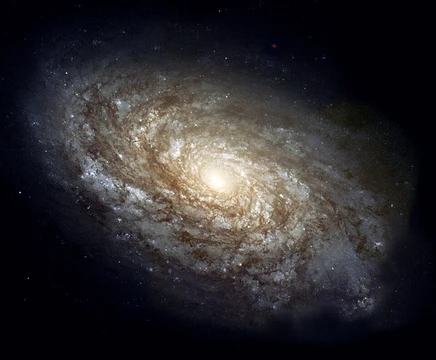
IC 4182
A face-on Magellanic spiral that calibrated the Hubble constant.

IC 4182 is a Magellanic spiral galaxy in the constellation Canes Venatici, located about 14 million light years from Earth. It is notable for being the first Type Ia supernova to have its distance calibrated using Cepheid variable stars, a milestone in measuring the Hubble constant.
Quick Facts
- Epoch
- J2000
- Ra
- 13 · 05 · 48.7008
- Dec
- +37 · 36 · 12.996
- Dist Ly
- 13.7 ± 2.6 Mly (4.2 ± 0.79 Mpc)
- Z
- 0.001071 ± 0.000003
- H Radial V
- 321 ± 1 km/s
- Appmag V
- 11.4
- Constellation Name
- Canes Venatici
Facts from the source article.
Lore & Background
IC 4182 was discovered by German astronomer Max Wolf on 21 March 1903. The galaxy is seen nearly face-on and has a low surface brightness disk with patches of star formation but no spiral pattern. Its brightest stars are resolvable through large telescopes, with photometric blue filter apparent magnitude of 19.2, and visual magnitudes around 20 for the brightest blue stars and around 21 for the brightest red stars. The density of ultraviolet sources decreases monotonically with radius.
The galaxy is considered a member of the M94 Group, though Garcia considered it part of the LGG 334 group along with NGC 5005 and NGC 5033. One supernova has been observed: SN 1937C, a Type Ia event discovered by Fritz Zwicky on 24 August 1937. It was located 30 arcseconds north and 40 arcseconds east of the nucleus, a few days post maximum, with a peak apparent B-magnitude estimated at 8.7.
Reader's Guide
IC 4182 holds a pivotal place in cosmology because of the supernova SN 1937C. In 1992, the Hubble Space Telescope repeatedly observed the galaxy, leading to the discovery of Cepheid variable stars within it. SN 1937C then became the first Type Ia supernova to have its distance calibrated using Cepheid stars, allowing it to be used as a standard candle to calculate the Hubble constant. This calibration helped refine the expansion rate of the universe, making IC 4182 a key object in extragalactic distance measurements. The galaxy's face-on orientation and resolvable stars further aided these studies, cementing its legacy as a cornerstone in the cosmic distance ladder.
Frequently Asked Questions
What is IC 4182?
IC 4182 is a face-on Magellanic spiral galaxy sitting roughly 14 million light years away in the constellation Canes Venatici. It spans about 28,000 light years across, making it a compact but visually striking island of stars.
Why is IC 4182 famous in astronomy?
It earned its reputation as the first host galaxy where a Type Ia supernova's distance was pinned down using Cepheid variable stars. That calibration became a critical stepping stone in refining the Hubble constant and our picture of the universe's expansion rate.
Who discovered IC 4182 and when?
German astronomer Max Wolf identified the galaxy on 21 March 1903. It has carried the catalog designation IC 4182 ever since.
What type of galaxy is IC 4182?
It is classified as a Magellanic spiral, meaning it shows the loose, open spiral structure typical of irregular-to-spiral transition systems. Its face-on orientation lets observers see those sweeping arms clearly.
How far away is IC 4182?
It sits approximately 14 million light years from Earth, placing it within the local cosmic neighborhood. At that distance, its roughly 28,000-light-year diameter makes it a relatively small galaxy compared to the Milky Way.
More in Elliptical and Irregular Galaxies, Part 5 1-24
Spotted an error? Know more?
Reader corrections go straight into our review queue. Suggest an edit · How this site is sourced