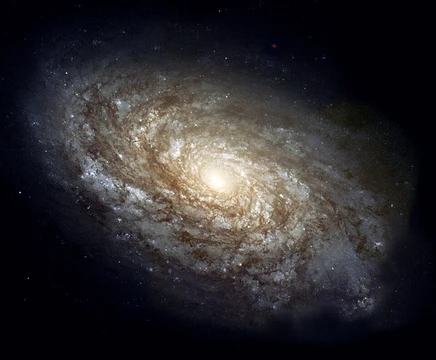
DDO 44
Dwarf spheroidal galaxy with tidal tails, satellite of NGC 2403.

DDO 44 (also known as UGCA 133) is a dwarf spheroidal galaxy in the M81 Group. It is notable for being a relatively large dwarf galaxy that is believed to be a satellite galaxy of the nearby NGC 2403, and for exhibiting tidal tails and stellar streams indicative of ongoing tidal disruption.
Quick Facts
- Epoch
- J2000
- Constellation Name
- Camelopardalis
- Ra
- 07 · 34 · 11.5
- Dec
- +66 · 52 · 47
- Z
- 0.000711
- Dist Ly
- 9.82 ± 0.59 Mly
- Appmag V
- 15.6
- Names
- UGCA 133, Anon 0729+66, LEDA 21302, KK98a 61, KK98a 072913.1+665940
Facts from the source article.
Lore & Background
DDO 44 is a dwarf spheroidal galaxy located in the M81 Group, approximately 3 million parsecs from the Milky Way. It is positioned about 79 arcminutes north-northwest of NGC 2403, corresponding to a projected separation of roughly 75 kiloparsecs. Based on its proximity and relative velocity, it is believed to be a satellite galaxy of NGC 2403, and it is by far the most massive known satellite of that galaxy, with a luminosity-based mass estimate of 2×10⁷ to 6×10⁷ solar masses. The only other known satellite of NGC 2403, MADCASH J074238+652501-dw, has a mass of only about 10⁵ solar masses.
The galaxy has been observed to possess a tidal tail extending at least 50,000 parsecs from its center. Stellar streams have been observed flowing both toward and away from NGC 2403, indicating tidal disruptions are occurring. Around 20 percent of DDO 44's stars are of intermediate age (between 2 and 8 billion years old), and the most recent stellar formation is estimated to have occurred about 300 million years ago, based on the lack of young bright blue stars. This absence of bright stars contributes to the galaxy's relatively low level of brightness. HI observations place an upper limit on its hydrogen gas mass at 4×10⁵ solar masses.
Reader's Guide
DDO 44 holds significance as a relatively large dwarf spheroidal galaxy that is undergoing tidal disruption while in orbit around NGC 2403. Its observed tidal tail, extending at least 50,000 parsecs, and the stellar streams flowing both toward and away from NGC 2403 provide direct evidence of ongoing tidal interactions in a low-mass galaxy environment. As the most massive known satellite of NGC 2403—with a mass roughly 200 to 600 times that of the next known satellite—it offers a unique laboratory for studying how dwarf galaxies are stripped of stars and gas as they interact with a larger host. The galaxy's low hydrogen gas mass upper limit and its lack of young bright stars suggest that star formation has been largely quenched, with the most recent episode occurring roughly 300 million years ago. Its metallicity of [Fe/H] = –1.54 ± 0.14 places it among metal-poor systems, consistent with its dwarf spheroidal classification. The legacy of DDO 44 lies in its role as a clear example of tidal destruction in a relatively isolated group, helping to illuminate the processes that shape dwarf galaxy evolution and the buildup of stellar halos around larger galaxies.
Did You Know?
- It is the most massive known satellite galaxy of NGC 2403, with a mass of 2×10⁷–6×10⁷ M☉.
- Around 20 percent of its stars are of intermediate age (2 to 8 billion years old).
- The galaxy's hydrogen gas mass has an upper limit of 4×10⁵ M☉.
More in Elliptical and Irregular Galaxies, Part 5 1-24
Spotted an error? Know more?
Reader corrections go straight into our review queue. Suggest an edit · How this site is sourced