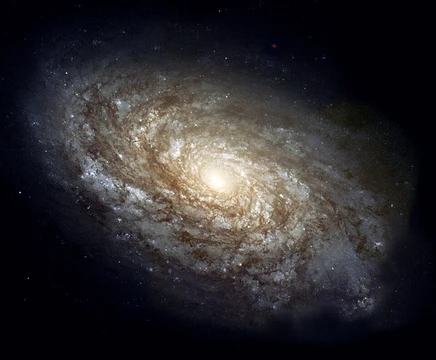
Coma Berenices (dwarf galaxy)
A dark-matter-dominated dwarf spheroidal satellite of the Milky Way.

Coma Berenices (Com) is a dwarf spheroidal galaxy in the constellation Coma Berenices. Discovered in data from the Sloan Digital Sky Survey, it is one of the smallest and faintest satellites of the Milky Way, notable for its extreme dark matter dominance and ancient stellar population.
Quick Facts
- Epoch
- J2000
- Ra
- 12 · 26 · 59
- Dec
- +23 · 55 · 09
- Appmag V
- 14.5 ± 0.5
- Constellation Name
- Coma Berenices
- Names
- Coma Dwarf, PGC 4713557
Facts from the source article.
Lore & Background
Coma Berenices was discovered in 2006 using data from the Sloan Digital Sky Survey. It lies about 44 kpc from the Sun and is receding at roughly 98 km/s. Classified as a dwarf spheroidal galaxy, it has an elliptical shape with an axis ratio of about 5:3 and a half-light radius of approximately 70 pc.
The galaxy's stellar population consists mainly of very old stars, formed more than 12 billion years ago. Their metallicity is extremely low, at [Fe/H] ≈ −2.53 ± 0.45, meaning they contain about 350 times fewer heavy elements than the Sun. No star formation is currently occurring, and no neutral hydrogen has been detected down to an upper limit of 46 solar masses.
Coma Berenices is located near the Sagittarius Stream, a tidal feature composed of stars stripped from the Sagittarius Dwarf Elliptical Galaxy. This proximity may indicate that Coma Berenices was originally a satellite or star cluster of that galaxy.
Reader's Guide
Coma Berenices holds significance as one of the faintest and most dark-matter-dominated known satellites of the Milky Way. Its integrated luminosity is only about 3700 times that of the Sun, yet its mass is roughly 1.2 million solar masses, yielding a mass-to-light ratio of around 450. This high ratio implies that the galaxy is overwhelmingly composed of dark matter, making it a valuable laboratory for studying dark matter on small scales.
The galaxy's ancient stellar population—stars formed more than 12 billion years ago with extremely low metallicity—suggests that its stars were among the first to form in the Universe. The absence of neutral hydrogen and ongoing star formation indicates that Coma Berenices is a fossil system, preserving conditions from the early cosmos.
Its proximity to the Sagittarius Stream raises the possibility that Coma Berenices was once part of the Sagittarius Dwarf Elliptical Galaxy, either as a former satellite or a stripped star cluster. This connection ties it to the broader dynamical history of the Milky Way's satellite system. As one of the smallest and faintest dwarf spheroidals known, Coma Berenices provides a unique window into the properties of dark matter halos and the earliest epochs of galaxy formation.
Did You Know?
- Coma Berenices has a mass-to-light ratio of about 450, indicating it is dominated by dark matter.
- No neutral hydrogen has been detected in Coma Berenices, with an upper limit of only 46 solar masses.
- The galaxy lies near the Sagittarius Stream and may have been a former satellite or star cluster of the Sagittarius Dwarf Elliptical Galaxy.
More in Elliptical and Irregular Galaxies, Part 5 1-24
Spotted an error? Know more?
Reader corrections go straight into our review queue. Suggest an edit · How this site is sourced