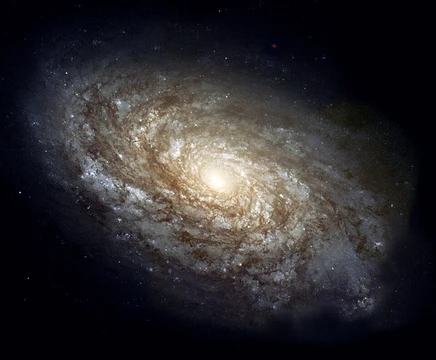
Cassiopeia Dwarf
Brightest and most massive dwarf spheroidal satellite of Andromeda.

The Cassiopeia Dwarf, also called Andromeda VII, lies about 2.45 million light-years away in the constellation Cassiopeia. It belongs to the Local Group and orbits the Andromeda Galaxy (M31) as a satellite. Because it sits behind the Milky Way’s galactic plane when viewed from Earth, its light is reddened by 0.194 magnitudes. Among all of Andromeda’s dwarf spheroidal satellites, this galaxy is both the brightest and the most massive, with a luminosity of 1.8×10⁷ times that of the Sun and a stellar mass of 19.73×10⁶ solar masses. It also has the highest metallicity of any such satellite.
Discovered in 1998 by a Russian-Ukrainian team (Karachentsev and Karachentseva) alongside the Pegasus Dwarf, the Cassiopeia Dwarf lies farther from M31 than most of its known companions, though it still appears gravitationally bound. Neither galaxy contains young, massive stars or shows signs of recent star formation. Instead, both are dominated by very old stars, some up to 10 billion years in age. The main burst of star formation in the Cassiopeia Dwarf occurred roughly 6.2 billion years ago, and by 5 billion years ago, 90% of its star formation had already finished.
Quick Facts
- Epoch
- J2000
- Ra
- 23 · 26 · 31.0
- Dec
- +50 · 41 · 31
- Dist Ly
- 2.45 Mly
- Z
- −307 ± 2 km/s
- Appmag V
- 12.9
- Absmag V
- −13.3 ± 0.3
- Constellation Name
- Cassiopeia
- Notes
- satellite galaxy of the Andromeda Galaxy
- Names
- Andromeda VII, And VII, Cas dSph, PGC 2807155, / Cassiopeia Dwarf Galaxy
Facts from the source article.
Lore & Background
The Cassiopeia Dwarf was discovered in 1998 by a team of astronomers (Karachentsev and Karachentseva) in Russia and Ukraine, together with the Pegasus Dwarf. Both galaxies lie farther from M31 than its other known companions, yet they still appear gravitationally bound to it. The galaxy appears behind the Milky Way's galactic plane, causing its light to be reddened by 0.194 magnitudes.
Neither the Cassiopeia Dwarf nor the Pegasus Dwarf contains young, massive stars or shows signs of recent star formation. Instead, both are dominated by very old stars, with ages reaching up to 10 billion years. The main period of star formation in the Cassiopeia Dwarf occurred around 6.2 billion years ago, and 90% of its star formation was completed by 5 billion years ago.
Reader's Guide
The Cassiopeia Dwarf holds significance as the brightest and most massive dwarf spheroidal satellite of the Andromeda Galaxy, as well as the one with the highest metallicity. Its discovery in 1998, alongside the Pegasus Dwarf, expanded the known population of Andromeda's outer satellites. The galaxy's lack of young stars and its ancient stellar population—with star formation peaking about 6.2 billion years ago and largely ceasing by 5 billion years ago—indicate it is a quiescent, evolved system. Its position behind the Milky Way's plane adds observational challenges, but its status as a bound satellite of M31 helps astronomers study the dynamics and composition of the Local Group's outer regions. The Cassiopeia Dwarf's relatively high metallicity among Andromeda's dwarf spheroidals suggests a distinct chemical enrichment history, offering clues about the early evolution of small galaxies in a major galaxy's vicinity.
Did You Know?
- The Cassiopeia Dwarf is also known as Andromeda VII.
- It is the brightest and most massive of Andromeda Galaxy's dwarf spheroidal satellites.
- The galaxy's main star formation period occurred around 6.2 billion years ago.
- It was discovered in 1998 by Karachentsev and Karachentseva.
More in Elliptical and Irregular Galaxies, Part 5 1-24
Spotted an error? Know more?
Reader corrections go straight into our review queue. Suggest an edit · How this site is sourced