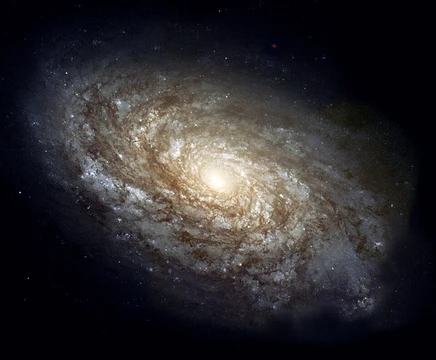
Boötes III
A faint, possibly disrupted dwarf spheroidal in the Milky Way halo.

Boötes III is a faint overdensity in the Milky Way’s halo, likely a dwarf spheroidal galaxy that is being torn apart. Discovered in 2009 using Sloan Digital Sky Survey data, it lies in the constellation Boötes, about 46 kiloparsecs from the Sun, and is moving away at roughly 200 kilometers per second. Its shape is elongated, with an axis ratio of 2:1 and a radius of about 0.5 kiloparsecs. This large, irregular form hints that Boötes III is caught between a gravitationally bound galaxy and a completely unbound system.
Among the Milky Way’s satellites, Boötes III is one of the smallest and dimmest. Its total luminosity is only about 18,000 times that of the Sun, corresponding to an absolute visible magnitude of roughly −5.8—fainter than many globular clusters. Estimating its mass is tricky because the galaxy is being disrupted; in such a case, the velocity spread of its stars does not reflect the system’s mass.
The stars in Boötes III are mostly moderately old, having formed more than 12 billion years ago. Their metallicity is low, at [Fe/H] = −2.1 ± 0.2, meaning they contain about 120 times fewer heavy elements than the Sun. This galaxy may be the origin of the Styx stream, a stellar feature in the galactic halo that was found at the same time as Boötes III.
Quick Facts
- Epoch
- J2000
- Ra
- 13 · 57 · 00
- Dec
- +26 · 48 · 00
- Dist Ly
- 150 kly (46 kpc)
- Appmag V
- 12.6
- Constellation Name
- Boötes
- Names
- Boo III, PGC 4713562
Facts from the source article.
Lore & Background
Boötes III was discovered in data obtained by the Sloan Digital Sky Survey. It is situated in the constellation Boötes and lies at a distance of about 46 kpc from the Sun, moving away at about 200 km/s. The galaxy has an elongated shape with an axis ratio of 2:1 and a radius of about 0.5 kpc. Its large size and irregular shape may indicate that it is in a transitional phase between a gravitationally bound galaxy and a completely unbound system.
The stellar population of Boötes III consists mainly of moderately old stars formed more than 12 billion years ago. These stars have a low metallicity of [Fe/H] = −2.1 ± 0.2, meaning they contain about 120 times less heavy elements than the Sun. The mass of Boötes III is difficult to estimate because the galaxy is in the process of being disrupted; in this case, the velocity dispersion of its stars is not related to its mass.
Boötes III might be the source of stars of the Styx stream in the galactic halo, which was discovered together with this galaxy.
Reader's Guide
Boötes III holds significance as one of the smallest and faintest satellites of the Milky Way, with an integrated luminosity of only about 18,000 times that of the Sun and an absolute visible magnitude of about −5.8—much lower than many globular clusters. Its elongated shape and irregular structure suggest it is undergoing disruption, possibly transitioning from a gravitationally bound dwarf spheroidal galaxy into an unbound system. This transitional state makes it a valuable object for studying the processes of tidal disruption and the fate of low-mass galaxies in the Milky Way's halo. The difficulty in estimating its mass, due to the disruption, highlights the challenges in understanding such systems. Additionally, its potential link to the Styx stream suggests that Boötes III may have contributed stars to the galactic halo, providing clues about the assembly history of the Milky Way. Its very low metallicity and old stellar population (formed more than 12 billion years ago) offer insights into the early chemical enrichment and star formation in the universe.
Did You Know?
- Boötes III may be a disrupted dwarf spheroidal galaxy.
- Its stars formed more than 12 billion years ago and have very low metallicity.
- Boötes III might be the source of stars in the Styx stream.
More in Elliptical and Irregular Galaxies, Part 5 1-24
Spotted an error? Know more?
Reader corrections go straight into our review queue. Suggest an edit · How this site is sourced